
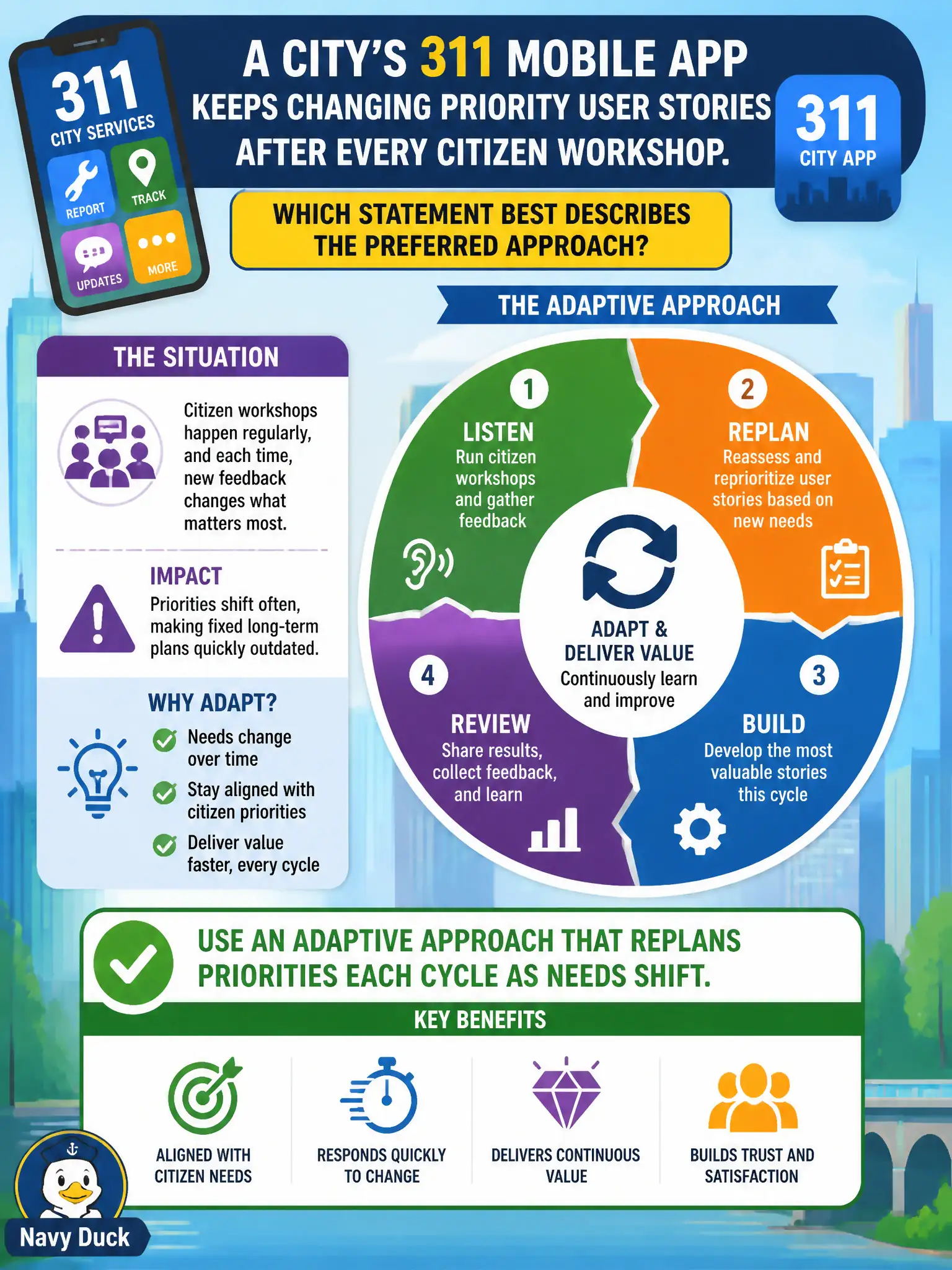
A city’s 311 mobile app keeps changing priority user stories after every citizen workshop. Which statement best describes the preferred approach?
Select an answer to reveal the explanation.
Short Explanation
Citizen workshops that reshuffle the backlog are a signal, not a failure. Adaptive teams expect that shuffle and replan the next slice instead of pretending the first design was final forever.
Full Explanation
High uncertainty and frequently changing stakeholder needs favor adaptive delivery that revisits priorities each cycle. When a city’s 311 mobile app keeps changing priority user stories after every citizen workshop, the preferred approach is adaptive replanning of priorities as needs shift. Locking a predictive detailed design now and rejecting all later workshop input fails by concept because it freezes learning in a domain where citizen needs are still being discovered. Canceling delivery planning because changing needs mean no approach applies fails because changeability is exactly why adaptive planning exists—it is not a reason to abandon planning. Treating each workshop as an operations ticket with no product backlog fails because evolving product features require backlog-driven product delivery, not ad-hoc operations tickets that never form an increment strategy. Exam caveat: CAPM adaptive content expects candidates to keep planning discipline (backlog, cycles, prioritization) while accepting that detailed long-horizon design will change—adaptive is not “no plan.” Operational check: after each workshop, re-order the backlog with product ownership, communicate the next-cycle priority set to stakeholders, and avoid promising a frozen feature catalog until discovery stabilizes.