
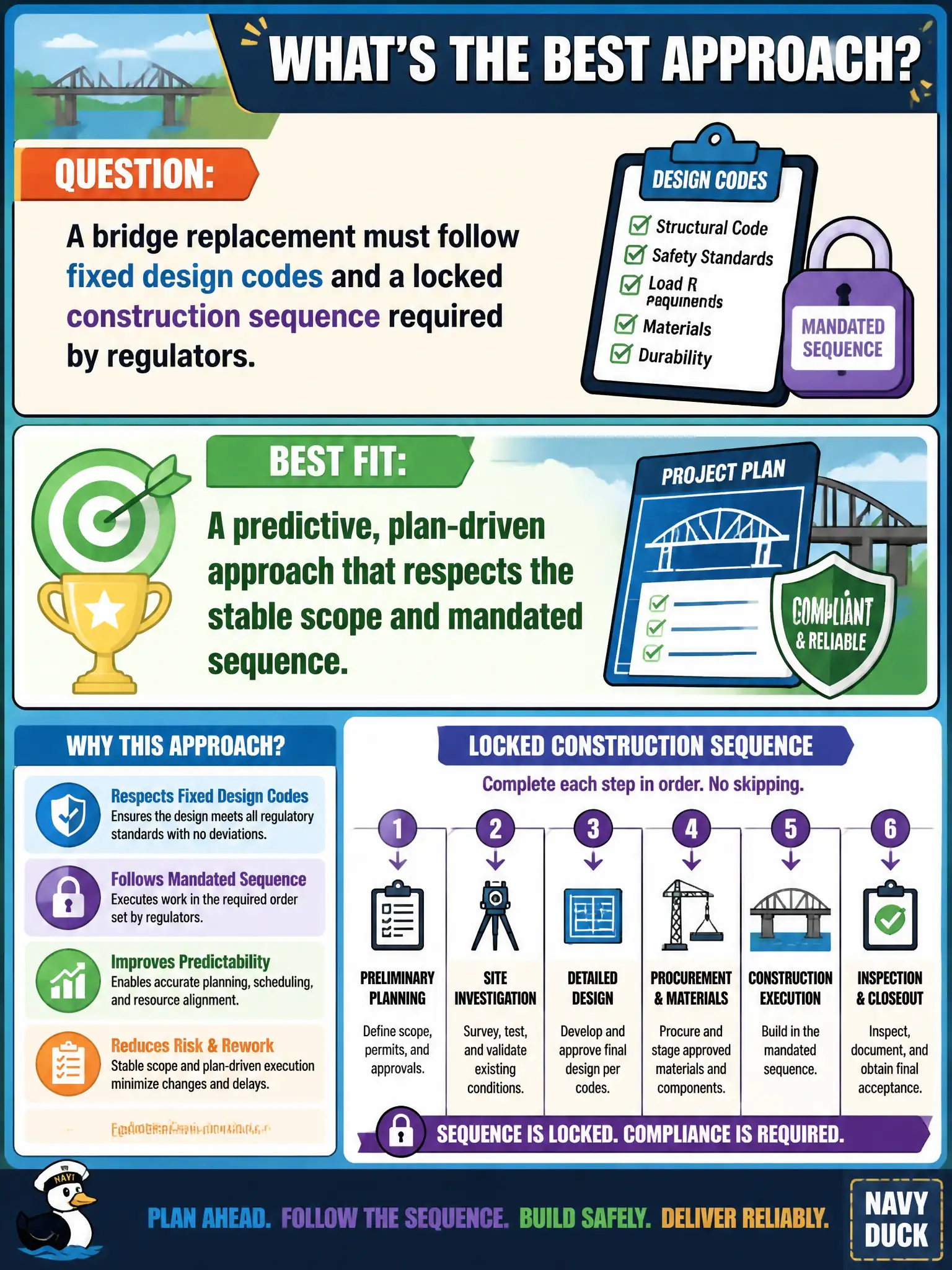
A bridge replacement must follow fixed design codes and a locked construction sequence required by regulators. Which approach is the best fit?
Select an answer to reveal the explanation.
Short Explanation
Bridges and building codes do not love surprise midstream redesigns. When scope and sequence are stable and regulated, predictive planning is the honest fit—map the path, then execute it.
Full Explanation
Predictive, plan-driven approaches fit when requirements are stable, well understood, and constrained by fixed sequences such as regulatory design codes. A bridge replacement with locked construction sequencing required by regulators is a strong predictive candidate. Purely adaptive sprints that redefine structural codes each iteration fail by concept because structural codes and mandated sequences are not optional backlog items to renegotiate every sprint. Having no baseline plan because field crews invent the sequence daily fails because regulated construction needs an authorized baseline sequence for safety, inspection, and compliance—not daily improvisation of the critical path. Portfolio-only oversight with no project schedule for construction fails because portfolio ranking does not replace a project schedule, work packages, and control baseline for the bridge delivery itself. Exam caveat: CAPM does not treat adaptive as universally superior; approach selection follows stability and constraint—CapEx civic construction under fixed codes is frequently predictive-suitable. Operational check: confirm design-code constraints and regulatory sequence in the project management plan, baseline the schedule against that sequence, and route any sequence change through formal change control with engineering and regulator input.