
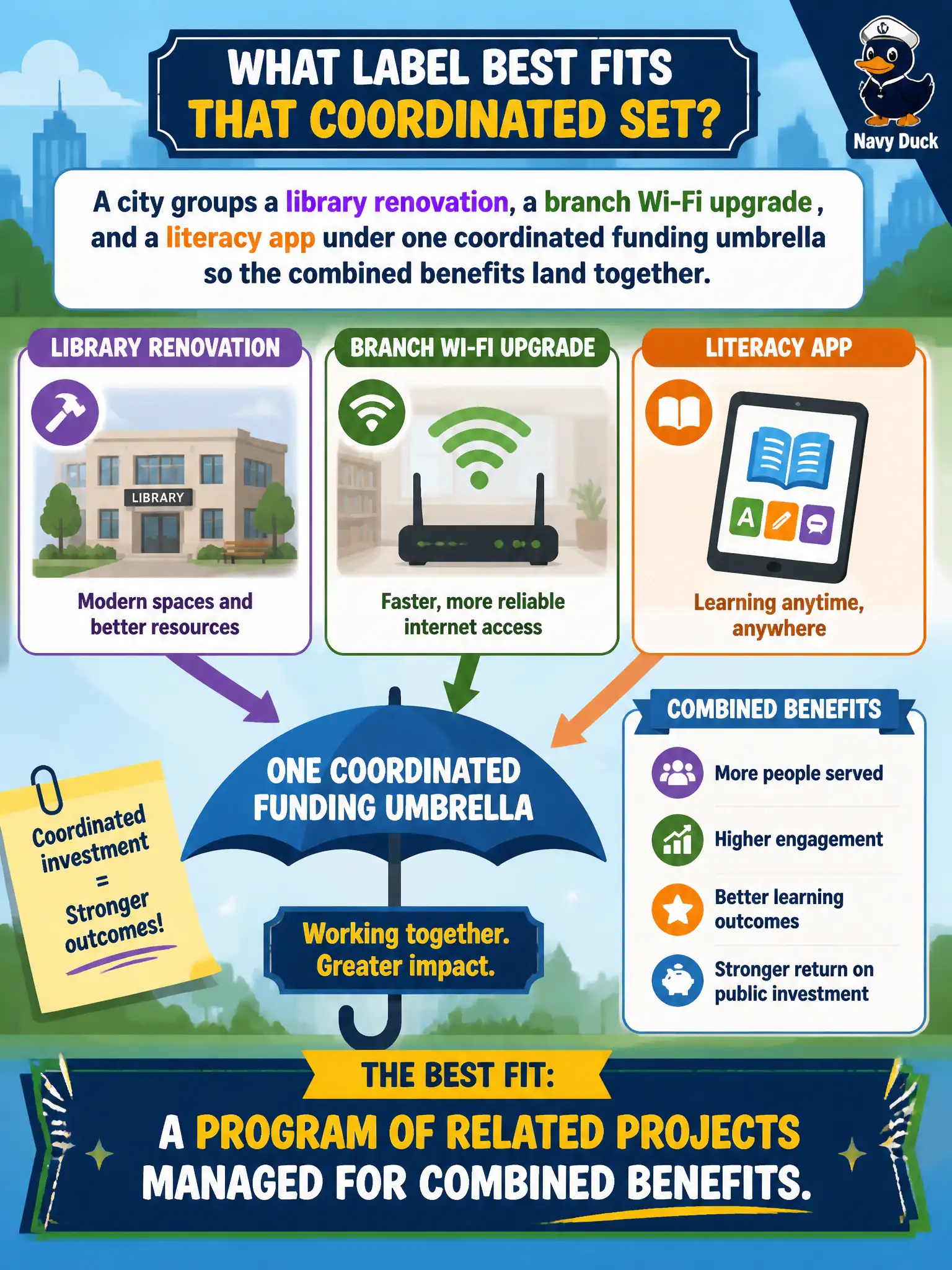
A city groups a library renovation, a branch Wi-Fi upgrade, and a literacy app under one coordinated funding umbrella so the combined benefits land together. What label best fits that coordinated set?
Select an answer to reveal the explanation.
Short Explanation
When several related builds share one benefit story—renovate, connect, then launch the literacy app—you’re looking at a program. One project is too small a label, and the whole city portfolio is much broader than this coordinated suite.
Full Explanation
A program is a group of related projects managed in a coordinated way to obtain benefits and control not available from managing them individually. The city’s library renovation, branch Wi-Fi upgrade, and literacy app are distinct projects deliberately grouped under one funding umbrella so combined benefits land together; that is program management. Treating the set as a single project because one funding umbrella exists fails by concept: one appropriation can fund multiple related projects without collapsing them into one deliverable or one temporary endeavor. Calling the set a portfolio because every city initiative must sit in a portfolio first fails because a portfolio is the broader collection of projects, programs, and operations prioritized for strategic alignment—not every coordinated suite of related builds. Labeling the work ongoing operations because libraries run year-round fails because the renovation, Wi-Fi, and app are temporary unique efforts, even if the library organization continues afterward. Exam caveat: CAPM items often tempt candidates to use portfolio as a catch-all for any grouping; reserve portfolio for strategy and funding prioritization across the enterprise, and program for related projects pursuing combined benefits. Operational check: document the shared benefit statement, name a program-level coordinator or governance cadence, and keep separate project charters or initiation records for renovation, Wi-Fi, and app delivery.