
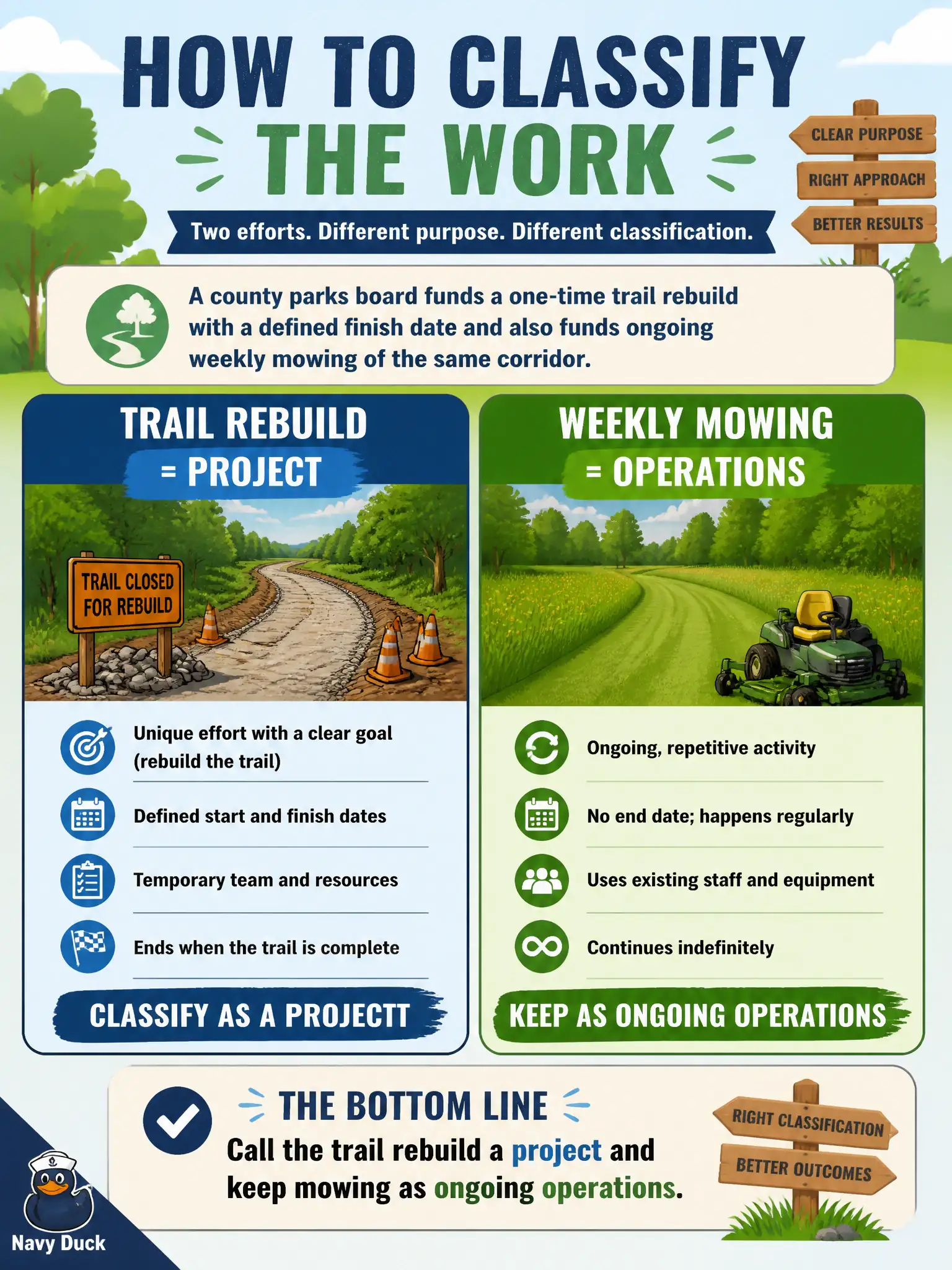
A county parks board funds a one-time trail rebuild with a defined finish date and also funds ongoing weekly mowing of the same corridor. How should the project team classify those two efforts?
Select an answer to reveal the explanation.
Short Explanation
Think of a project like building a new porch once, and operations like mowing the lawn every week. The trail rebuild has a unique outcome and an end; weekly mowing just keeps the corridor usable. Same place, different kind of work.
Full Explanation
A project is a temporary endeavor undertaken to create a unique product, service, or result; the one-time trail rebuild with a defined finish date meets that definition for the county parks board. Weekly mowing is recurring business-as-usual operations that sustain the corridor after and beside the capital work. Correct classification therefore keeps the rebuild under project governance and leaves mowing with operations. Treating both efforts as one project because they share a corridor or budget line fails by concept: shared location or funding does not convert continuous BAU into temporary unique work. Labeling mowing as a program that governs the rebuild fails because a program coordinates related projects for combined benefits—it is not a synonym for routine maintenance of an existing asset. Calling both portfolio work because parks is a strategic theme fails because portfolio management selects and prioritizes programs and projects against strategy; it does not redefine every parks activity as portfolio delivery. Exam caveat: CAPM associates must separate project versus operations even when the same municipal department funds both from one appropriation—classification follows the nature of the work, not the org chart line item. Operational check: confirm the rebuild has a charter or equivalent authorizing document with end criteria, and confirm mowing remains on the operations calendar with no temporary-endeavor closure package.