
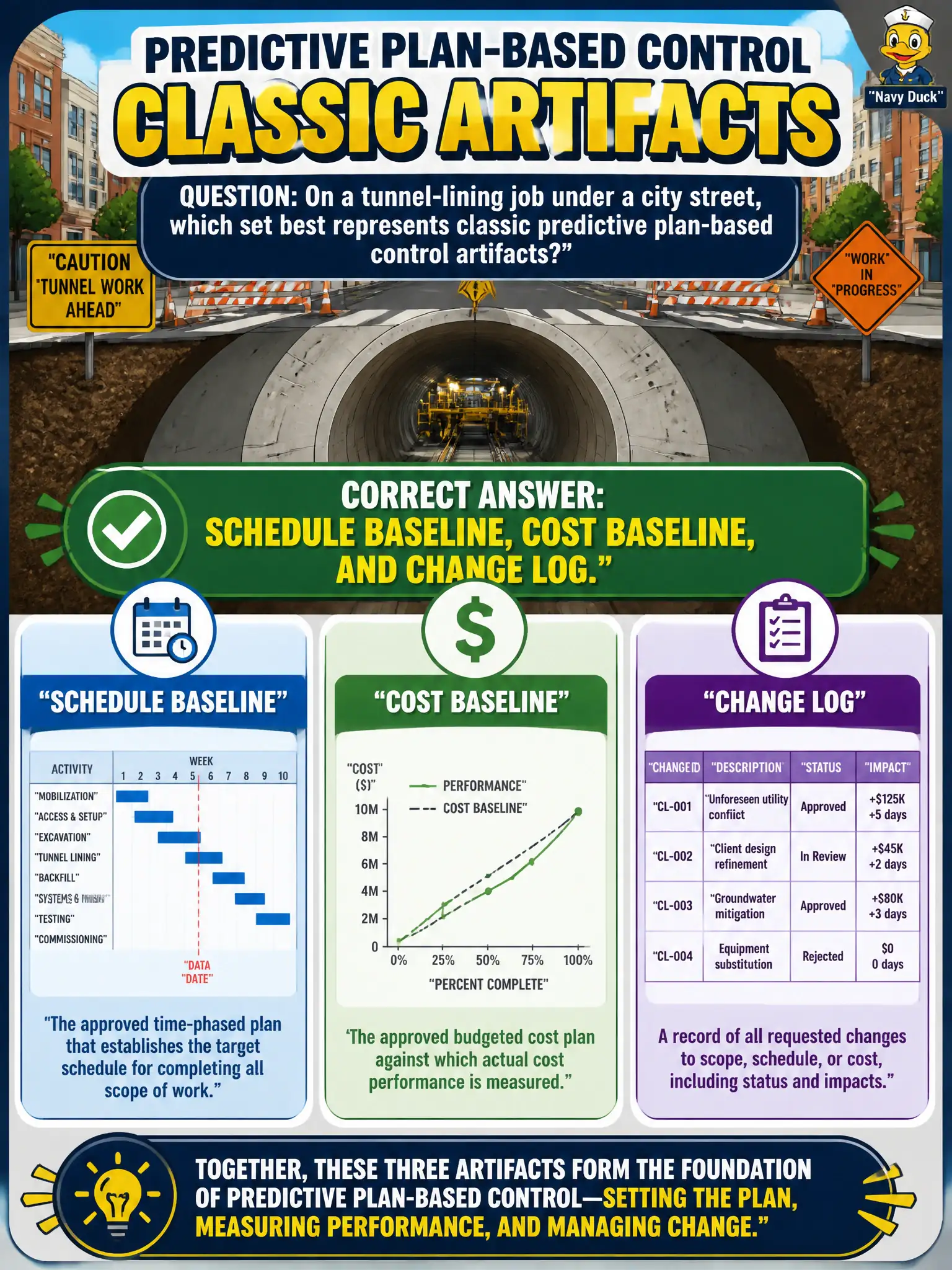
On a tunnel-lining job under a city street, which set best represents classic predictive plan-based control artifacts?
Select an answer to reveal the explanation.
Short Explanation
Predictive control leans on the locked schedule and cost baselines plus a change log—like surveyed benchmarks and a diary of approved moves. A standup sticky or WIP poster alone is a different playbook.
Full Explanation
On a tunnel-lining job under a city street, classic predictive plan-based control artifacts include the schedule baseline, cost baseline, and change log. Those artifacts support variance analysis and governed modification of the plan as subsurface realities emerge. Civic underground work still needs baselines and change history, not only informal notes.
Daily standup notes alone without baselines or change history are insufficient predictive control. A product backlog velocity chart without a schedule baseline reflects adaptive tracking, not the classic predictive trio. A Kanban WIP limit poster may help flow but does not replace schedule/cost baselines and a change log.
Exam caveat: Associates should recognize baseline-plus-change-log patterns as predictive control signatures, while acknowledging agile artifacts serve different life cycles.
Operational check: maintain approved schedule and cost baselines for the lining package, record approved changes in the change log, and report performance against those baselines each control period. Store baseline files and the change log in the project repository with clear current-version labels. Tunnel teams rotating shifts need one authoritative predictive control set.