
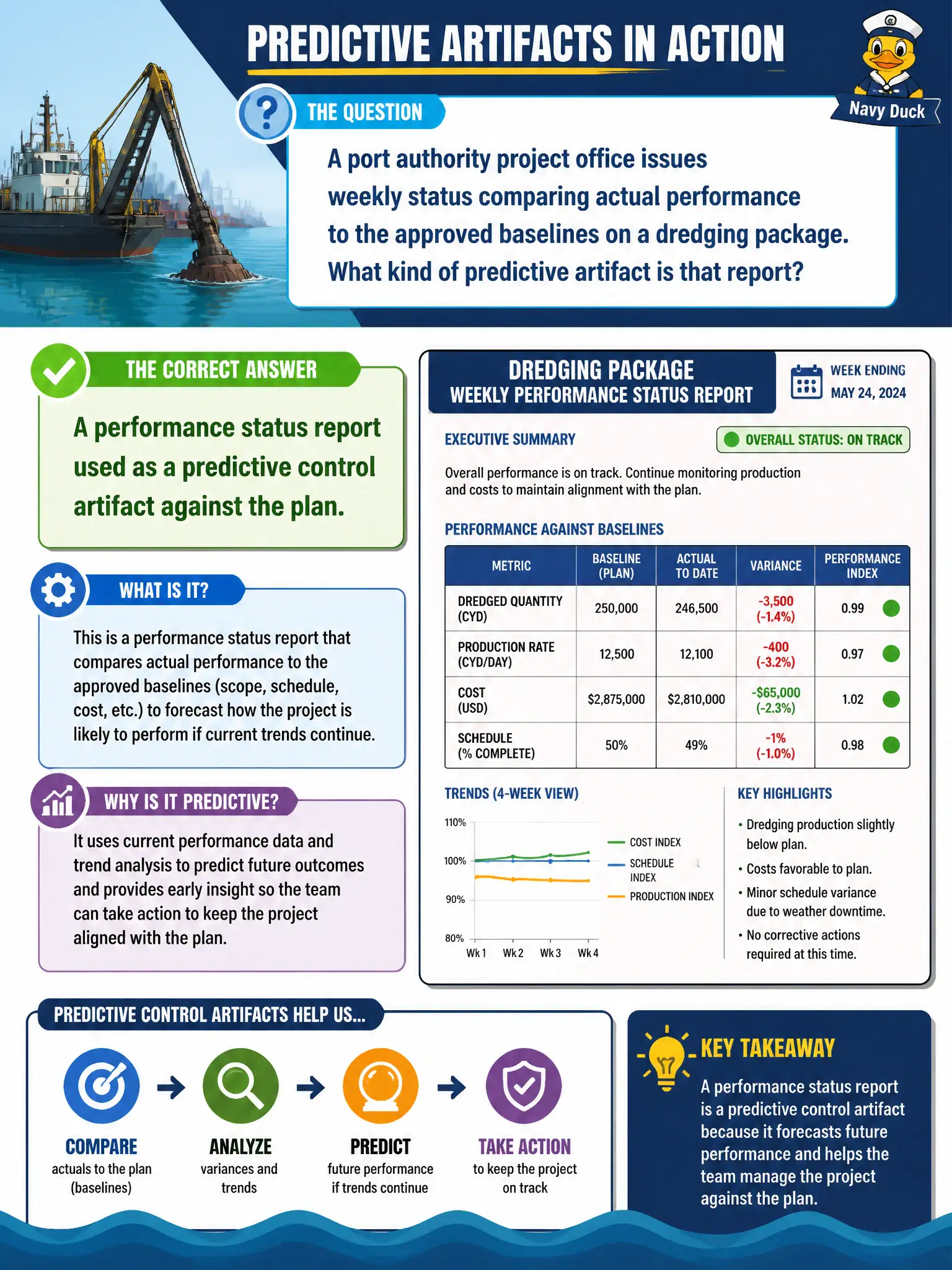
A port authority project office issues weekly status comparing actual performance to the approved baselines on a dredging package. What kind of predictive artifact is that report?
Select an answer to reveal the explanation.
Short Explanation
Comparing actuals to the baselines is the weekly report card for the dredge job. That status report is a predictive control artifact—it shows where you stand versus the plan, not a new charter or a bid ad.
Full Explanation
A port authority weekly status that compares actual performance to approved baselines on a dredging package is a performance status report used as a predictive control artifact against the plan. It communicates where the package stands versus what was authorized and baselined. That comparison is the essence of predictive monitoring and controlling for civic marine work.
Such a report is not a substitute charter that voids the original business case. It is not a procurement solicitation awarding the next dredge contract. It is not a risk brainstorm list lacking performance measures. Those are different artifacts with different purposes.
Exam caveat: CAPM associates should classify status reports that compare actuals to baselines as control outputs, distinct from initiation, procurement, or identification tools.
Operational check: each week, compile actual schedule/cost (and related) performance, compare to baselines, explain variances, recommend actions, and keep the report audience aligned to decision needs—not to rewrite the charter. Keep recommendations actionable and owned. A dredging status report that only narrates variance without next steps is incomplete as a control artifact.