
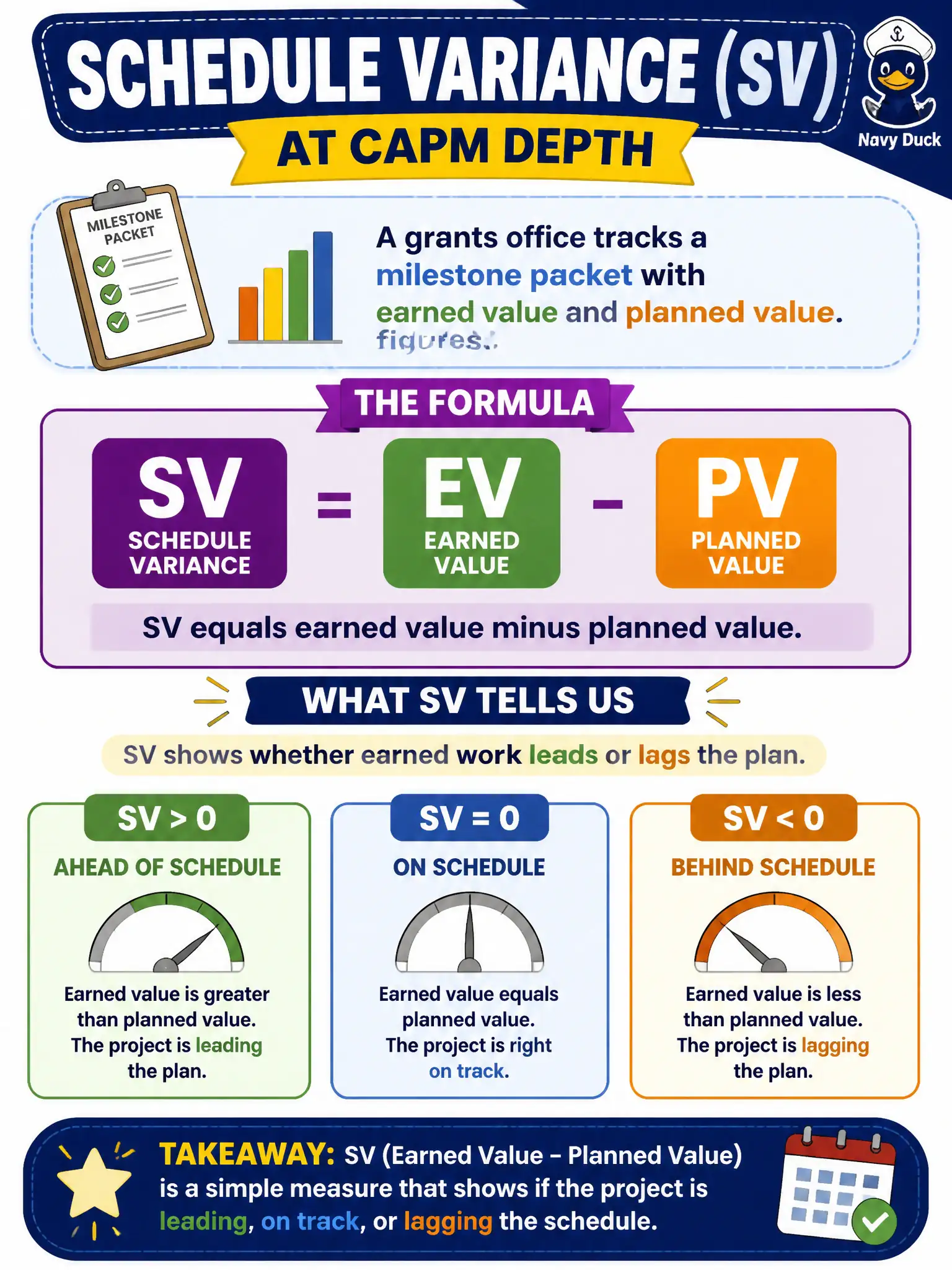
A grants office tracks a milestone packet with earned value and planned value figures. Which statement correctly describes schedule variance at CAPM depth?
Select an answer to reveal the explanation.
Short Explanation
Schedule variance is a simple scoreboard: earned progress minus what the plan said you should have earned by now. If the grant packet is behind that plan line, SV is negative—no need to invent a different formula.
Full Explanation
At CAPM depth, schedule variance equals earned value minus planned value and shows whether earned work leads or lags the plan. SV = EV − PV is the associate-level definition grants offices and project controls use on milestone packets. The sign tells schedule performance versus the time-phased baseline for civic grant reporting.
SV does not equal actual cost minus planned value, and it is not only a budget-overrun measure—that confuses cost ideas with schedule variance. SV does not equal planned value minus sunk cost while ignoring earned progress. SV is not contingency reserve minus management reserve; reserves are funding concepts, not SV.
Exam caveat: Formula discrimination is heavily tested. Memorize SV = EV − PV and CV = EV − AC, and interpret signs correctly without mixing reserve accounting into variance definitions.
Operational check: pull EV and PV for the milestone packet date, compute SV, explain ahead/behind in plain language to stakeholders, and review CV alongside SV for a fuller control picture. Show the formula on the status sheet beside the numbers to prevent stakeholder confusion with cost metrics. Grant reviewers often mix SV and CV language under time pressure.