
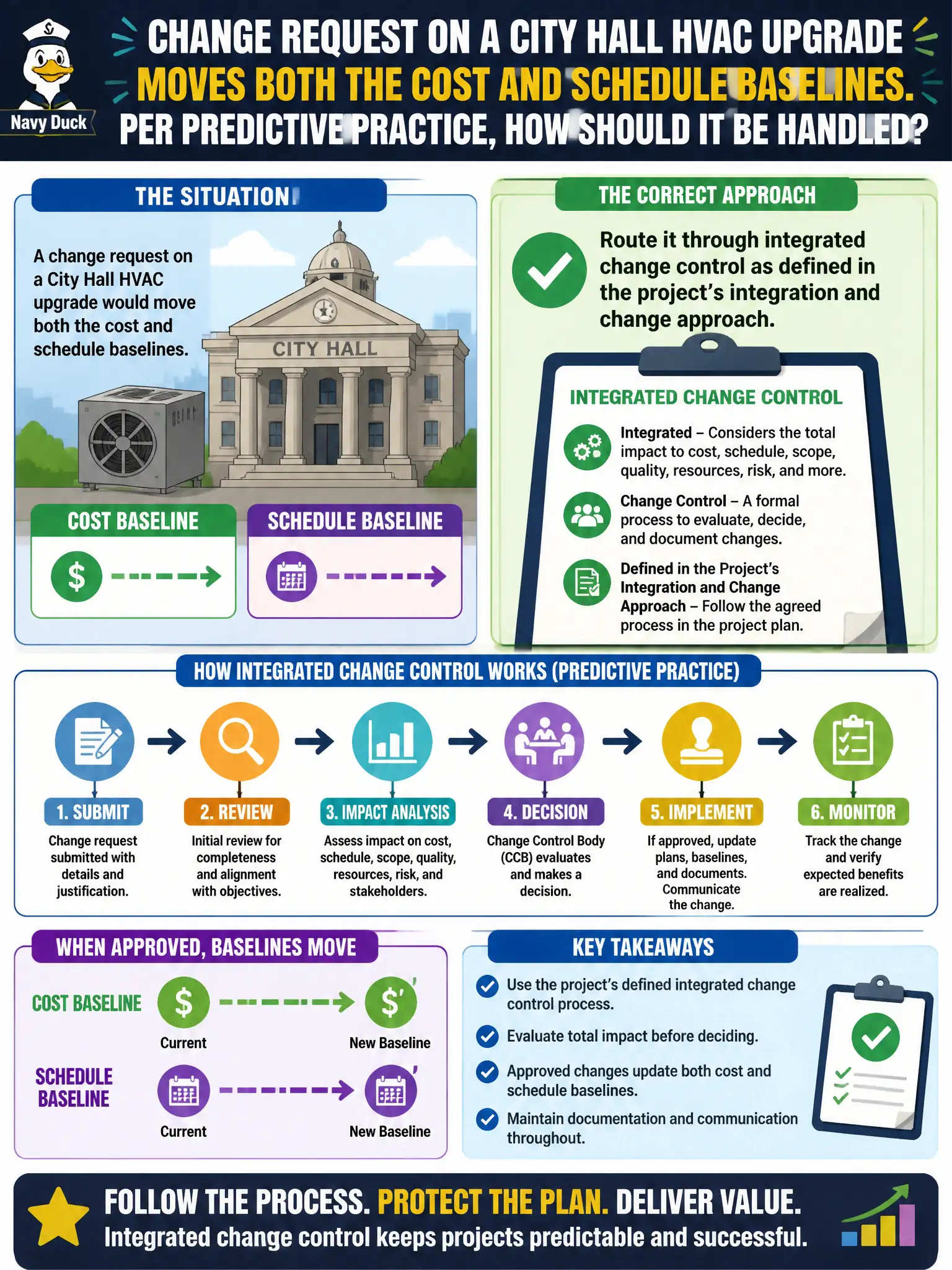
A change request on a city hall HVAC upgrade would move both the cost and schedule baselines. Per predictive practice, how should it be handled?
Select an answer to reveal the explanation.
Short Explanation
When a change nudges both money and calendar baselines, you do not freestyle it in the mechanical room. You run it through the integrated change process so cost and schedule stay honest together.
Full Explanation
A change request on a city hall HVAC upgrade that would move both cost and schedule baselines must be routed through integrated change control as defined in the project’s integration and change approach. Baseline-moving changes are exactly what predictive governance is built to evaluate. Informal approval creates mismatched documents and weak audit trails for public work.
Applying the change immediately in the field and updating documents later bypasses evaluation and desynchronizes baselines. Updating only the risk register because “baseline moves are never formal changes” is false—baseline moves are formal changes. Asking the lowest-cost vendor to approve verbally during a toolbox talk assigns authority to the wrong party.
Exam caveat: Associates should treat any baseline-affecting request as an integrated change-control item. Speed can be accelerated; skipping the process cannot be justified by field convenience.
Operational check: enter the HVAC change request, analyze cost and schedule impacts, convene the change authority, record the decision, update both baselines and related documents if approved, and communicate the new plan to the field. Ensure the change log captures decision, date, and baseline versions affected. HVAC field teams should receive the approved revision identifier before installing to the new scope.