
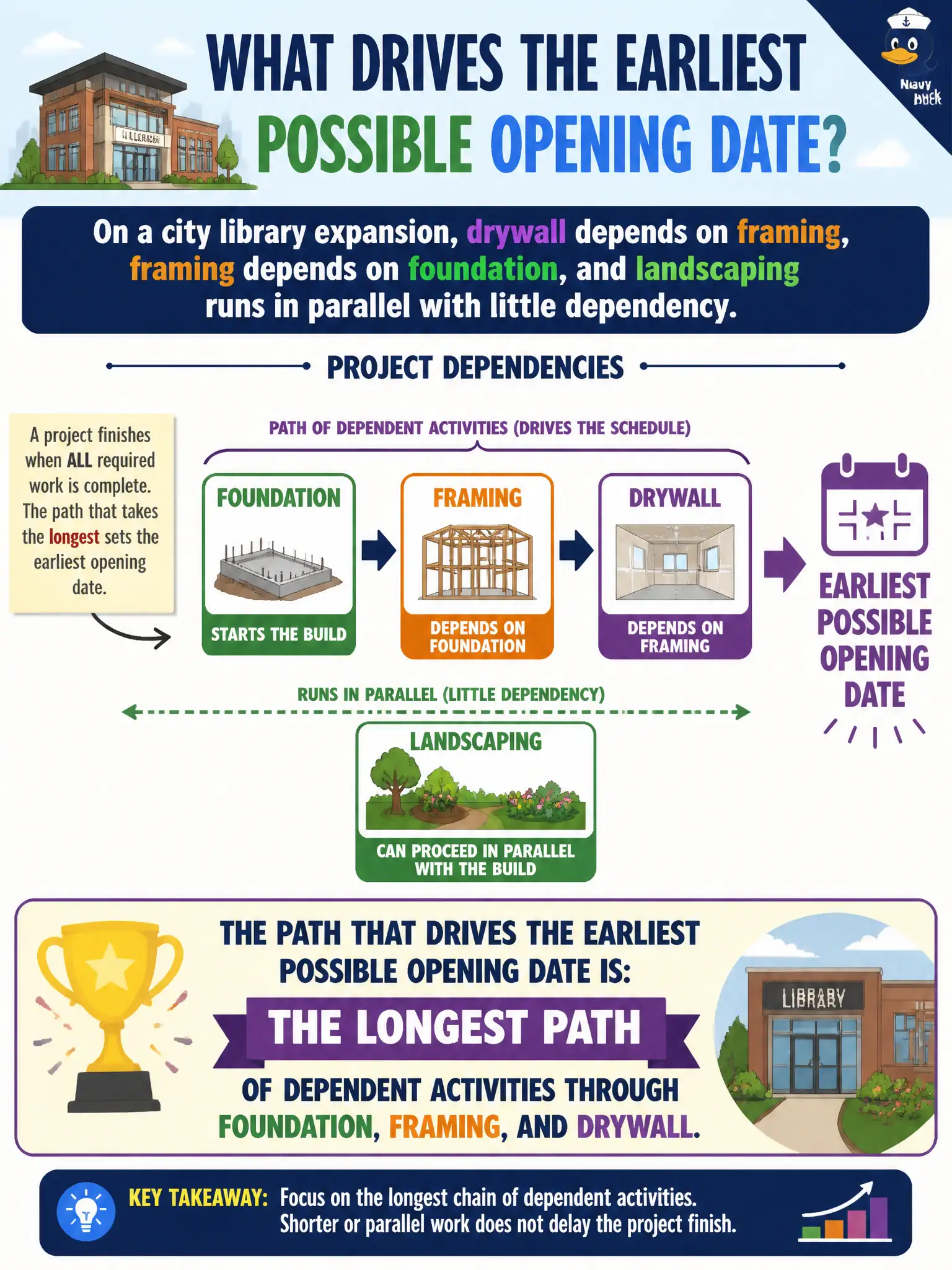
On a city library expansion, drywall depends on framing, framing depends on foundation, and landscaping runs in parallel with little dependency. Which path drives the earliest possible opening date?
Select an answer to reveal the explanation.
Short Explanation
Think of the library finish like the slowest runner on a relay that must hand off in order. The longest chain of dependent work sets when you can open—parallel landscaping can finish early and still wait on that chain.
Full Explanation
On a city library expansion where drywall depends on framing, framing depends on foundation, and landscaping runs largely in parallel, the earliest possible opening date is driven by the longest path of dependent activities through foundation, framing, and drywall. That chain is the critical path in predictive schedule logic. Parallel landscaping may matter to curb appeal, but it does not control finish if it is not the longest dependent chain.
Choosing landscaping because outdoor work is the “public face” confuses stakeholder visibility with network logic. Choosing the shortest path inverts critical-path theory—the shortest chain does not unlock the finish. Choosing the path with the most vendors assumes contract count equals schedule criticality, which is not a network rule.
Exam caveat: CAPM associates must identify the critical path as the longest path of dependent activities (typically with least float), not the most visible or most contracted workstream. Civic optics do not redefine float math.
Operational check: build or review the schedule network, compute path lengths and float, confirm foundation→framing→drywall as critical, and monitor that path’s activities for opening-date control while tracking landscaping separately.