
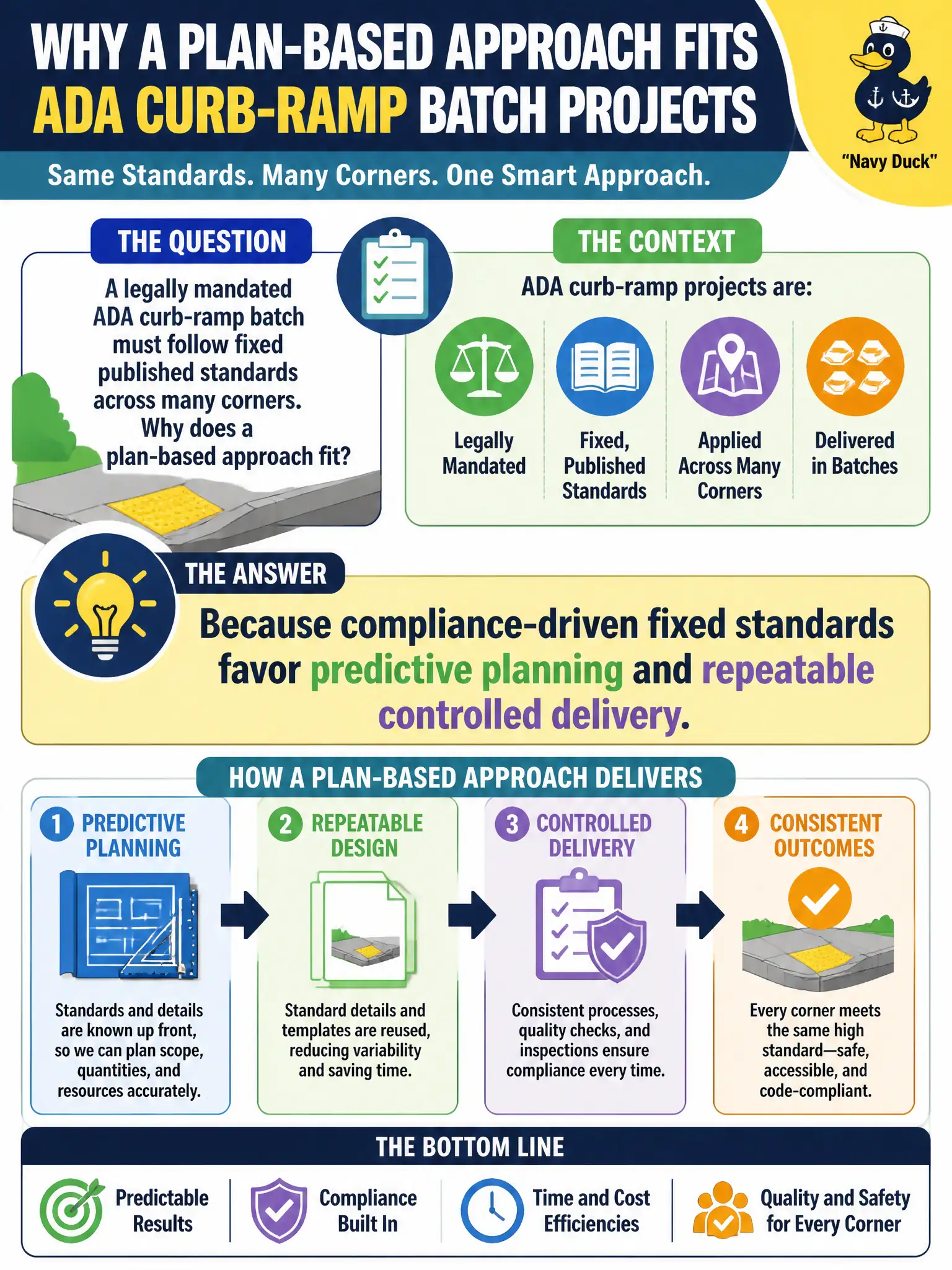
A legally mandated ADA curb-ramp batch must follow fixed published standards across many corners. Why does a plan-based approach fit?
Select an answer to reveal the explanation.
Short Explanation
When the standard is already written into law and drawings, you are assembling known parts, not inventing a new product each week. Predictive planning fits that compliance batch work. Reinvention for its own sake would fight the mandate, not serve it.
Full Explanation
A legally mandated ADA curb-ramp batch that must follow fixed published standards across many corners fits a plan-based approach because compliance-driven fixed standards favor predictive planning and repeatable controlled delivery. Geometry and acceptance criteria are largely known up front, enabling templates, WBS repetition, schedules, and quality checklists across locations. Civic accessibility mandates often look like this.
Compliance standards do not change unpredictably every day with no fixed criteria in this scenario. ADA work does not forbid schedules, WBS elements, or quality checklists. Continuous weekly reinvention of ramp geometry is unnecessary when published standards already define compliant design.
Exam caveat: Associates should link regulatory fixedness to predictive suitability. Adaptive discovery is valuable when requirements are unclear—not when the mandate already publishes the standard.
Operational check: baseline a standard curb-ramp work package and checklist from the published ADA criteria, schedule the corner batch against that template, and inspect each location to the same acceptance thresholds. Standardize inspection photos and measurement records across corners so compliance evidence is comparable. Predictive repetition is a strength when ADA criteria are already published.