
On a predictive water-main replacement, what is the key difference between the issue log and the risk register?
Select an answer to reveal the explanation.
Short Explanation
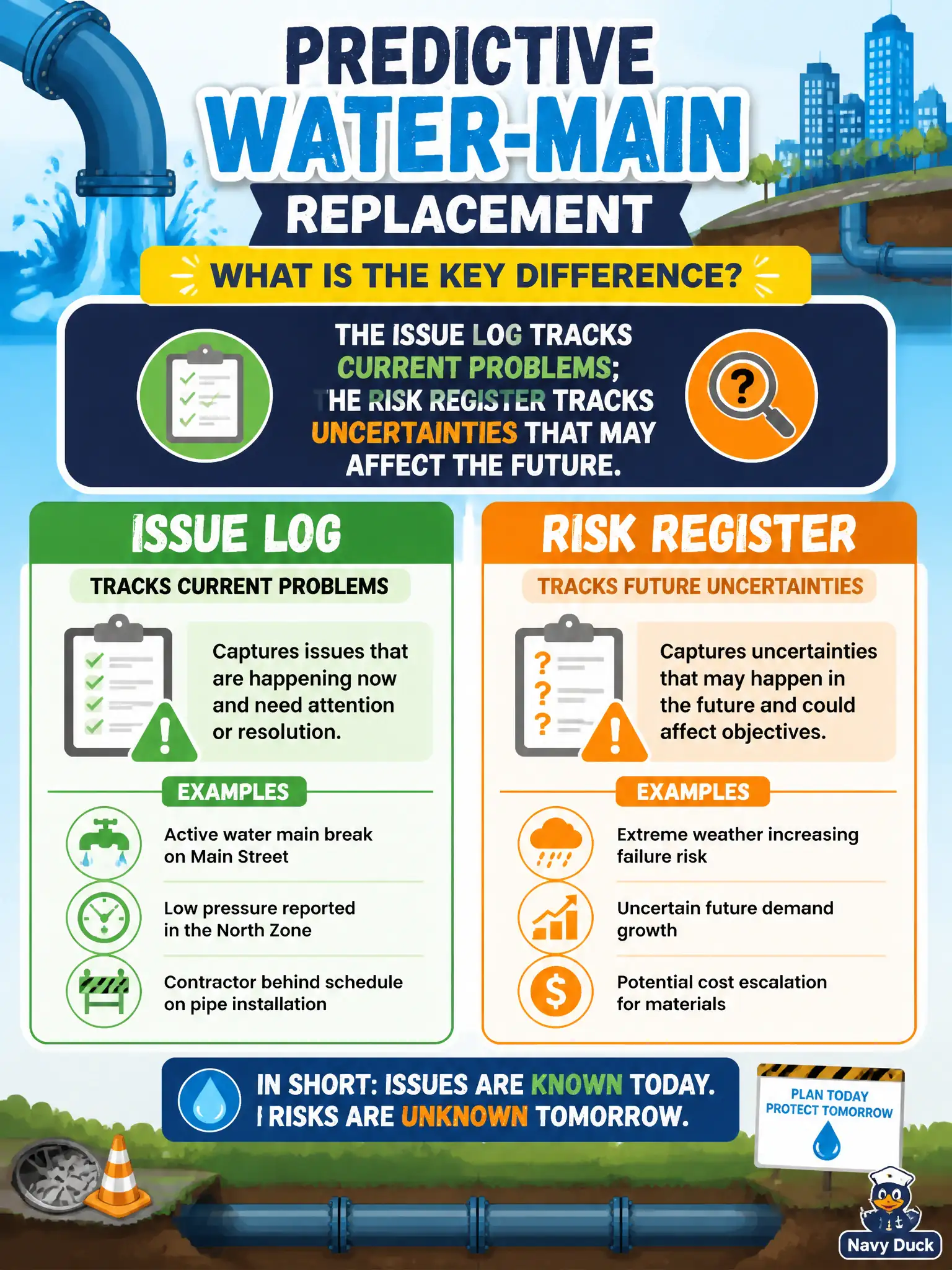
Issues are the flat tire you already have; risks are the potholes that might still get you. Keep them in separate books so today’s fires and tomorrow’s maybe-problems do not blur. Swapping those definitions confuses response urgency.
Full Explanation
On a predictive water-main replacement, the issue log tracks current problems, while the risk register tracks uncertainties that may affect the future. Issues are live obstacles requiring resolution now; risks are uncertain events or conditions that might help or harm later. Civic teams need both artifacts without merging their meanings.
The risk register is not merely an invoice list, and the issue log is not only post-closeout lessons. The logs do not store identical information. Issues are not “always future uncertainties,” and risks are not only problems that already blocked work—those swapped definitions are classic traps.
Exam caveat: CAPM associates must distinguish issue versus risk by time horizon and certainty. Mixing them corrupts both response strategies and status reporting.
Operational check: when a water-main problem is already happening, enter it in the issue log with owner and due date; when a potential future event is identified, enter it in the risk register with analysis and response—promote a risk to an issue if it occurs. Train the team to ask “has it happened?” when classifying entries. If yes and active, it is an issue; if uncertain and future, it is a risk—then apply the matching response pattern.