
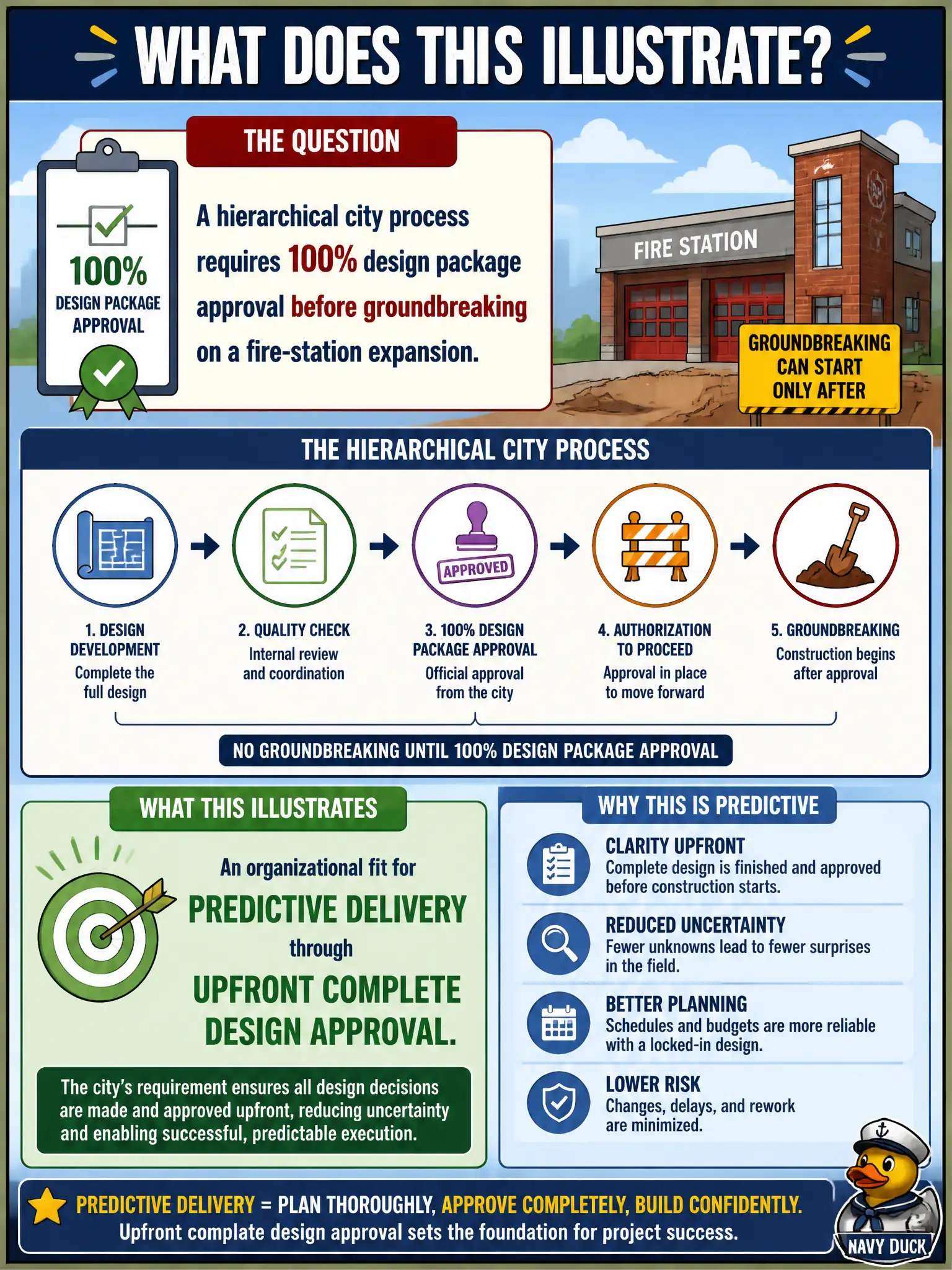
A hierarchical city process requires 100% design package approval before groundbreaking on a fire-station expansion. What does this illustrate?
Select an answer to reveal the explanation.
Short Explanation
No shovel hits dirt until the full design package is stamped—that is predictive org fit in action. Hierarchy and complete-design approval pair naturally with plan-based delivery. Pouring first and designing later would invert that culture.
Full Explanation
A hierarchical city process that requires 100% design package approval before groundbreaking on a fire-station expansion illustrates organizational fit for predictive delivery through upfront complete design approval. Governance demands a finished design package as a gate into construction. That culture and control preference align with plan-based methods.
Discovering design only after concrete is poured is an adaptive-leaning anti-pattern for this governance model. Refusing any project management plan or schedule contradicts predictive practice. Hierarchical cities can and do use baselines and stage gates; hierarchy is not proof they cannot.
Exam caveat: Associates should read organizational process constraints as suitability signals for predictive approaches, especially for public-safety facilities with strict design approval norms.
Operational check: complete the design package to the city’s 100% standard, obtain required approvals, baseline scope/schedule/cost from the approved package, then authorize groundbreaking. Confirm the city’s definition of “100% design” (disciplines, stamps, cost estimate class) before calling the gate met. Premature groundbreaking under a hierarchical process creates compliance and rework exposure.