
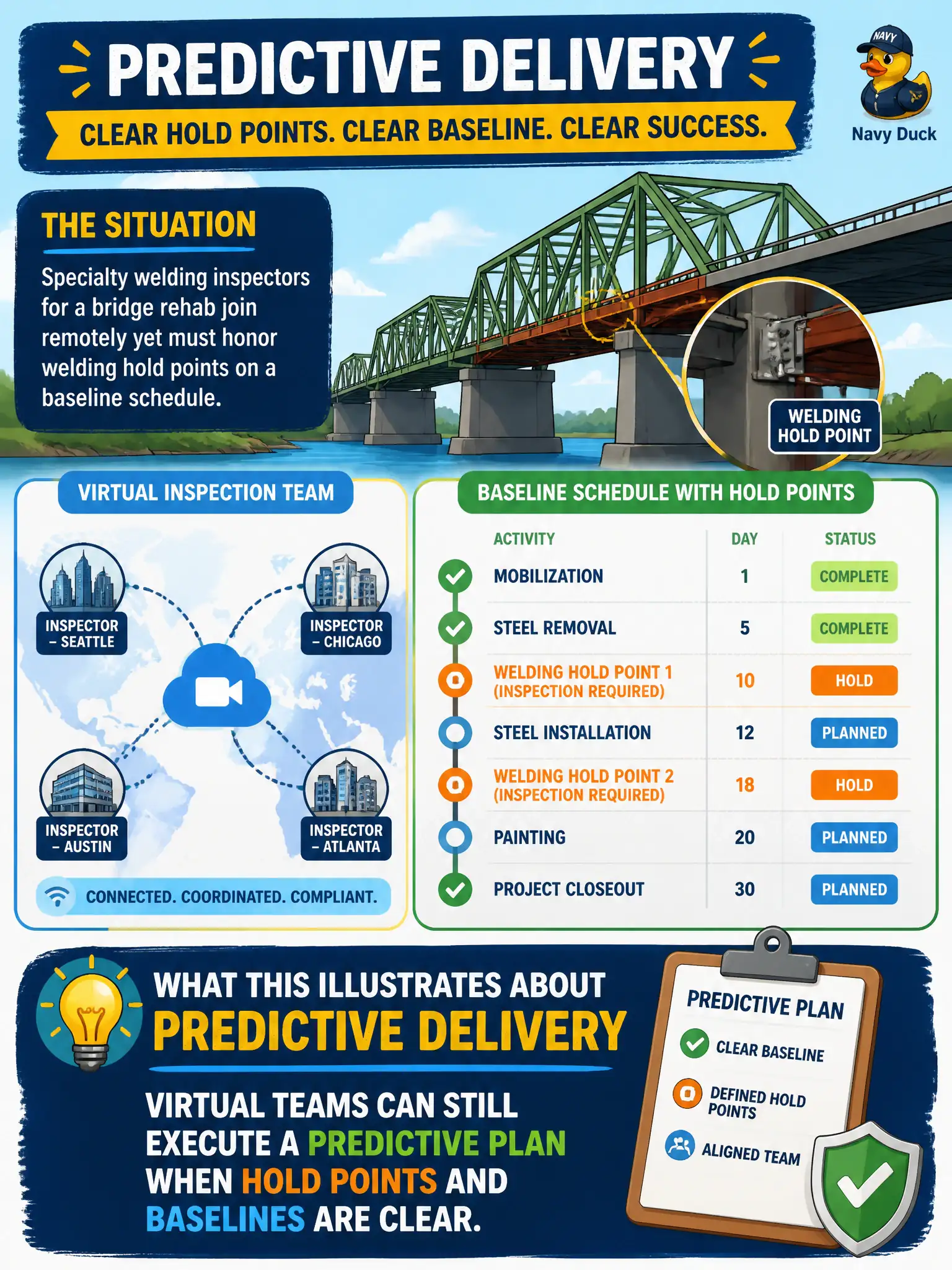
Specialty welding inspectors for a bridge rehab join remotely yet must honor welding hold points on a baseline schedule. What does this illustrate about predictive delivery?
Select an answer to reveal the explanation.
Short Explanation
Remote does not mean random. If the baseline says when welding hold points happen, inspectors can show up virtually and still protect quality. Clear plan beats geography for this kind of control.
Full Explanation
Specialty welding inspectors who join a bridge rehab remotely yet must honor welding hold points on a baseline schedule illustrate that virtual teams can still execute a predictive plan when hold points and baselines are clear. Location flexibility does not erase regulatory inspection logic on civic infrastructure. Predictive control depends on defined gates, not on everyone sharing one trailer.
Virtual participation does not make baseline schedules unusable. Predictive methods do not require every inspector on site all day if hold points and evidence requirements are defined. Hold points should not be ignored so remote inspectors can work ad hoc; that would undermine quality and compliance.
Exam caveat: Associates should separate team geography from life-cycle suitability. Remote or hybrid participation is compatible with predictive delivery when control points are explicit.
Operational check: publish the welding hold-point schedule, define required remote evidence (photos, reports, sign-offs), integrate inspector availability into the baseline, and stop work at holds until clearance is recorded. Ensure remote inspectors receive the same hold-point checklist and acceptance evidence standards as onsite staff. Predictive quality fails when remote participation becomes an excuse for informal waivers.