
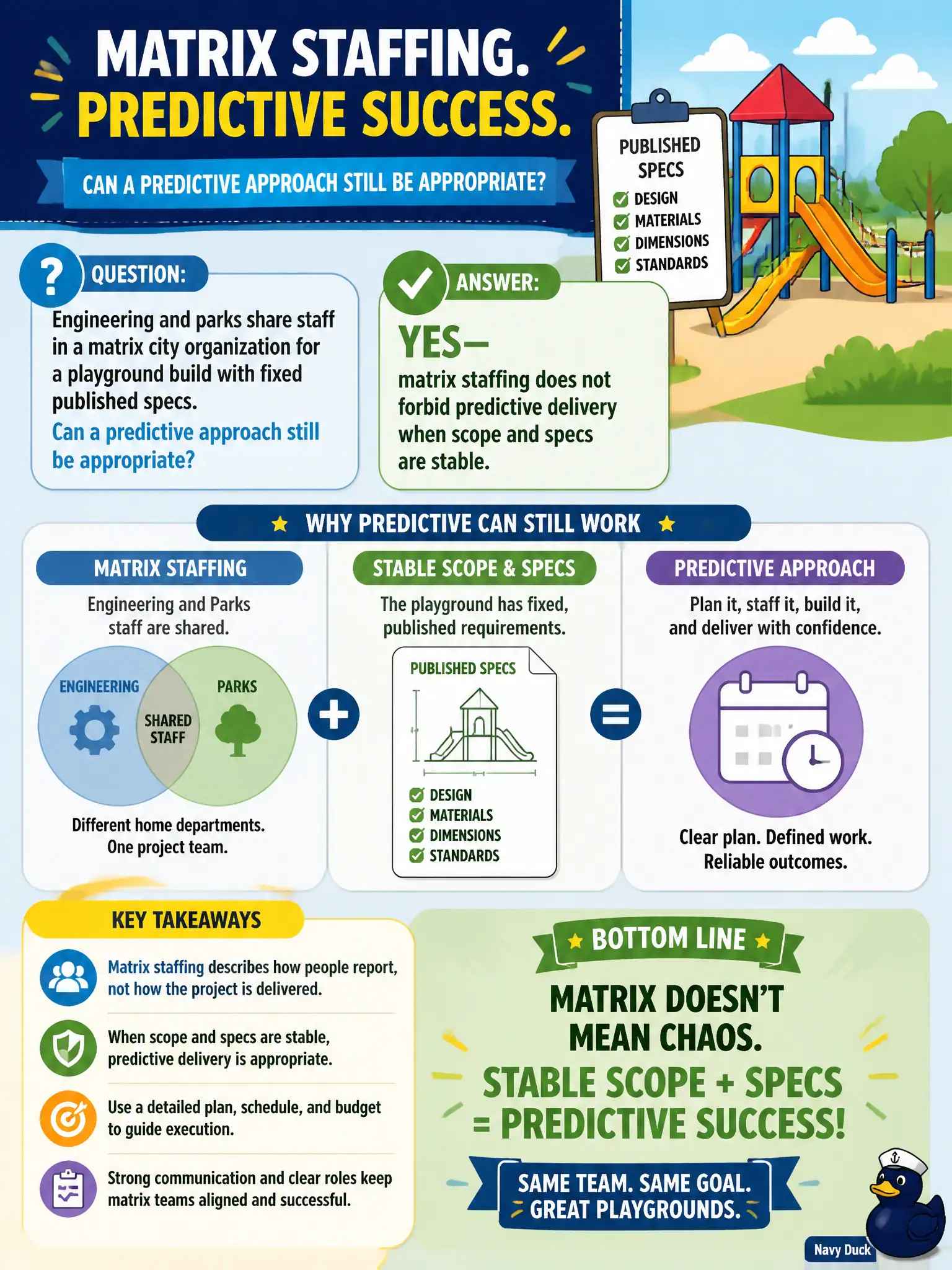
Engineering and parks share staff in a matrix city organization for a playground build with fixed published specs. Can a predictive approach still be appropriate?
Select an answer to reveal the explanation.
Short Explanation
Matrix just means people report in two directions; it does not delete the playground drawings. If the specs are fixed, predictive planning still makes sense. Org chart shape and life-cycle choice are related but not identical decisions.
Full Explanation
Engineering and parks sharing staff in a matrix city organization for a playground build with fixed published specs can still use a predictive approach. Matrix staffing complicates resource availability, but it does not forbid plan-based delivery when scope and specifications are stable. Civic matrix structures are common and routinely run predictive capital projects.
A matrix structure does not require abandoning plan-based methods entirely. Shared staff does not mandate weekly requirement reinvention. Predictive appropriateness also does not require avoiding a WBS; decomposition remains a predictive cornerstone.
Exam caveat: CAPM questions may tempt candidates to treat organizational structure as destiny for life-cycle selection. Structure affects communication and authority paths; requirement stability still drives predictive versus adaptive fit.
Operational check: confirm specs are stable enough to baseline, build a WBS and schedule despite shared matrix resources, and negotiate resource assignments explicitly across engineering and parks managers. In matrix settings, document who can decide trade-offs when engineering and parks priorities collide. Predictive delivery still needs a clear path to resolve resource conflicts without reinventing playground scope weekly.