
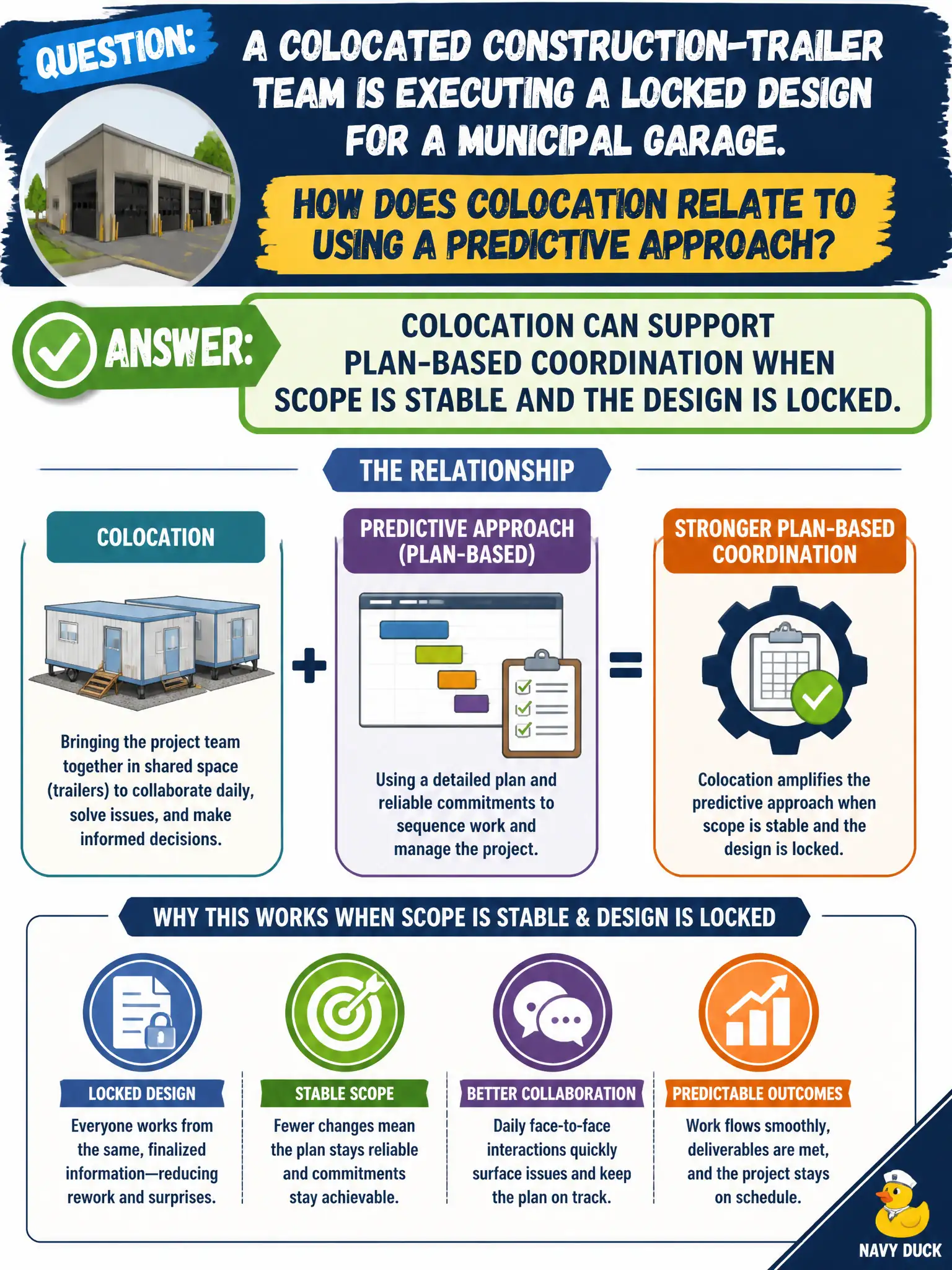
A colocated construction-trailer team is executing a locked design for a municipal garage. How does colocation relate to using a predictive approach?
Select an answer to reveal the explanation.
Short Explanation
Being in the same trailer helps people talk fast—it does not magically rewrite the drawings. With a locked design, predictive baselines still guide the work; colocation just makes coordination smoother. Do not confuse sitting together with needing a new life cycle.
Full Explanation
A colocated construction-trailer team executing a locked design for a municipal garage can use colocation to support plan-based coordination when scope is stable. Sitting together improves communication, but it does not force an adaptive life cycle. Predictive delivery remains appropriate when the design is locked and control is baseline-driven.
Colocation does not always require dropping baselines for Kanban-only work. Predictive methods can be used when people share a trailer. Colocation also does not replace the need for schedule or scope baselines; proximity is a communication enhancer, not a substitute for planning artifacts.
Exam caveat: Associates should avoid false binaries such as “colocation equals agile” or “predictive forbids colocation.” Life-cycle choice follows work characteristics more than seating chart.
Operational check: keep the locked-design scope and schedule baselines, use trailer colocation for daily coordination and issue resolution, and still process baseline changes formally. Use colocation for issue huddles and look-ahead planning against the baseline calendar. If someone proposes dropping baselines because “we’re all here,” restate that proximity complements control—it does not replace it.