
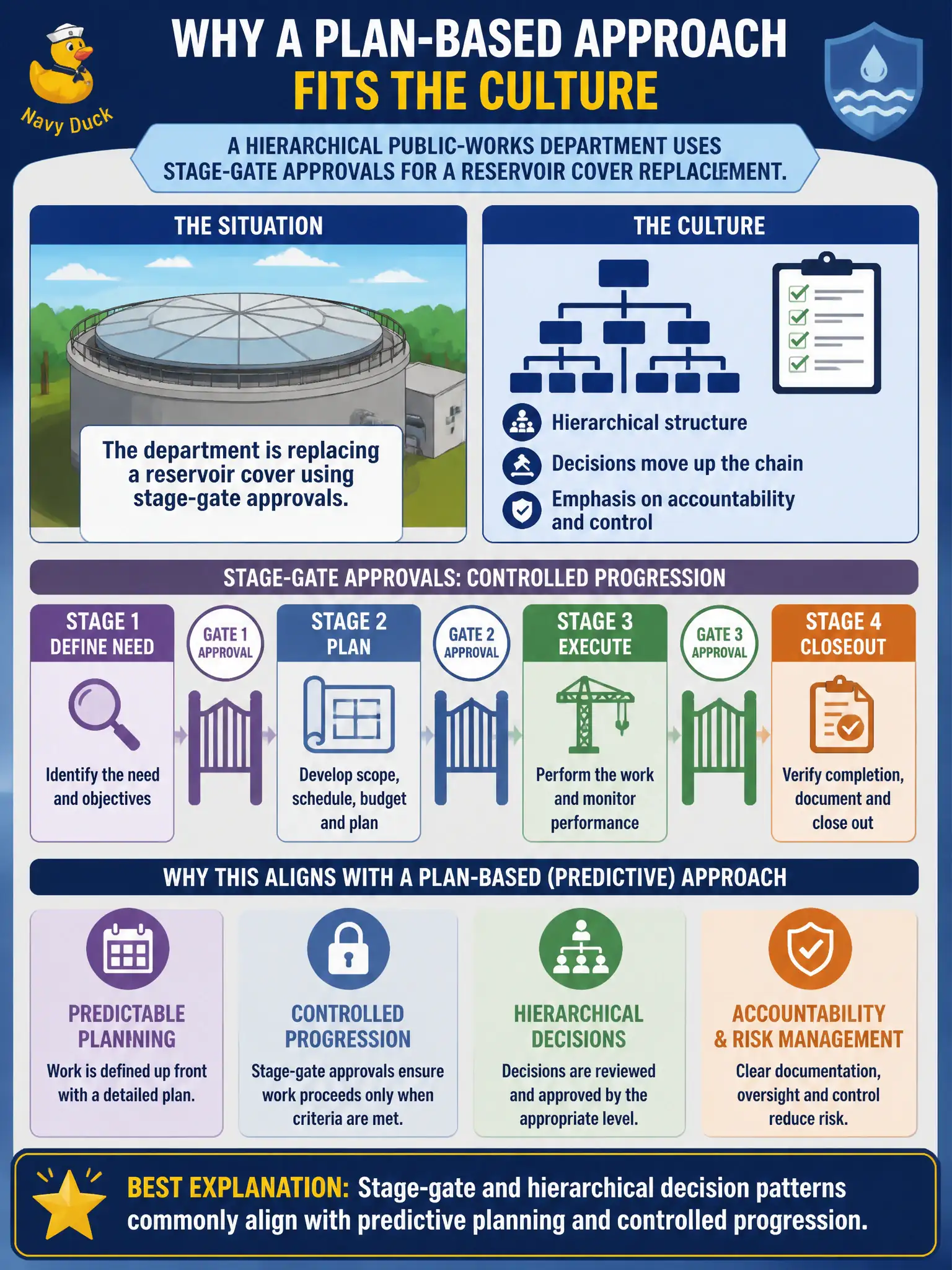
A hierarchical public-works department uses stage-gate approvals for a reservoir cover replacement. Which statement best explains why a plan-based approach fits the culture?
Select an answer to reveal the explanation.
Short Explanation
Picture a ladder of signatures before the next phase starts—that is stage-gate life. Predictive planning plays nicely with that culture because phases and baselines match how authority actually flows. Fighting the hierarchy with pure improvisation usually just slows the cover replacement.
Full Explanation
A hierarchical public-works department that uses stage-gate approvals for a reservoir cover replacement commonly aligns with predictive planning and controlled progression. Stage gates and hierarchical decision rights fit plan-based delivery: complete defined packages, review, then proceed. Organizational culture and governance mechanisms are legitimate suitability factors for life-cycle choice on civic capital work.
Stage gates do not make predictive planning impossible in government; they often reinforce it. Hierarchical approvals do not require abandoning the schedule baseline. Claiming only fully self-managing agile teams can replace a reservoir cover under regulation ignores how regulated infrastructure is frequently delivered predictively.
Exam caveat: CAPM associates should consider culture and governance fit alongside requirement stability. Predictive is not mandated by hierarchy alone, but hierarchy plus stage gates is a strong alignment signal.
Operational check: map required stage-gate packages and approvers into the project management plan, align schedule milestones to gates, and ensure baseline updates follow gate decisions and change control. Align document packages to each gate so reviewers are not improvising completeness criteria. When a gate fails, stop progression and open change or rework paths rather than quietly starting the next construction phase.