
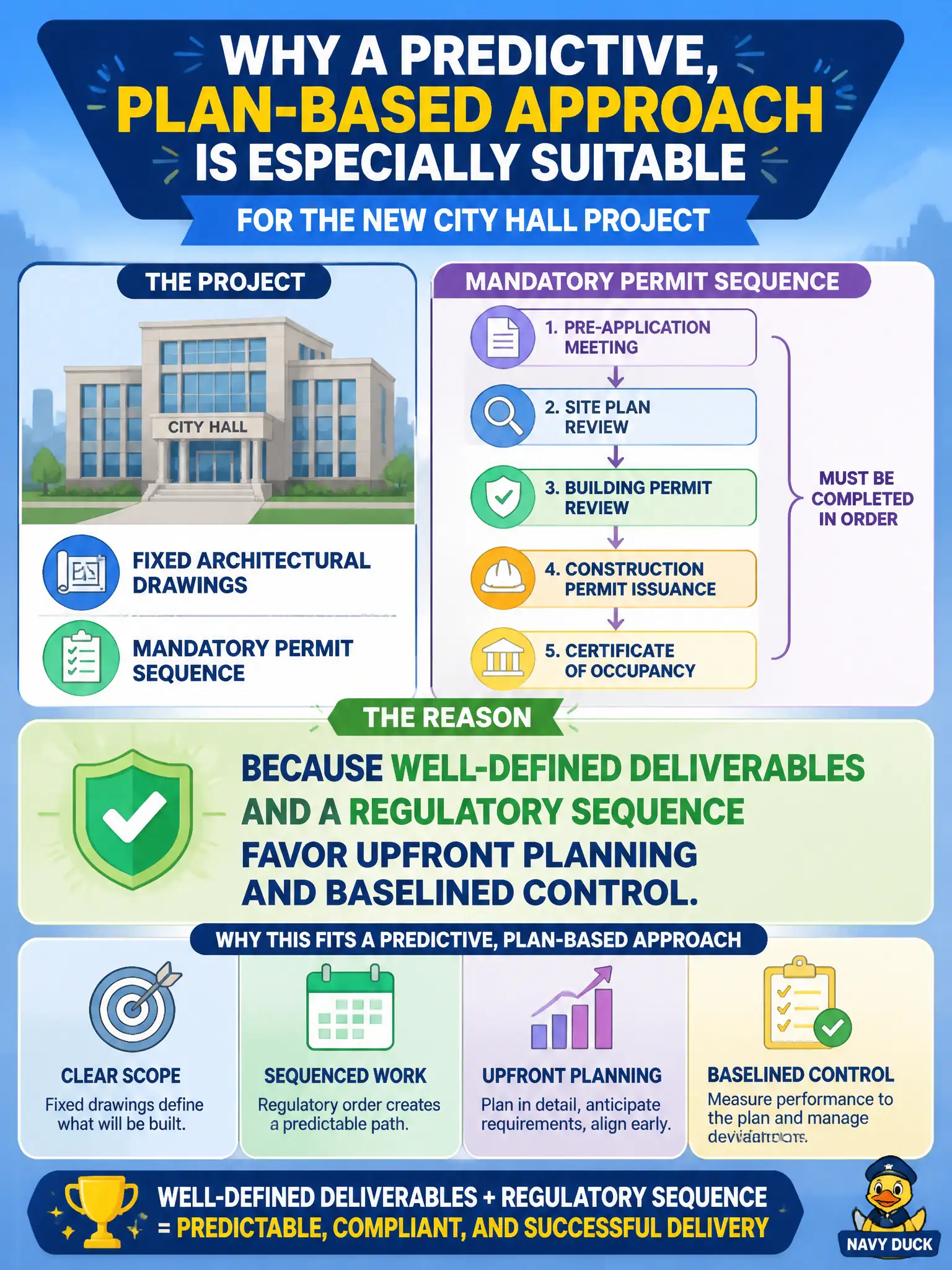
A new city hall structure has fixed architectural drawings and a mandatory permit sequence. Why is a predictive, plan-based approach especially suitable?
Select an answer to reveal the explanation.
Short Explanation
When the drawings are locked and the permits have a fixed order, you are not exploring—you are executing a known path. Predictive planning loves that kind of clarity. Weekly redesign chaos would fight the permit clock, not help it.
Full Explanation
A new city hall structure with fixed architectural drawings and a mandatory permit sequence is especially suited to a predictive, plan-based approach because well-defined deliverables and a regulatory sequence favor upfront planning and baselined control. Civic vertical construction rarely benefits from reinventing the building layout every sprint. Stable design plus permit logic supports sequenced work packages, schedules, and change control.
Expecting requirements to change every sprint with no stable design describes an adaptive-favoring context, not this fixed-drawing scenario. Inventing the building layout during each daily standup contradicts locked architecture and permitting. Claiming predictive methods forbid schedules or work packages reverses predictive practice entirely.
Exam caveat: CAPM life-cycle selection questions hinge on stability of requirements, regulatory constraints, and deliverable clarity. Associates should pick predictive when those conditions dominate—not because “government always means waterfall,” but because the work characteristics fit.
Operational check: baseline scope from the approved drawings, build the schedule around permit hold points, and route design changes through integrated change control rather than informal field redesign.