
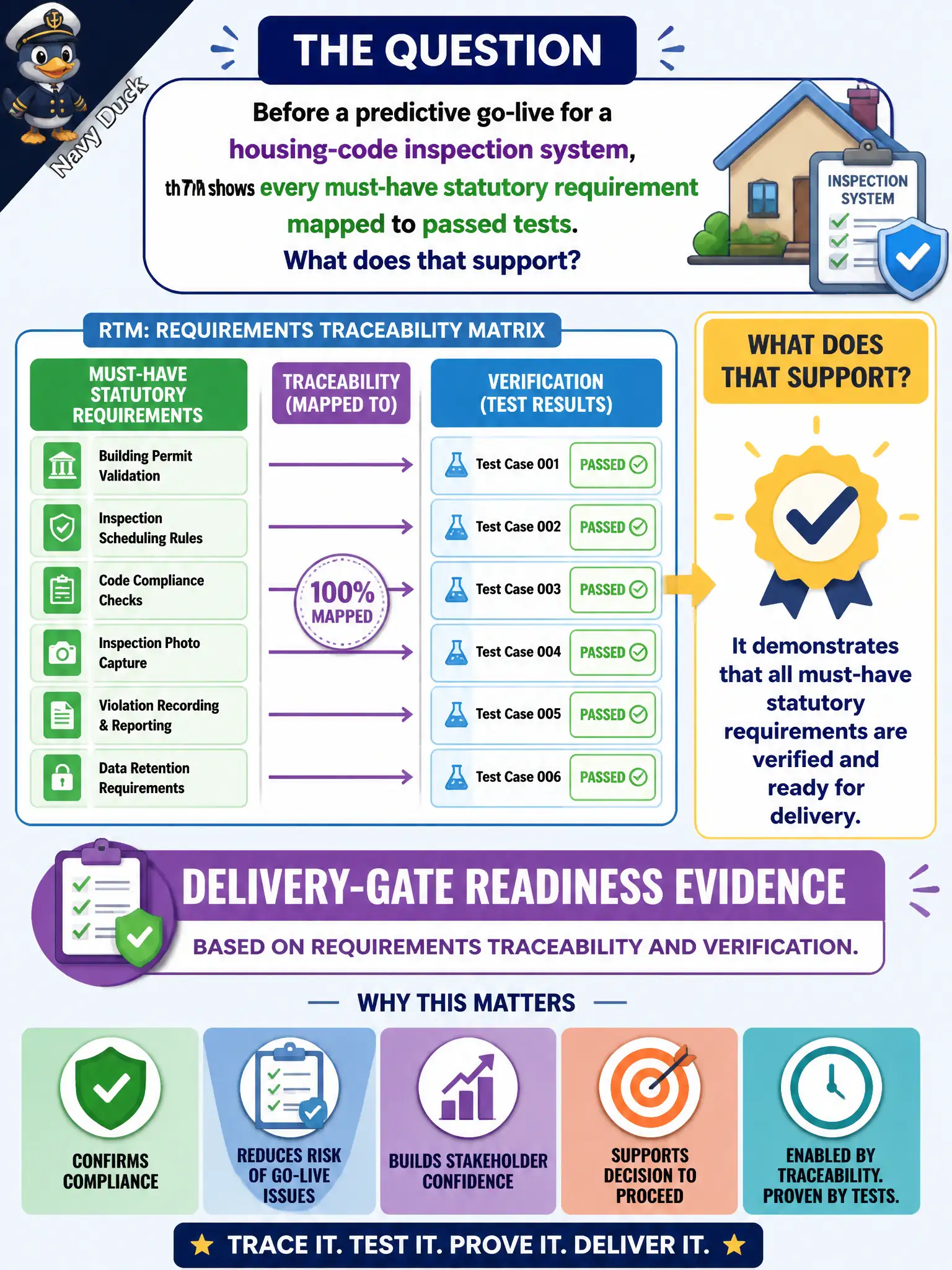
Before a predictive go-live for a housing-code inspection system, the RTM shows every must-have statutory requirement mapped to passed tests. What does that support?
Select an answer to reveal the explanation.
Short Explanation
A clean RTM with must-haves tested is like a boarding pass—strong evidence you’re ready for the gate. It doesn’t skip UAT or ops handoff; it shows the statutory checklist is covered.
Full Explanation
Before a predictive go-live for a housing-code inspection system, an RTM that shows every must-have statutory requirement mapped to passed tests supports delivery-gate readiness evidence based on requirements traceability and verification. That evidence answers whether mandated scope was specified and proven before inspectors and residents rely on the system. Civic inspection systems use such gates to reduce the chance of releasing unlawful gaps.
Immediate cancellation of UAT because documents replace user checks fails conceptually because RTM evidence complements, rather than replaces, user acceptance where required by governance. Proof that schedule variance is zero regardless of defects fails because schedule health is not the same as requirements verification readiness. Permission to skip operations handover documentation fails because readiness includes operational transition, not only test mapping on the RTM.
Exam caveat: Full statutory RTM coverage with passed tests is readiness evidence—not a license to skip UAT or ops handover. Operational check: present the housing-code RTM with passed statutory tests at the delivery gate, confirm any required UAT and ops handover artifacts are also complete, and open remaining gaps as blockers rather than assuming RTM alone finishes readiness.