
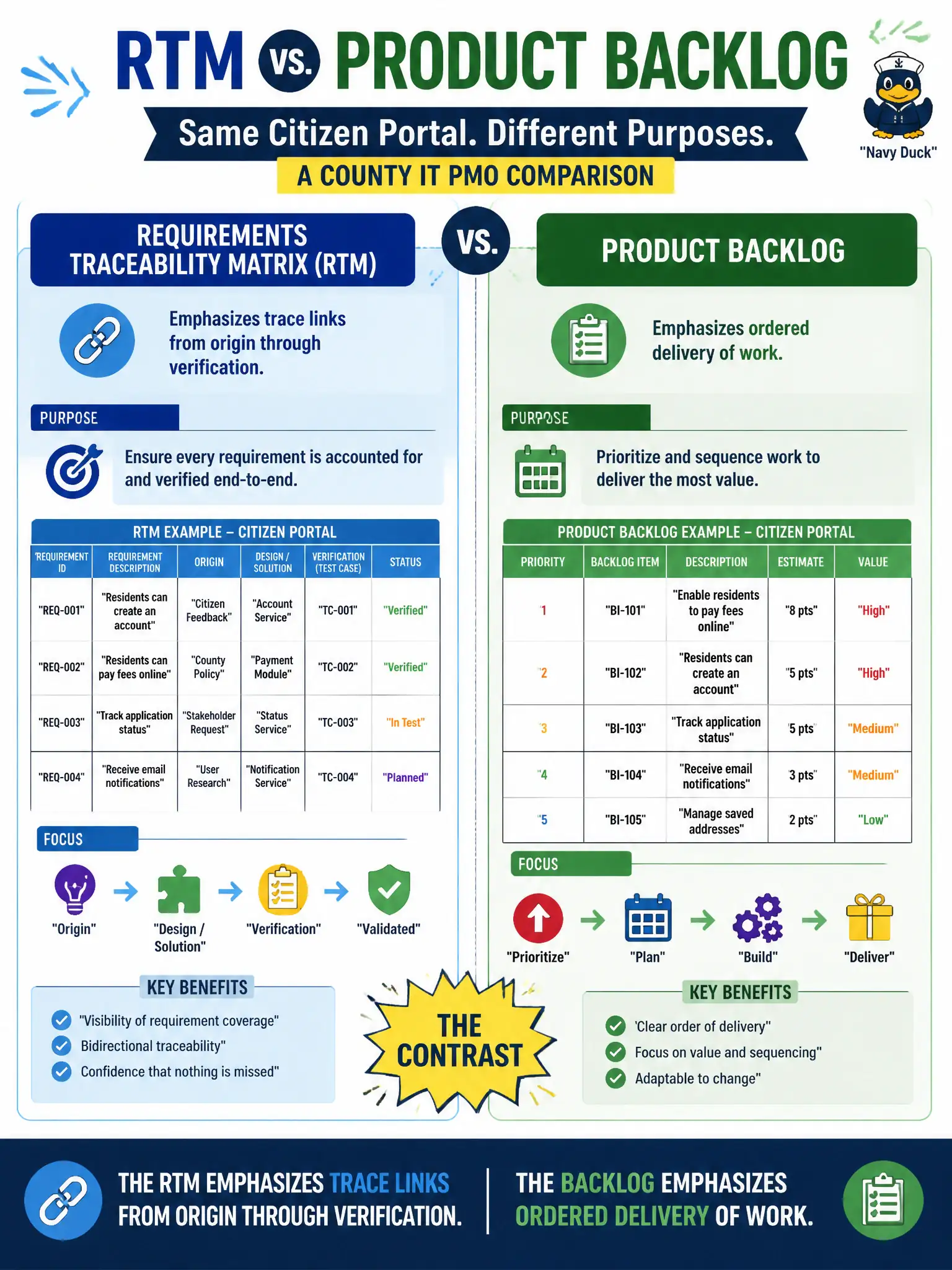
A county IT PMO compares a requirements traceability matrix with a product backlog for the same citizen portal. What contrast best describes their primary purposes?
Select an answer to reveal the explanation.
Short Explanation
RTM is the ‘where did this come from and how do we prove it’ binder; the backlog is the ‘what do we build next’ queue. Same project can need both—they just answer different questions.
Full Explanation
Comparing an RTM and a product backlog for the same citizen portal highlights different primary purposes: the RTM emphasizes trace links from origin through verification, while the backlog emphasizes ordered delivery of work. Both can coexist on municipal products. Confusing them leads teams either to lose statutory traceability or to lose adaptive ordering discipline that civic portals need under changing resident priorities.
Saying both exist only to record vendor payment milestones fails conceptually because neither artifact’s primary purpose is accounts payable tracking. Claiming the backlog replaces all need for tracing statutory rules to tests fails because ordered delivery does not prove ordinance coverage or verification. Claiming the RTM is only for agile teams while backlogs are only for predictive teams fails because RTMs are common in predictive control and backlogs are central to adaptive work—the stated pairing is reversed and oversimplified.
Exam caveat: Know each artifact’s job—trace versus order—rather than treating them as interchangeable or methodology-exclusive. Operational check: for the citizen portal, maintain RTM links for statutory requirements to tests and maintain an ordered backlog for delivery, then show both views at the next PMO checkpoint without substituting one for the other.