
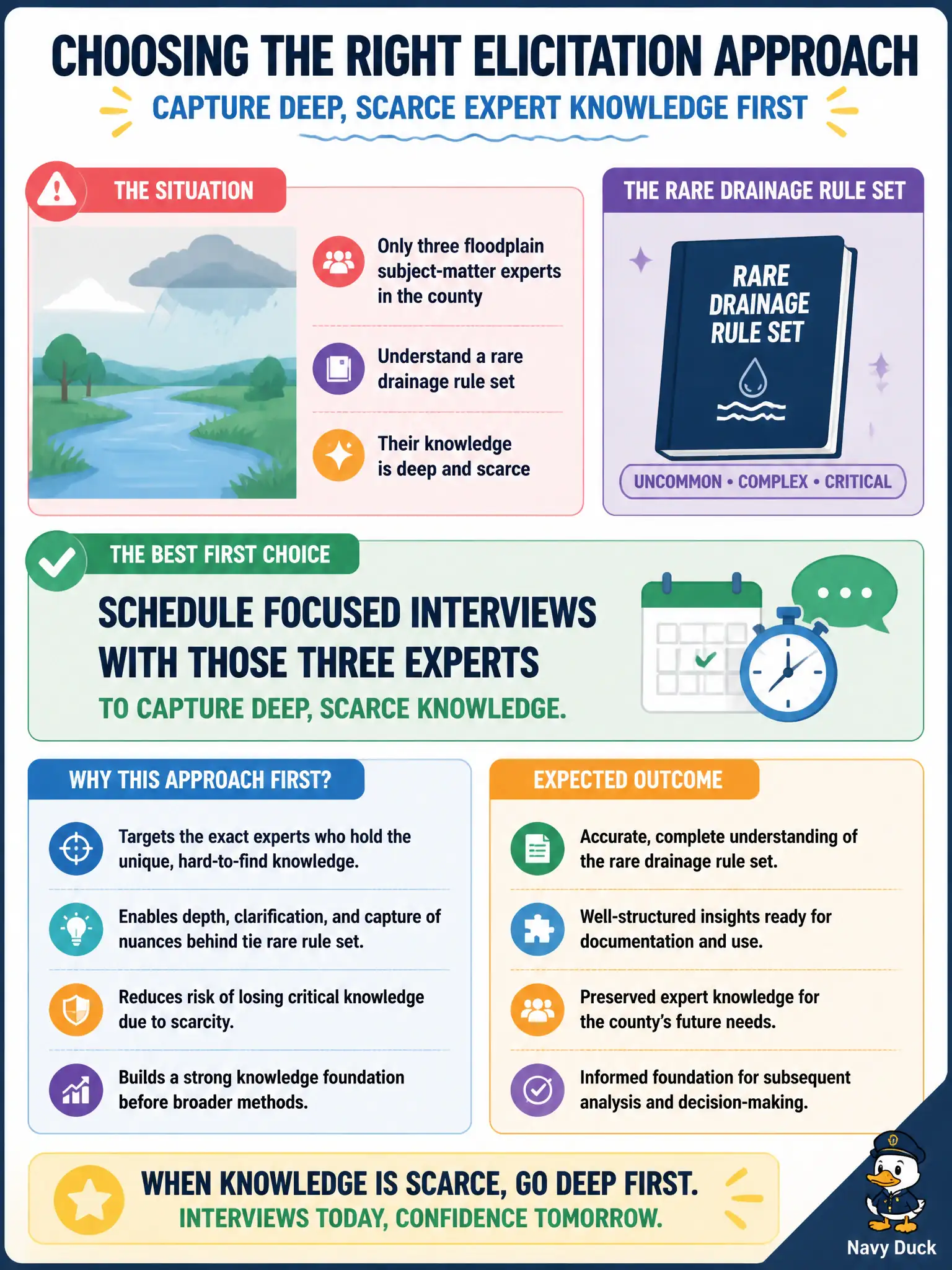
Only three floodplain subject-matter experts in the county understand a rare drainage rule set. Which elicitation approach should the analyst choose first?
Select an answer to reveal the explanation.
Short Explanation
When three people hold the whole map to a flooded creek’s quirks, you sit down with them—not blast a county-wide quiz. Interviews pull deep expertise when the knowledge pool is tiny.
Full Explanation
When only three floodplain subject-matter experts in the county understand a rare drainage rule set, the analyst should first schedule focused interviews with those experts to capture deep, scarce knowledge. Interviews concentrate elicitation where expertise actually lives and reduce the risk that rare rules are guessed, crowdsourced incorrectly, or copied blindly. Civic floodplain controls that miss scarce expertise can produce unsafe or noncompliant drainage decisions.
Broadcasting an anonymous public survey to all residents before speaking with anyone fails conceptually because the public cannot supply rare technical rule knowledge held by three specialists; breadth without expertise yields noise. Skipping elicitation and copying a neighboring county’s website fails because another jurisdiction’s published summary may not match local code, hydrology, or legal interpretation. Running only large open-space workshops so every neighborhood debates the rules at once fails as a first step because mass debate is a poor primary channel for scarce technical expertise and can politicize rule capture before facts are clear.
Exam caveat: Scarce SME knowledge calls for focused interviews first; broad techniques come later for validation or prioritization if needed. Operational check: interview the three floodplain experts with a structured guide, document the drainage rule set and exceptions, validate the write-up with them, then introduce broader stakeholders only for impact and prioritization—not as the primary source of the rare rules.