
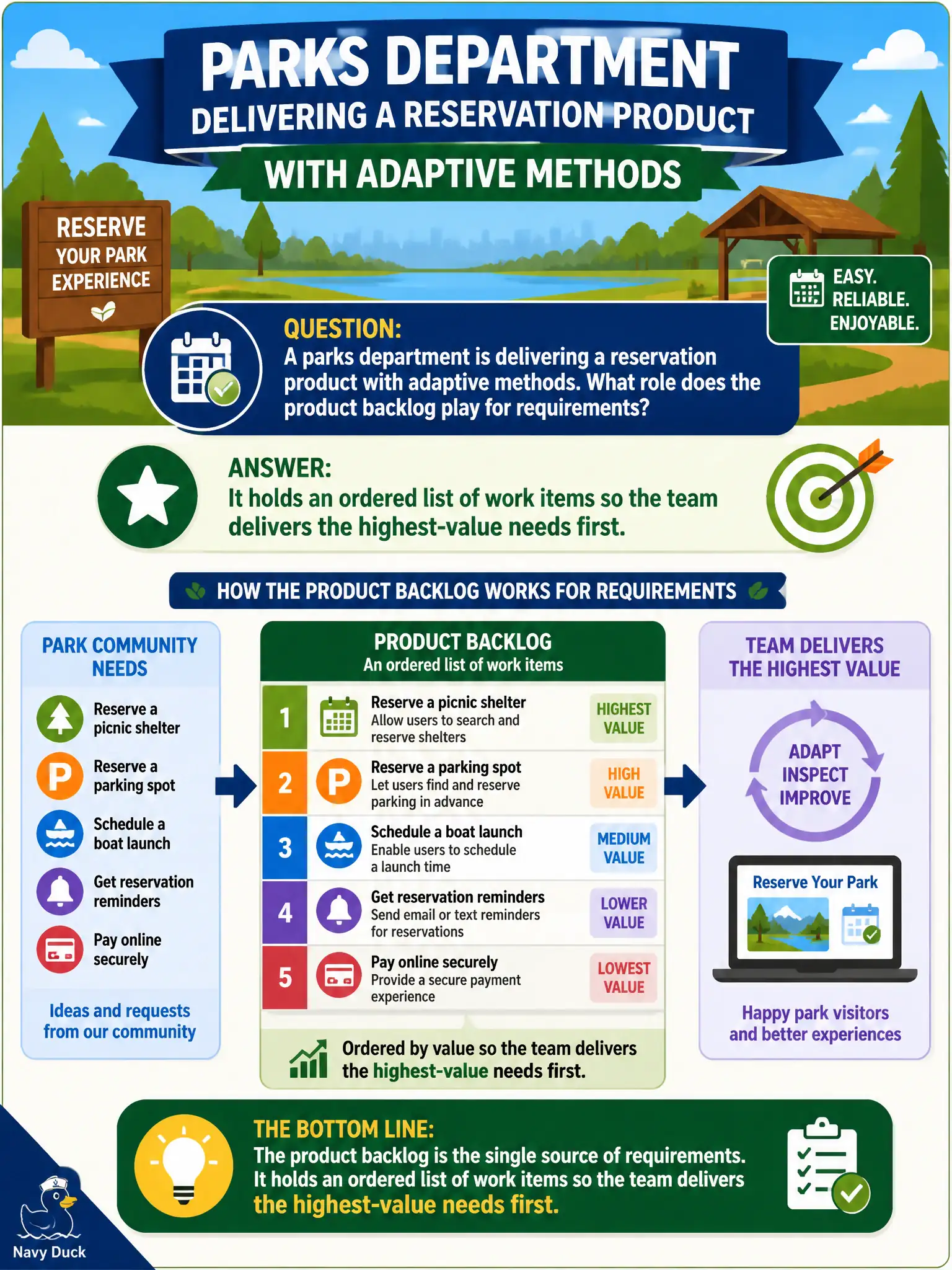
A parks department is delivering a reservation product with adaptive methods. What role does the product backlog play for requirements?
Select an answer to reveal the explanation.
Short Explanation
A backlog is like a diner’s ticket rail—orders closest to the cook get plated first. For parks reservations, the prioritized list tells the team what citizens need most next, and it can be reshuffled as learning arrives.
Full Explanation
In an adaptive parks reservation product, the product backlog holds an ordered list of work items so the team delivers the highest-value needs first. Ordering, refinement, and incremental delivery are the backlog’s job: it keeps civic product decisions visible and changeable as learning accumulates. It is the living queue of value, not a frozen contract pretending to be agile.
Freezing all requirements in a signed baseline that cannot be reordered after sprint one fails conceptually because that behavior is predictive baselining, not adaptive backlog management. Claiming the backlog replaces stakeholder interviews fails because backlog items still require clarification, acceptance criteria, and ongoing elicitation. Treating the backlog as only a risk register for outdoor weather contingencies fails because weather risks belong in risk management; they do not redefine the backlog’s purpose as ordered delivery of product work.
Exam caveat: CAPM adaptive practice uses the backlog for ordered delivery of value, distinct from baselines and risk registers. Operational check: open the parks reservation backlog, confirm items are ordered by value with clear owners, refine the top items with acceptance criteria, and reject any claim that the backlog is locked against reordering after sprint one.