
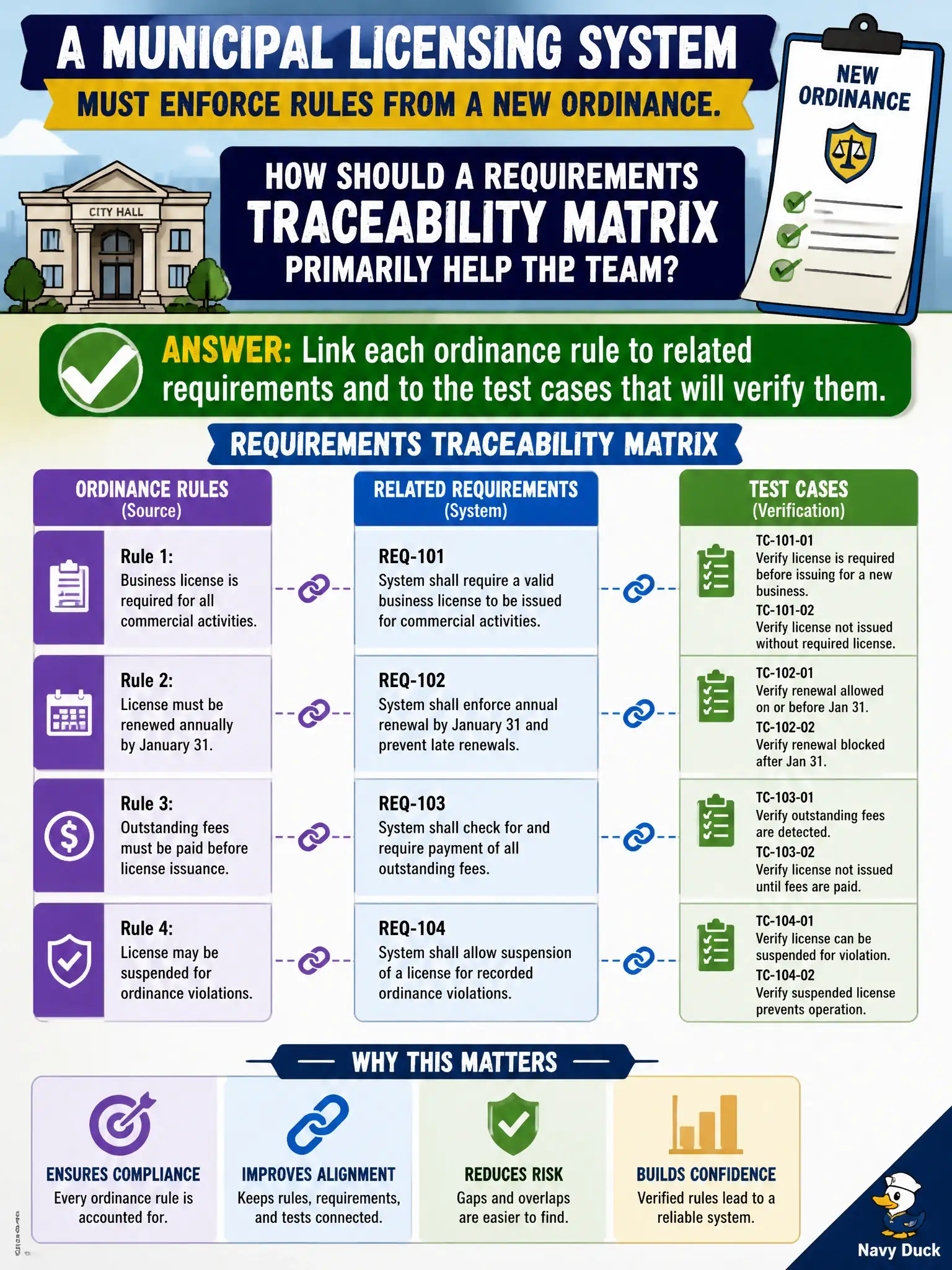
A municipal licensing system must enforce rules from a new ordinance. How should a requirements traceability matrix primarily help the team?
Select an answer to reveal the explanation.
Short Explanation
Think of an RTM like a trail map from the legal trailhead through the requirement campsite to the test finish line. If an ordinance rule can’t be followed to a test, something’s missing.
Full Explanation
For a municipal licensing system enforcing rules from a new ordinance, a requirements traceability matrix primarily links each ordinance rule to related requirements and to the test cases that will verify them. That forward and backward linkage shows auditors and delivery teams how law became system behavior and how behavior was proven. Traceability is the civic bridge from statute language to test evidence.
Replacing the product backlog so the team no longer needs prioritized delivery order fails conceptually because an RTM is not a sequencing or value-ordering tool; backlogs still order work. Listing only vendor invoice milestones fails because finance closeout artifacts do not prove ordinance rules were specified or tested. Storing raw interview transcripts without mapping them to deliverable artifacts fails because unmapped notes are evidence of conversation, not of requirement-to-test coverage.
Exam caveat: Associates should not confuse RTM purpose with backlog prioritization, procurement tracking, or raw elicitation storage. Operational check: for the new ordinance, add RTM rows from each rule to requirements and planned tests, highlight any rule without a test link, and resolve those gaps before licensing go-live readiness review.