
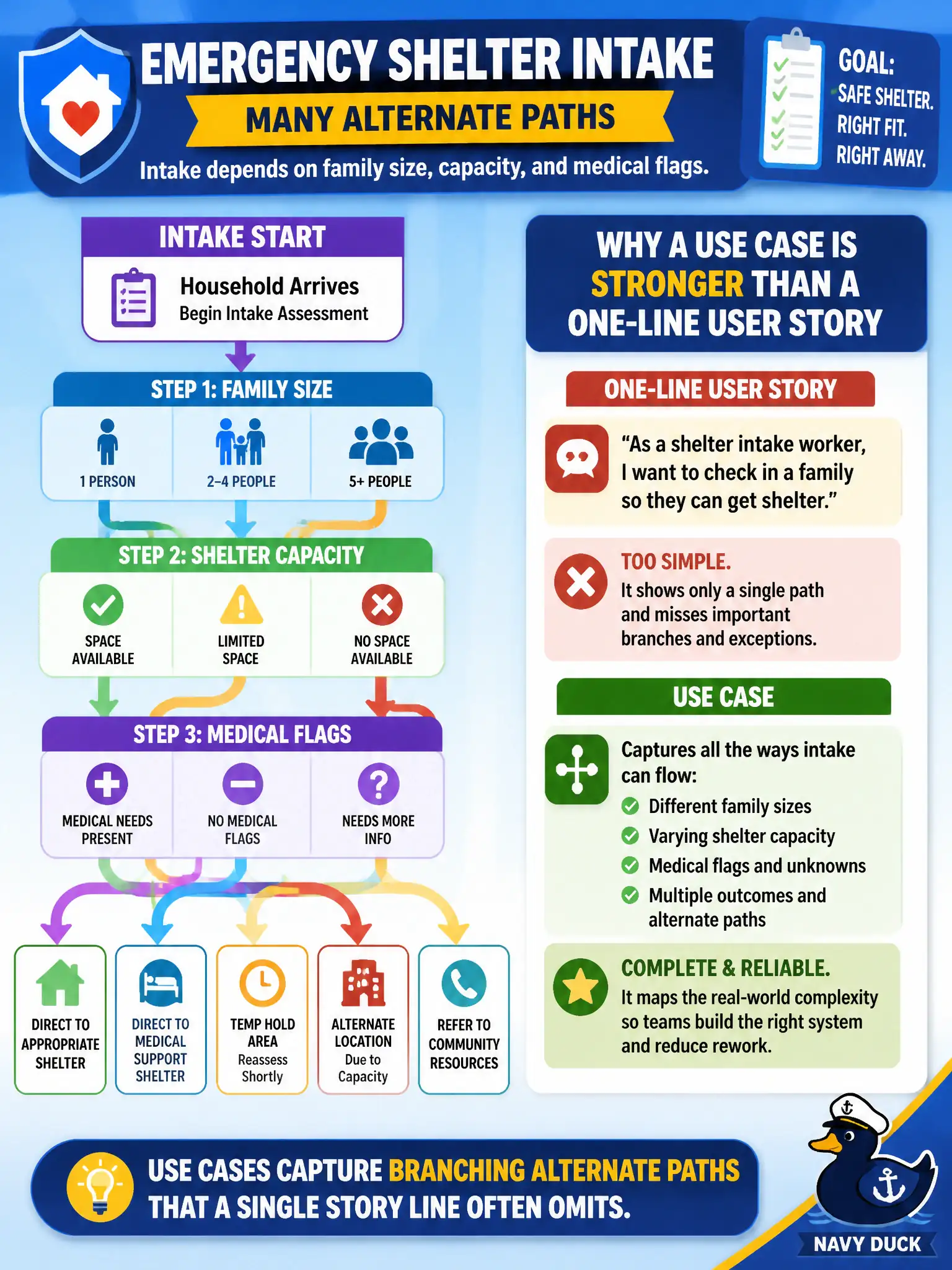
Emergency shelter intake has many alternate paths depending on family size, capacity, and medical flags. Why might a use case be stronger than a one-line user story alone?
Select an answer to reveal the explanation.
Short Explanation
Shelter intake isn’t one happy path—it’s a choose-your-own-adventure. A use case holds those forks; a lone story sentence usually doesn’t.
Full Explanation
Emergency shelter intake often branches on family size, capacity, and medical flags. A use case is stronger than a one-line user story alone because use cases systematically capture alternate and exception paths that a single story sentence typically omits. For civic human-services systems, missing branches are not cosmetic; they become unsafe or inequitable handling of vulnerable residents.
Claiming user stories always document every alternate path better than use cases fails conceptually because concise stories commonly defer or omit branching detail unless expanded with additional analysis. Saying use cases are forbidden on municipal human-services projects fails because no such ban exists; use cases are often appropriate for complex processes. Asserting one-line stories automatically include capacity and medical branching fails because a one-liner does not magically encode those decision trees.
Exam caveat: When paths multiply, strengthen analysis with use cases or equivalent structured models rather than relying on a single story line. Operational check: draft a shelter-intake use case covering family-size, capacity, and medical alternate paths, review it with intake staff, and ensure backlog stories and tests reference those branches before calling intake Done.