
A utilities team must get a binding scope decision from city council on a smart-meter rollout. Why is a chat thread an insufficient primary channel?
Select an answer to reveal the explanation.
Short Explanation
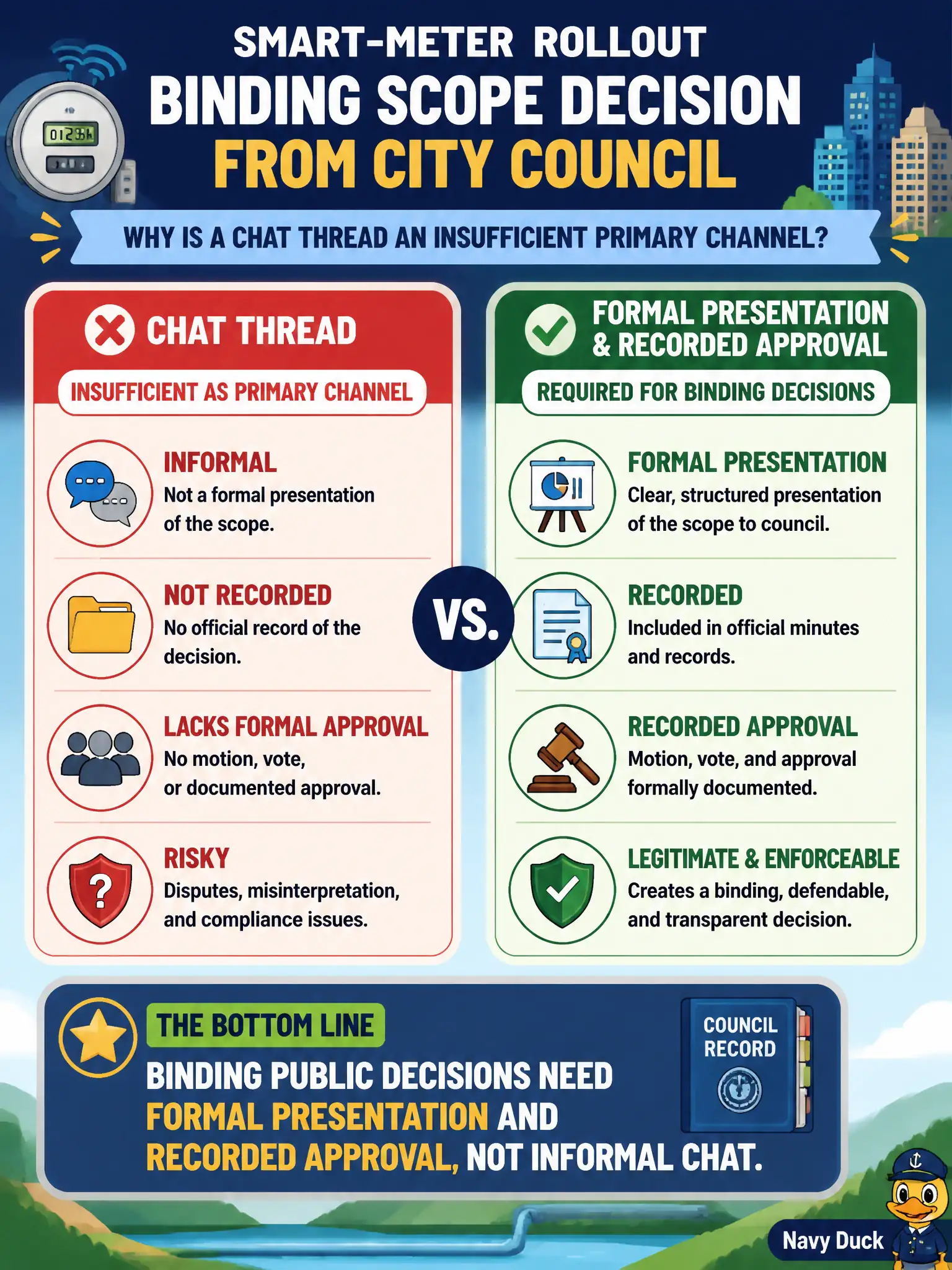
You wouldn’t pass a city ordinance in a group text. Binding scope from council needs a proper presentation and a recorded decision—not a chat scroll nobody can audit.
Full Explanation
When a utilities team needs a binding scope decision from city council on a smart-meter rollout, the decision must be formal, attributable, and auditable. A chat thread is an insufficient primary channel because binding public decisions require formal presentation and recorded approval, not informal messaging that lacks ceremony, completeness, and durable record. Civic accountability expects council actions to be visible in official proceedings, not buried in ephemeral chat history.
Claiming chat threads are always illegal for municipal projects fails conceptually because legality is not the core issue here; suitability for binding public decisions is—the absolute illegality claim overreaches. Asserting council members cannot understand metering unless engineers speak only in chat fails because it invents a false competency barrier and still ignores the need for formal recorded approval. Reserving formal presentations only for closing projects fails because major scope authorizations occur throughout initiation and planning, not only at closeout.
Exam caveat: CAPM communication planning must match formality to decision bindingness; informal tools can support dialogue but not replace recorded public approvals. Operational check: prepare a council-ready smart-meter scope presentation, route it through the required civic agenda process, and obtain recorded approval before treating chat comments as authorization to proceed.