
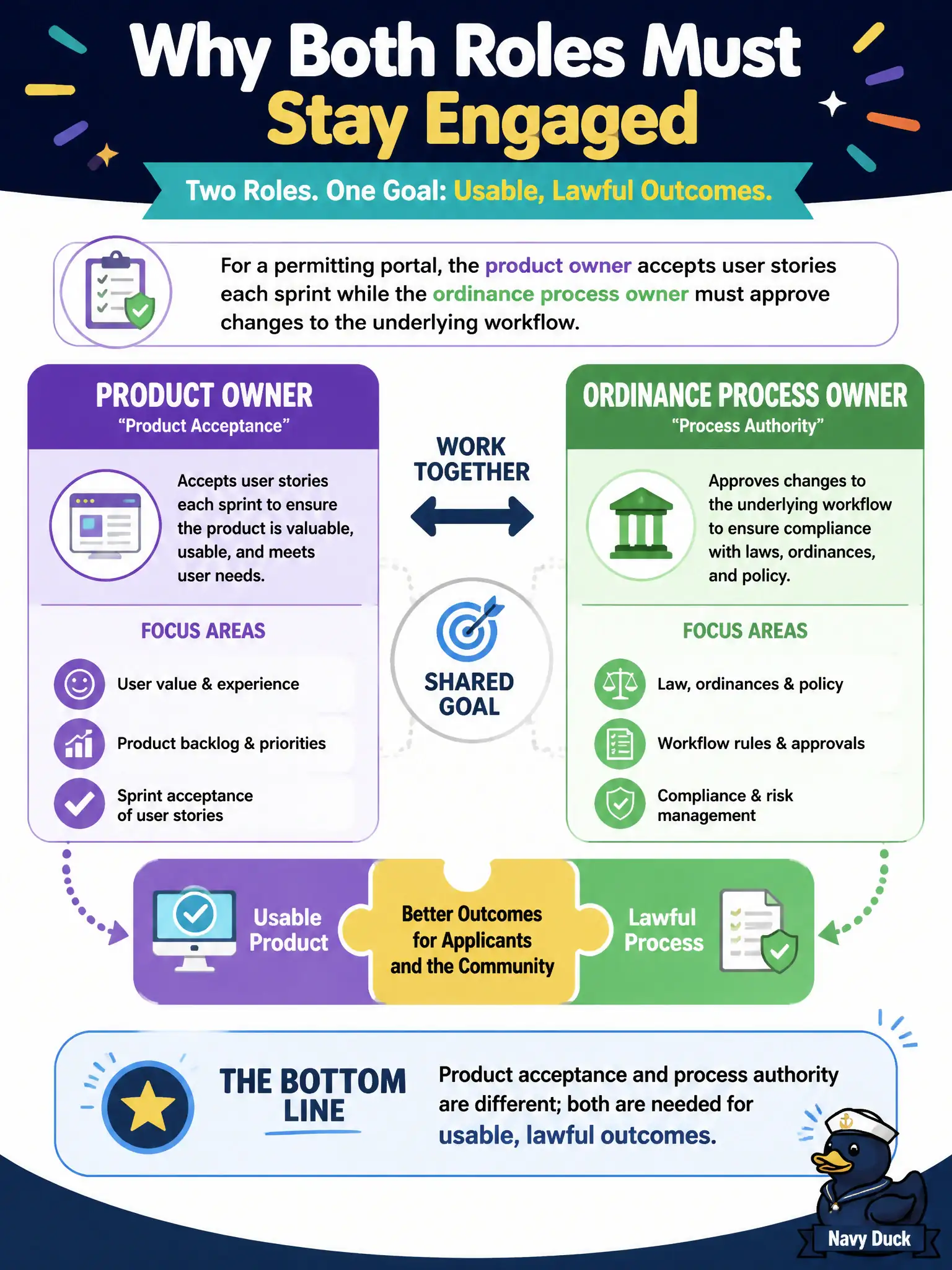
For a permitting portal, the product owner accepts user stories each sprint while the ordinance process owner must approve changes to the underlying workflow. Why must the team keep both roles engaged?
Select an answer to reveal the explanation.
Short Explanation
Think of it like a restaurant: the menu owner picks what goes on tonight’s specials, but the health inspector still owns the kitchen rules. Product owners accept stories; process owners own the ordinance workflow—you need both chairs filled.
Full Explanation
For a municipal permitting portal, product ownership and ordinance process ownership answer different questions. The product owner accepts user stories that shape backlog priority and incremental value, while the ordinance process owner holds authority over workflow rules rooted in law and policy. Keeping both roles engaged is required for outcomes that are usable in the product sense and lawful in the civic process sense. Collapsing either role leaves the portal either illegally streamlined or legally correct but undeliverable as product increments.
Treating only the product owner as relevant once stories exist fails conceptually because backlog acceptance does not confer authority to change ordinance-bound workflows; silent process-owner exclusion invites noncompliant releases. Asserting that only the process owner can accept stories fails because ordinance authority is not the same as product prioritization and acceptance of incremental delivery; product decisions would stall without a product owner. Claiming either role alone can approve both backlog priority and ordinance workflow changes fails because those are distinct decision classes that municipal governance keeps separate for accountability and auditability.
Exam caveat: Associates must distinguish product acceptance from process authority rather than assuming one municipal role covers both. Operational check: before the next permitting sprint review, confirm story acceptance lists the product owner and that any workflow-rule change touching ordinance steps has documented process-owner approval, then record gaps in the project decision log.