
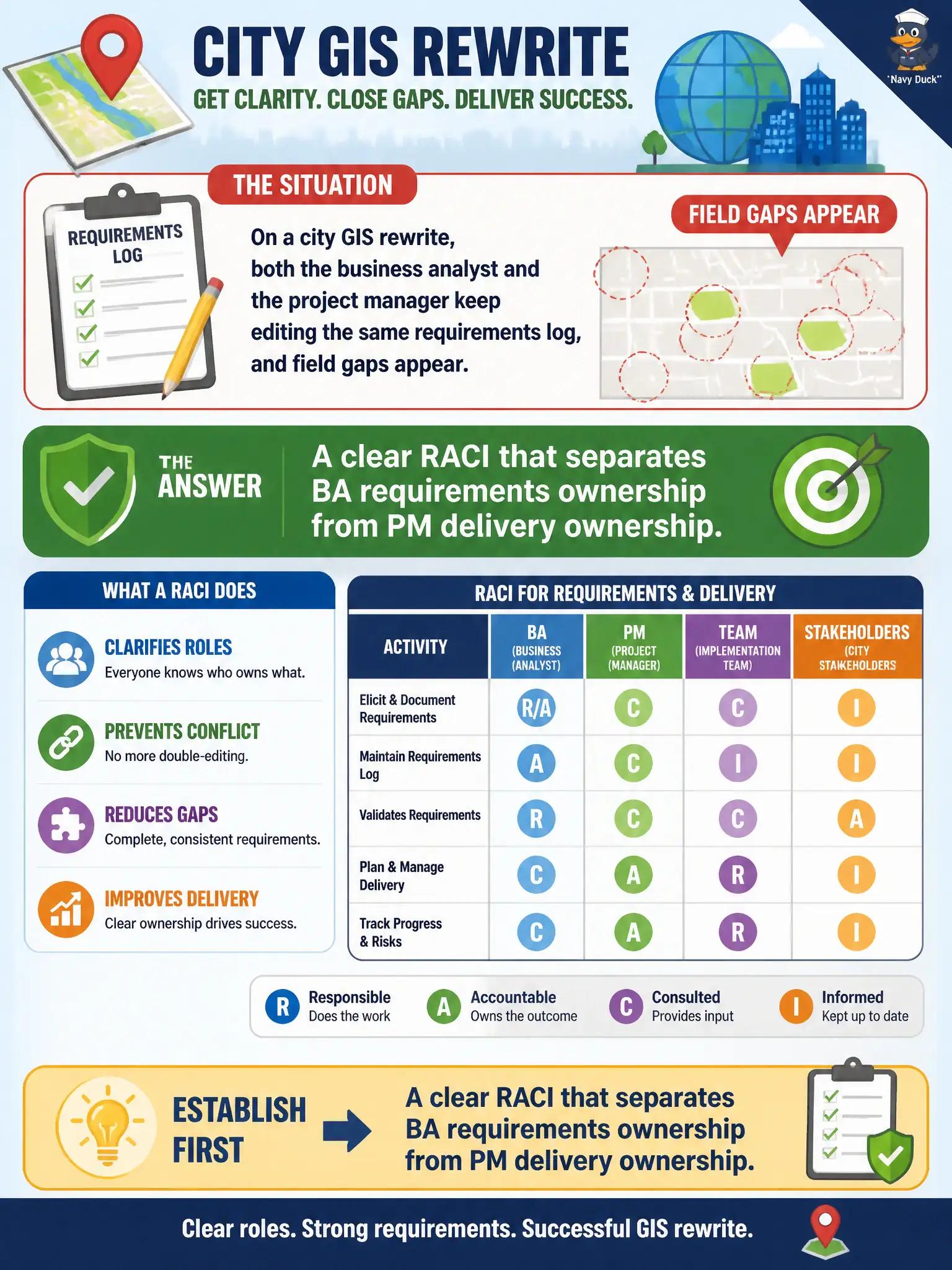
On a city GIS rewrite, both the business analyst and the project manager keep editing the same requirements log, and field gaps appear. What should the team establish first?
Select an answer to reveal the explanation.
Short Explanation
When two people both think they own the requirements notebook, pages go missing. A simple RACI for BA versus PM on a GIS rewrite stops the tug-of-war—who authors, who tracks delivery—so gaps and duplicates don’t sneak in.
Full Explanation
On a municipal GIS rewrite, unclear ownership between the business analyst and the project manager routinely produces duplicate edits, silent omissions, and field gaps that later become costly rework. Establishing a clear RACI that separates BA accountability for eliciting and maintaining requirements from PM accountability for schedule, cost, and delivery is the first governance step that restores single-threaded ownership. Role clarity does not eliminate collaboration; it defines who authors, who consults, who is informed, and who is ultimately accountable so the requirements log remains coherent under civic audit expectations.
A shared Kanban board that lets anyone rewrite requirements without named owners fails conceptually because a board is a work-visualization tool, not a substitute for accountability; unrestricted editing recreates the same ownership blur the team already suffers. A rule that only the sponsor may draft requirements while the BA only formats them fails because sponsors rarely hold day-to-day elicitation capacity, and reducing the BA to formatting undermines analysis quality and traceability. A daily stand-up that replaces documented roles fails because a short sync ceremony coordinates progress; it does not define lasting RACI boundaries for requirements versus delivery work.
Exam caveat: CAPM associates should not confuse collaboration ceremonies or boards with role definition; RACI answers who owns which decision class. Operational check: publish a one-page RACI for the GIS rewrite naming BA as accountable for the requirements log and PM as accountable for delivery baselines, walk it with both roles and the sponsor, then sample recent field gaps to confirm updates now flow through the named owner before the next sprint or phase gate.