
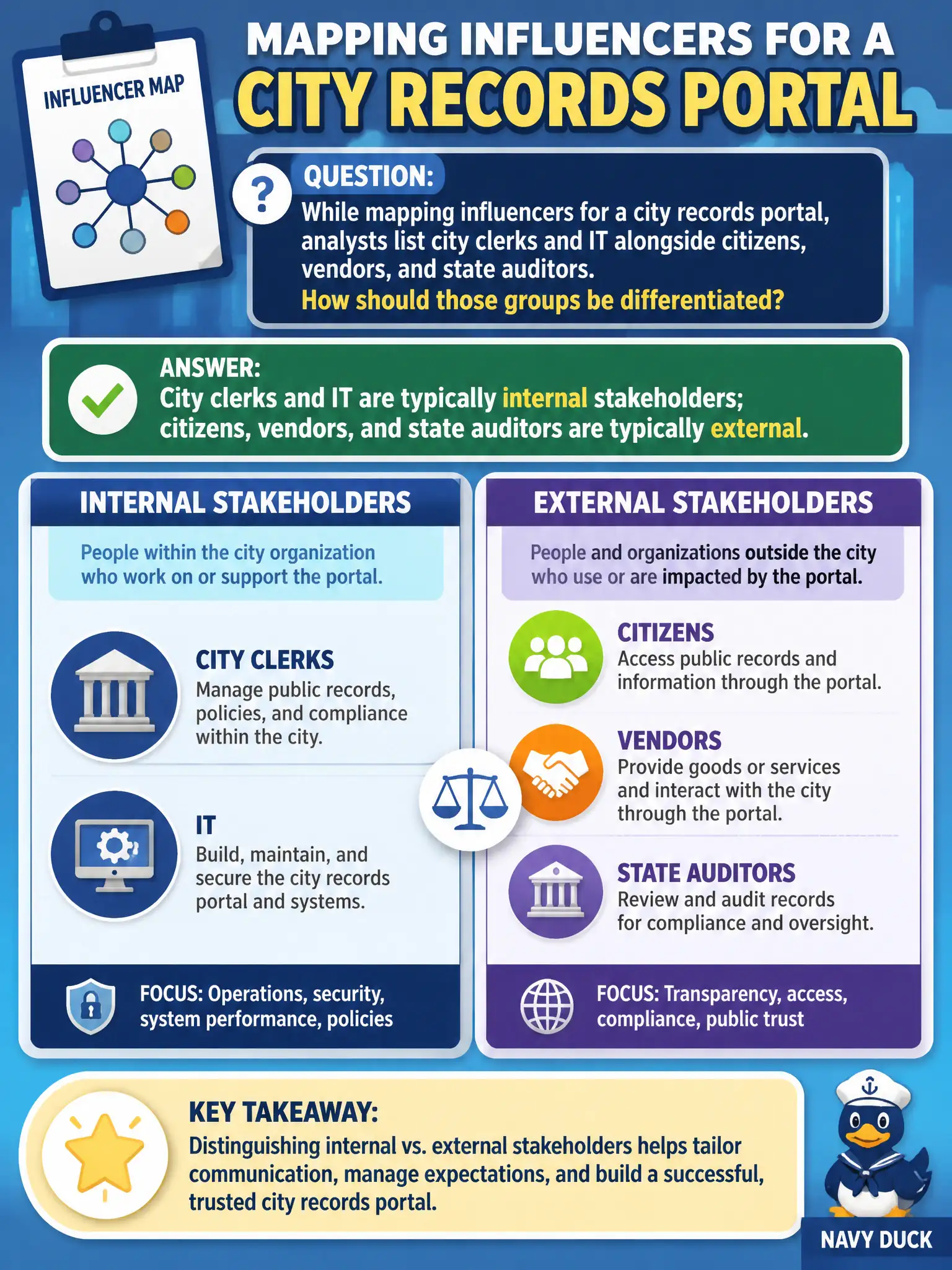
While mapping influencers for a city records portal, analysts list city clerks and IT alongside citizens, vendors, and state auditors. How should those groups be differentiated?
Select an answer to reveal the explanation.
Short Explanation
Inside the city tent versus outside looking in—clerks and IT usually sit inside; residents, vendors, and state auditors often sit outside. Same portal, different relationships. Tagging internal vs external keeps engagement plans honest.
Full Explanation
While mapping influencers for a city records portal, analysts listing city clerks and IT alongside citizens, vendors, and state auditors should differentiate internal versus external stakeholders: city clerks and IT are typically internal; citizens, vendors, and state auditors are typically external. That classification helps plan engagement paths, communication channels, and information access for civic business analysis without treating every party identically.
Claiming citizens on payroll are the only internal stakeholders while clerks are always external vendors fails conceptually because clerks and IT are organizational internals, and citizens are generally external service recipients. Claiming state auditors are internal employees of every city IT help desk fails because state auditors are typically external oversight parties. Claiming internal versus external labels are meaningless for civic projects and should be ignored fails because the distinction informs engagement strategy even in government contexts.
Exam caveat: CAPM and BA stakeholder mapping still uses internal versus external classifications meaningfully on civic projects. Operational check: tag clerks and IT as internal and citizens, vendors, and auditors as external on the records portal register; tailor engagement cadence and information access accordingly.