
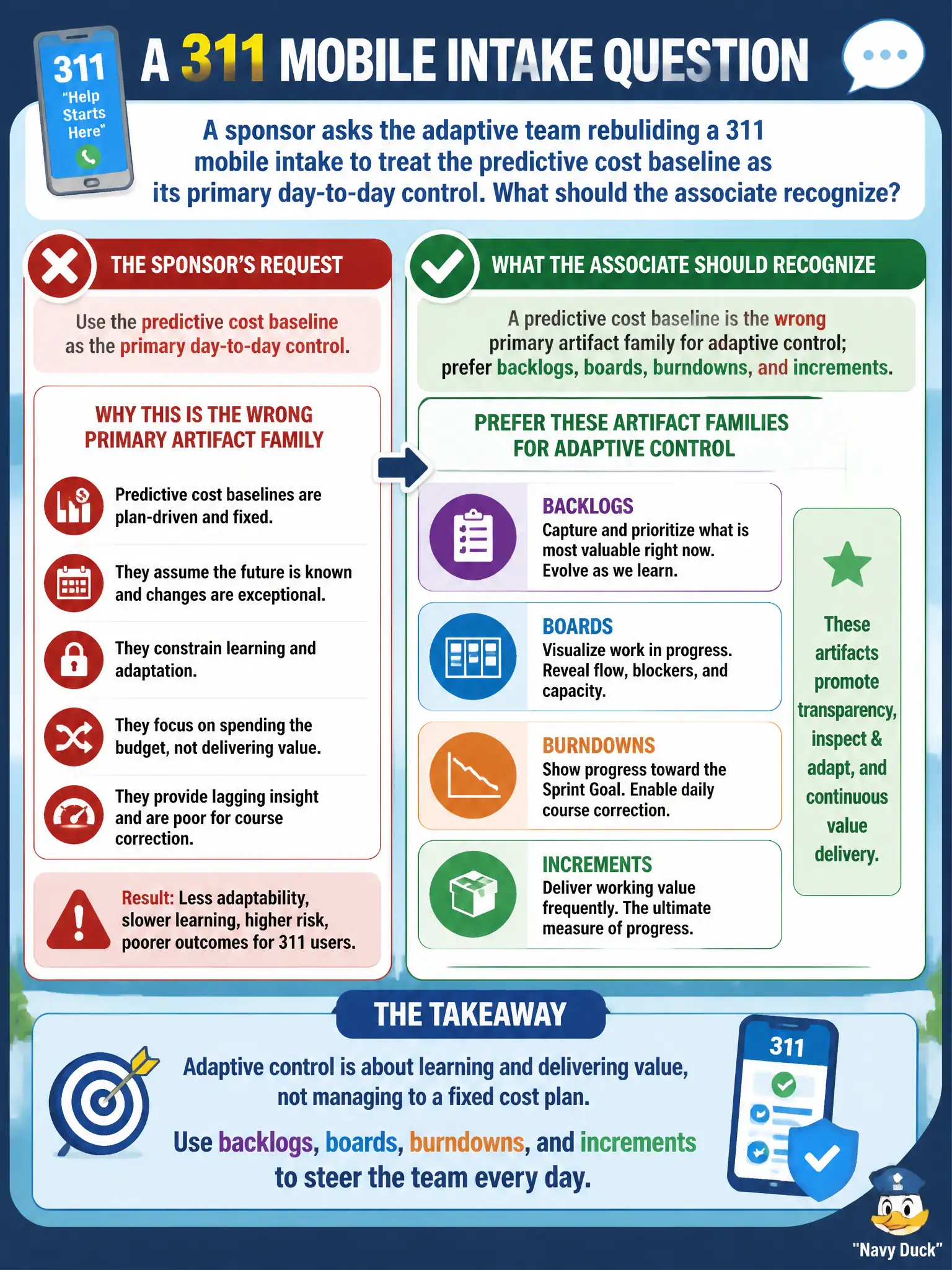
A sponsor asks the adaptive team rebuilding a 311 mobile intake to treat the predictive cost baseline as its primary day-to-day control. What should the associate recognize?
Select an answer to reveal the explanation.
Short Explanation
Using a predictive cost baseline as your main agile steering wheel is like navigating a bike race with a ship’s ledger. Adaptive control leans on backlogs, boards, burndowns, and increments. Keep the baseline for plan-based work where it belongs.
Full Explanation
When a sponsor asks an adaptive team rebuilding a 311 mobile intake to treat the predictive cost baseline as its primary day-to-day control, the associate should recognize that a predictive cost baseline is the wrong primary artifact family for adaptive control; prefer backlogs, boards, burndowns, and increments. Metrics still matter, but the steering artifacts should match the adaptive life cycle rather than importing predictive cost baselines as the main daily control for iterative civic intake work.
Claiming cost baselines are always the only valid control in both adaptive and predictive work fails conceptually because adaptive day-to-day control centers on empirical agile artifacts. Claiming adaptive teams should delete all metrics and rely only on informal hallway talk fails because adaptive control still uses visible metrics and artifacts; it does not abandon measurement. Claiming burndown charts are predictive artifacts and must never appear on agile teams fails because burndowns are common adaptive progress charts.
Exam caveat: CAPM expects associates to distinguish adaptive versus predictive primary controls and match artifact family to life cycle. Operational check: steer the 311 intake team with backlog order, board flow, burndown or burnup, and increment reviews; use cost information as supporting finance insight without making the predictive cost baseline the primary daily control.