
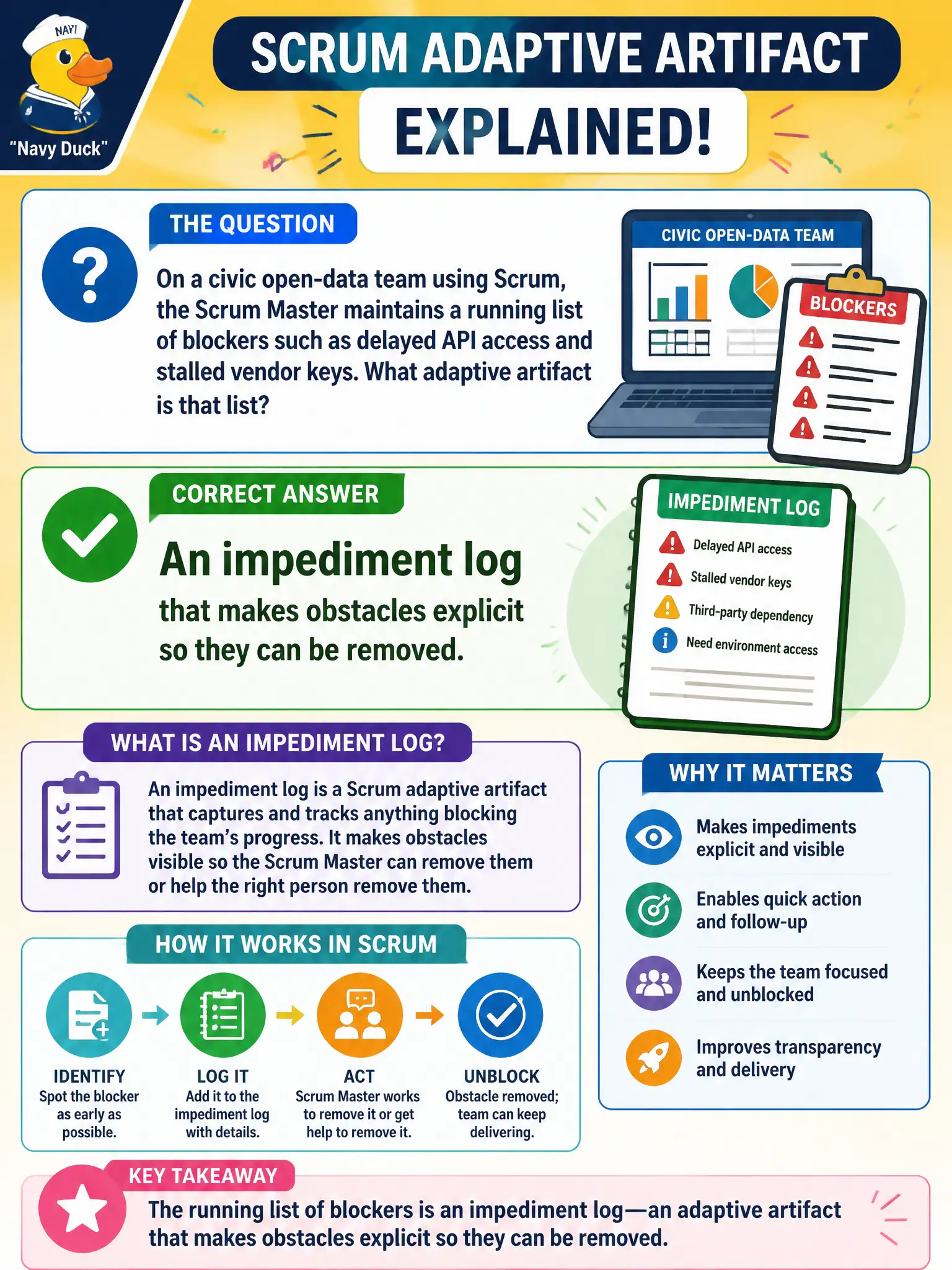
On a civic open-data team using Scrum, the Scrum Master maintains a running list of blockers such as delayed API access and stalled vendor keys. What adaptive artifact is that list?
Select an answer to reveal the explanation.
Short Explanation
Impediments are the rocks in the trail—if nobody writes them down, they keep tripping people. The impediment log makes blockers visible so the Scrum Master role can help clear them. It is not a construction payment schedule.
Full Explanation
On a civic open-data team using Scrum, a running list of blockers such as delayed API access and stalled vendor keys maintained by the Scrum Master is an impediment log that makes obstacles explicit so they can be removed. Tracking impediments transparently is a common adaptive control practice associated with the Scrum Master accountability for helping the team address obstacles that slow delivery of public data.
A predictive milestone payment schedule for capital construction only fails conceptually because payment schedules for capital work are not the team’s obstacle tracker for API and vendor-key blockers. A product roadmap that replaces daily obstacle tracking fails because roadmaps communicate direction; they do not replace an active impediment list. A Definition of Ready checklist used solely to score story points fails because DoR readiness criteria are not an impediment log, and scoring points is not the purpose of tracking blockers.
Exam caveat: Impediment logs make obstacles visible for removal—do not confuse them with capital payment schedules, roadmaps, or DoR point-scoring sheets. Operational check: keep the open-data impediment log current, assign owners and ages to blockers, and review removal progress daily until API access and vendor keys stop stalling the board.