
A wastewater-reporting portal keeps refinement notes that update story details and ordering as citizen needs change. How should the associate view the product backlog in that setting?
Select an answer to reveal the explanation.
Short Explanation
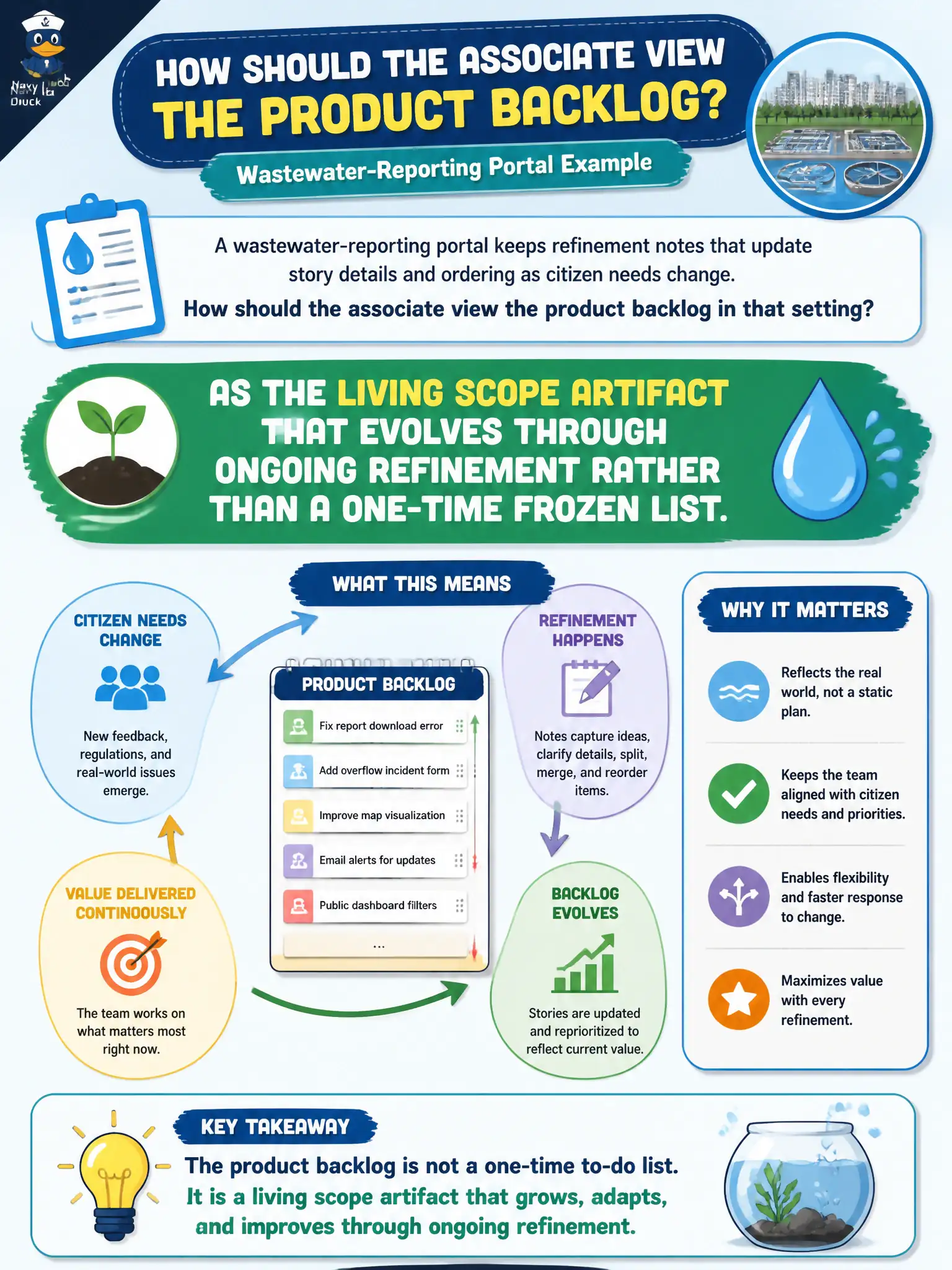
The backlog is a living grocery list, not a stone tablet from day one. Refinement notes keep items clear and ordered as reality shifts. Freeze it like a predictive WBS and you lose the adaptive advantage.
Full Explanation
On a wastewater-reporting portal, the product backlog should be viewed as the living scope artifact that evolves through ongoing refinement rather than a one-time frozen list. Refinement notes that update story details and ordering as citizen needs change are exactly how adaptive scope stays current. Treating the backlog as immutable predictive decomposition misunderstands its role in adaptive civic delivery.
Treating it as a predictive WBS dictionary that may never be reordered after kickoff fails conceptually because adaptive backlogs are expected to change order and detail as learning occurs. Treating it as a closed procurement file that only vendors can change fails because backlog ownership and refinement belong to the product function and team collaboration, not solely to vendors. Treating it as a substitute for increments so demos are unnecessary fails because the backlog lists work to do; increments and demos still prove outcomes to stakeholders.
Exam caveat: Product backlog equals a living ordered scope list under refinement—not an immutable WBS dictionary, vendor-only file, or replacement for demonstrated increments. Operational check: run regular refinement for the wastewater portal, update acceptance details from citizen and operator feedback, and reorder by value and risk before each planning event.