
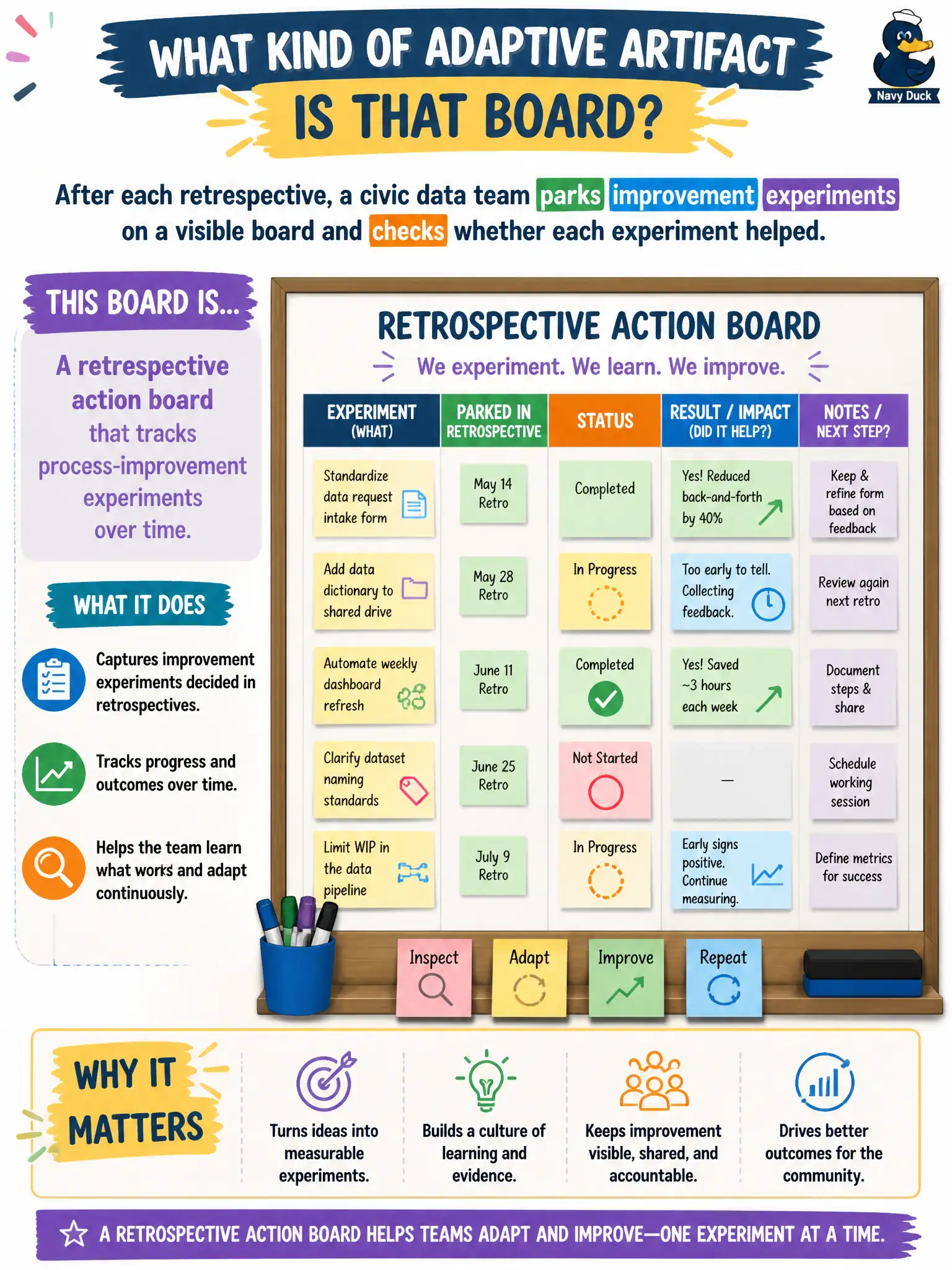
After each retrospective, a civic data team parks improvement experiments on a visible board and checks whether each experiment helped. What kind of adaptive artifact is that board?
Select an answer to reveal the explanation.
Short Explanation
Retros without follow-through are just venting sessions. An action board keeps the "try this next" experiments visible and checkable. That is process control, not a cost baseline or a power grid.
Full Explanation
After each retrospective, parking improvement experiments on a visible board and checking whether each experiment helped creates a retrospective action board—an adaptive artifact that tracks process-improvement experiments over time. Adaptive process control often includes making retrospective actions visible and reviewed so experiments are not forgotten between sprints. That differs from cost baselines, release burnup charts, or stakeholder identification grids.
A predictive cost baseline that freezes team working agreements forever fails conceptually because cost baselines control budget performance; they do not track improvement experiments, and freezing agreements forever fights continuous improvement. A release burnup chart that only measures feature scope remaining fails because burnup tracks scope progress toward a release, not retrospective experiment outcomes. A stakeholder power/interest grid used solely for initial identification fails because that grid supports stakeholder analysis, not ongoing process-improvement tracking.
Exam caveat: Match the artifact to the control purpose—retrospective actions versus cost baselines, burnup charts, or stakeholder grids. Operational check: after each civic data team retro, place experiments on the action board with owners and check-back dates, then keep or drop practices based on whether measured results helped delivery.