
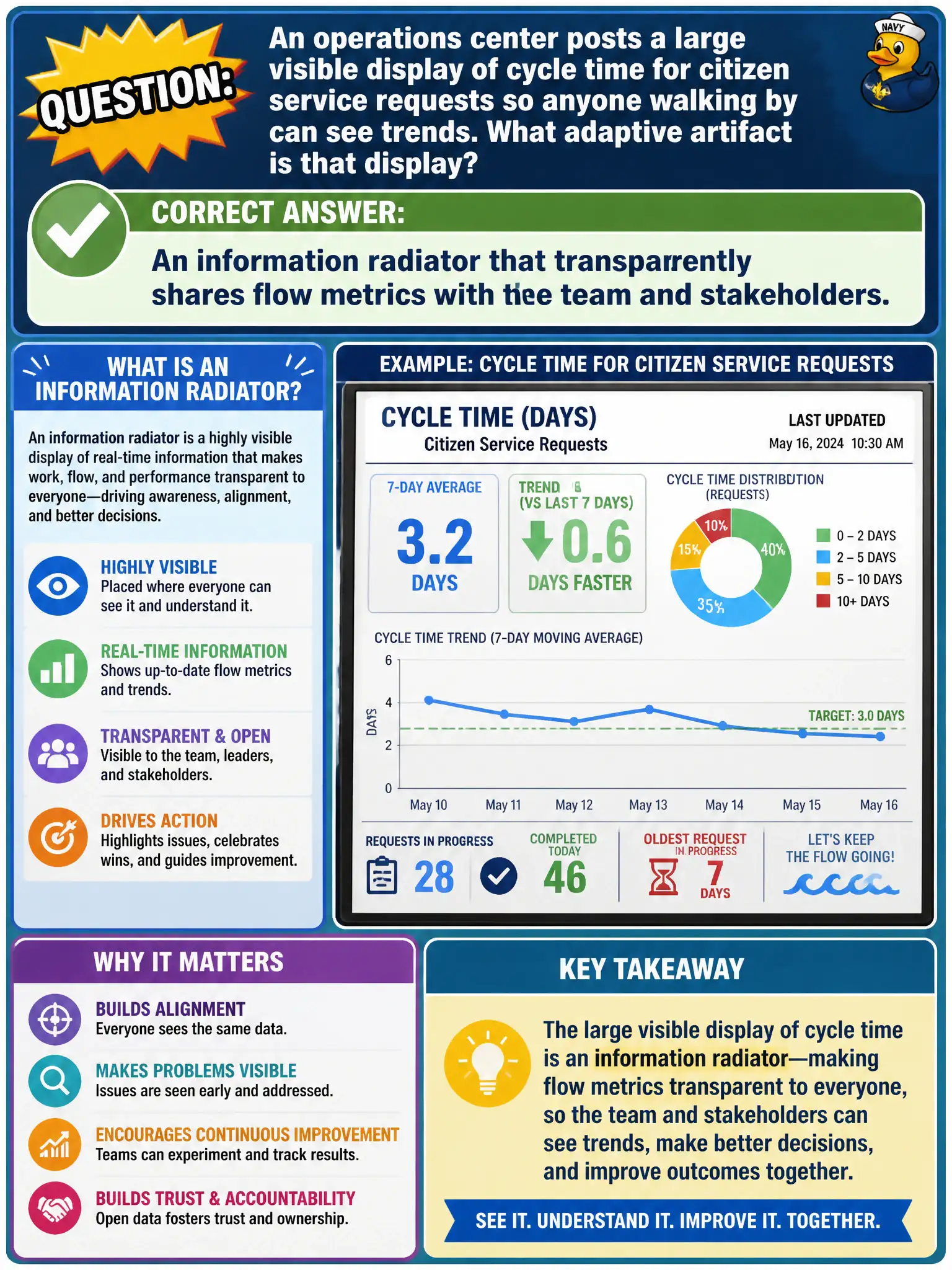
An operations center posts a large visible display of cycle time for citizen service requests so anyone walking by can see trends. What adaptive artifact is that display?
Select an answer to reveal the explanation.
Short Explanation
An information radiator is the big scoreboard on the wall—cycle time, flow, whatever matters—so nobody has to dig through a secret folder. Transparency is the feature. Hiding it in a vault misses the point.
Full Explanation
An operations center posting a large visible display of cycle time for citizen service requests is using an information radiator—a highly visible display of project or flow information that supports transparency in adaptive environments. Showing cycle time for citizen requests is a classic example so anyone walking by can see trends without digging through private files. Radiators make flow health communal knowledge for the civic team and visiting stakeholders.
A confidential risk register that must stay hidden from all non-sponsors fails conceptually because radiators are about broad visibility, whereas confidential registers restrict audience by design. A predictive procurement file that only contracting officers may view fails for the same reason: limited-audience procurement artifacts are not information radiators. A closed change-log vault that forbids any real-time metric visibility fails because it blocks the transparency radiators are meant to provide.
Exam caveat: Information radiators are defined by visible, shared status—not by confidential predictive files meant for limited audiences only. Operational check: keep the cycle-time radiator accurate and current in the operations center, pair it with WIP or throughput views if useful, and use visible trends to trigger flow improvements that shorten citizen wait times.