
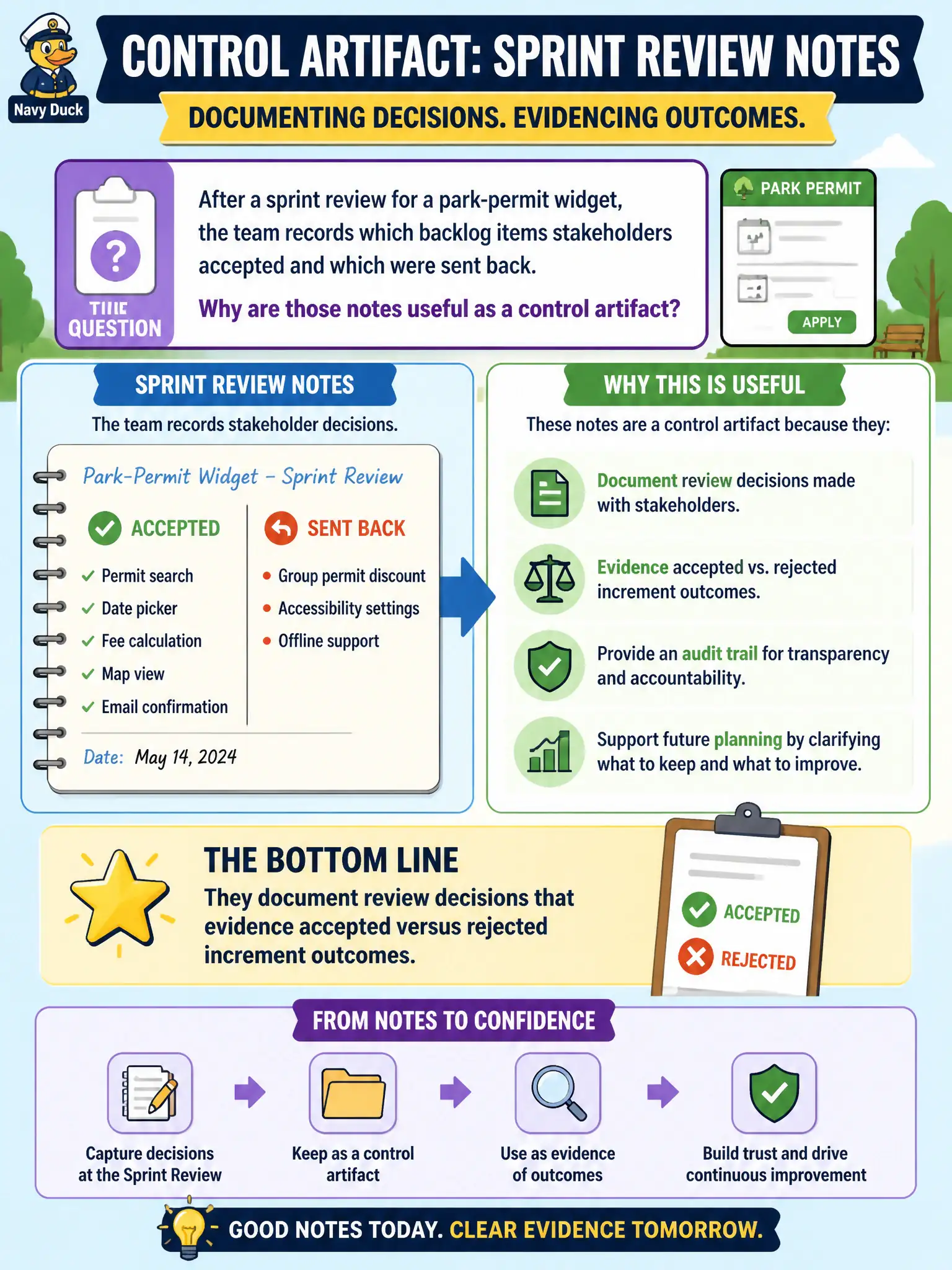
After a sprint review for a park-permit widget, the team records which backlog items stakeholders accepted and which were sent back. Why are those notes useful as a control artifact?
Select an answer to reveal the explanation.
Short Explanation
Review notes are the receipt after the demo—what landed, what bounced. That evidence keeps control honest when someone asks what stakeholders actually accepted. They do not erase history or retire the backlog.
Full Explanation
After a sprint review for a park-permit widget, recording which backlog items stakeholders accepted and which were sent back produces useful control evidence: review decisions that document accepted versus rejected increment outcomes. Those notes support transparency and follow-up refinement so rejected work returns with clearer criteria. They complement, rather than replace, the product backlog and are not merely an earned-value variance substitute for predictive control.
Permanently deleting rejected items from every historical record fails conceptually because control and learning require retaining what was rejected and why; erasure hides patterns. Replacing the product backlog so ordering is never revisited fails because review outcomes feed refinement; they do not abolish the backlog as the living scope list. Converting the review into a predictive earned-value variance report only fails because sprint review acceptance concerns increment outcomes and stakeholder feedback, not EV variance accounting as the sole purpose.
Exam caveat: Sprint review outcomes are adaptive control evidence of acceptance or rejection—keep them visible for refinement without treating them as EV reports or as backlog deletion events. Operational check: file acceptance and rejection notes after each park-permit review, update backlog items and acceptance criteria accordingly, and verify rejected work returns only when the agreed criteria are met.