
A business-licensing portal team works in an adaptive Scrum-style approach. Which set best represents common adaptive control artifacts they would use?
Select an answer to reveal the explanation.
Short Explanation
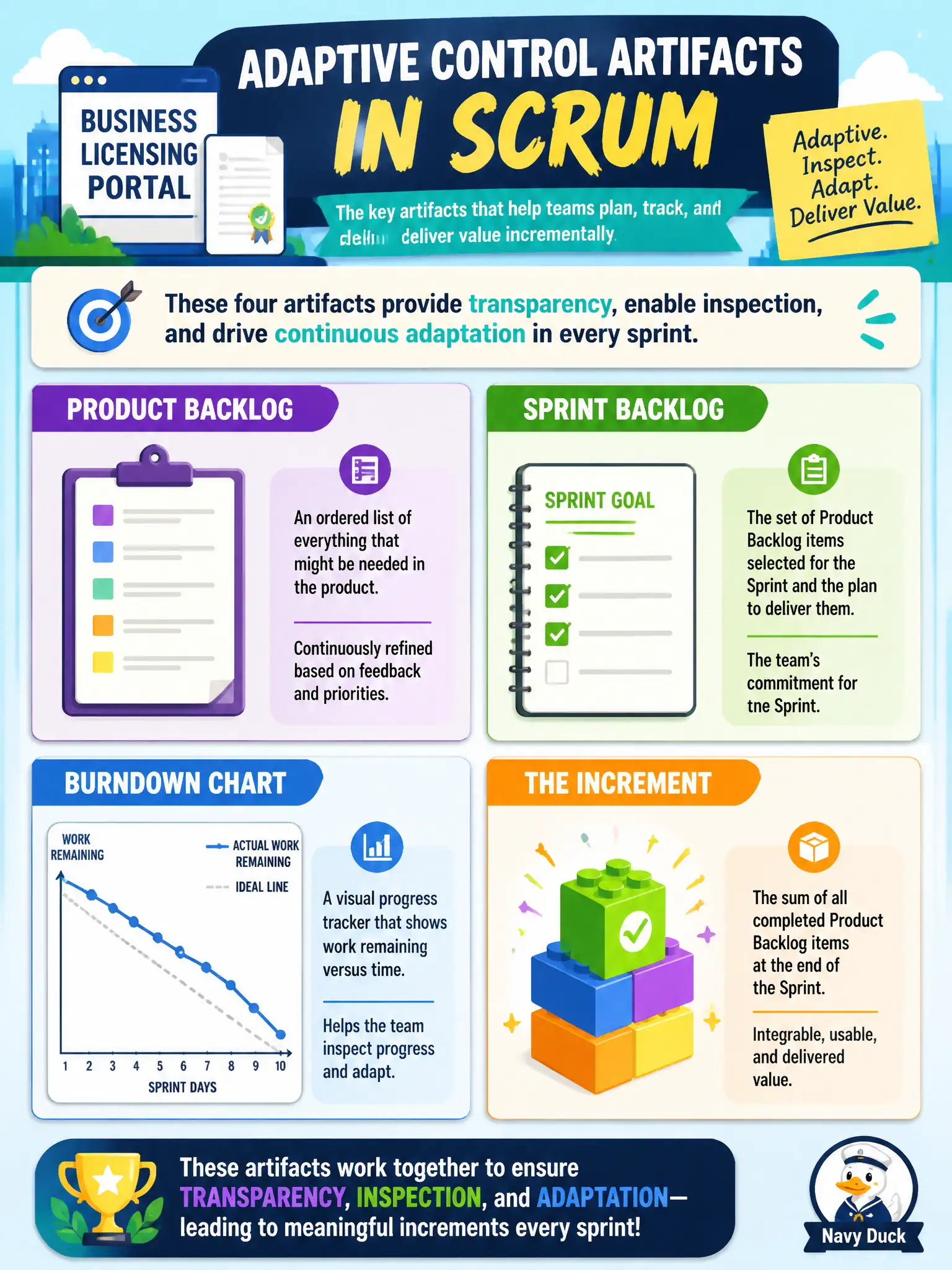
Adaptive teams keep a living backlog, a sprint-sized slice of work, a burn chart for pulse, and a real increment to show. That quartet is the usual toolkit—not a predictive cost baseline posing as the whole control system.
Full Explanation
A business-licensing portal team working in an adaptive Scrum-style approach commonly uses adaptive control artifacts such as the product backlog, sprint backlog, burndown chart, and the potentially releasable increment. That family supports ordering work, focusing the timebox, visualizing remaining work, and demonstrating outcomes. Predictive baselines and critical-path networks belong primarily to plan-based control and are not the primary adaptive set.
Using only a predictive cost baseline, change-control log, and critical-path network fails conceptually as the primary adaptive set because those are plan-based control artifacts. A closed annual charter with no backlog and no reviewed increments fails because it omits the living backlog and increment inspection adaptive control needs. Solely a procurement SOW that replaces all planning and review artifacts fails because a vendor SOW does not substitute for backlog, sprint focus, burndown, and increment review.
Exam caveat: CAPM Task 3 expects recognition of the agile artifact family at associate depth without denying that metrics still matter. Operational check: confirm the licensing portal maintains an ordered backlog, a sprint backlog, a visible burndown or equivalent, and a reviewable increment each cycle.