
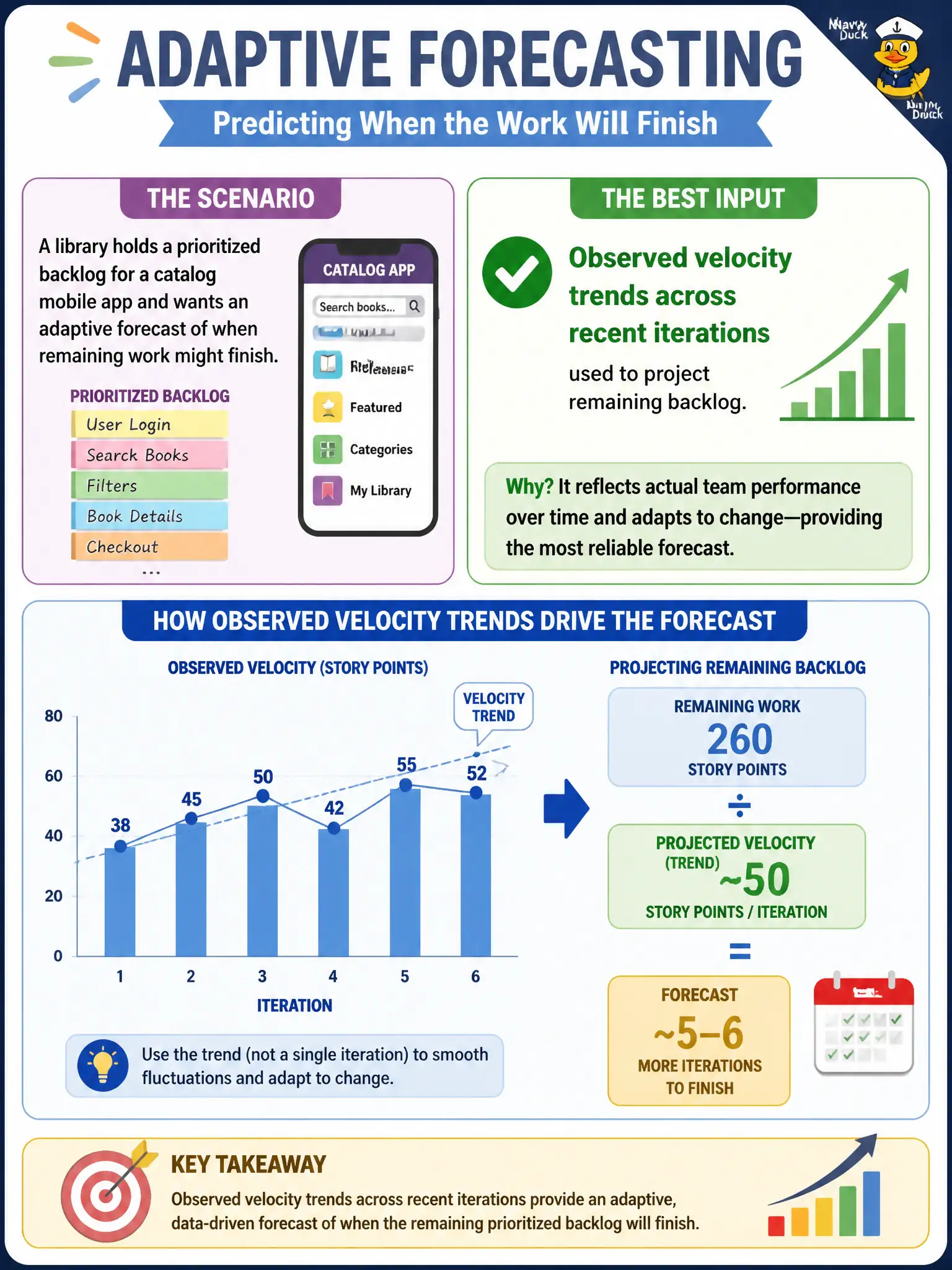
A library holds a prioritized backlog for a catalog mobile app and wants an adaptive forecast of when remaining work might finish. Which input best supports that forecast?
Select an answer to reveal the explanation.
Short Explanation
Velocity is like your average miles per tank—use recent trips to guess the rest of the road. Adaptive forecasting leans on that empirical trend, not only a frozen baseline. Target dates without throughput are just wishes.
Full Explanation
A library holding a prioritized backlog for a catalog mobile app and seeking an adaptive forecast of when remaining work might finish is best supported by observed velocity trends across recent iterations used to project remaining backlog. Adaptive forecasting commonly uses historical velocity or similar throughput trends as empirical input. A static predictive baseline without delivery data is a weaker primary input for iterative work.
Using a static predictive cost baseline alone with no empirical throughput data fails conceptually because cost baseline dollars do not by themselves forecast iteration throughput for remaining backlog. Deleting story points so forecasting relies only on executive target dates fails because dates without empirical capacity ignore how fast the team actually completes catalog work. A one-time Gantt chart never compared to completed increments fails because an unvalidated Gantt is not adaptive empirical forecasting.
Exam caveat: CAPM-level practice favors evidence-based trends over date mandates that ignore completed increments when forecasting adaptive work. Operational check: compute recent velocity for the catalog app, divide remaining backlog by that trend, present a forecast range to library leadership, and update the forecast each iteration.