
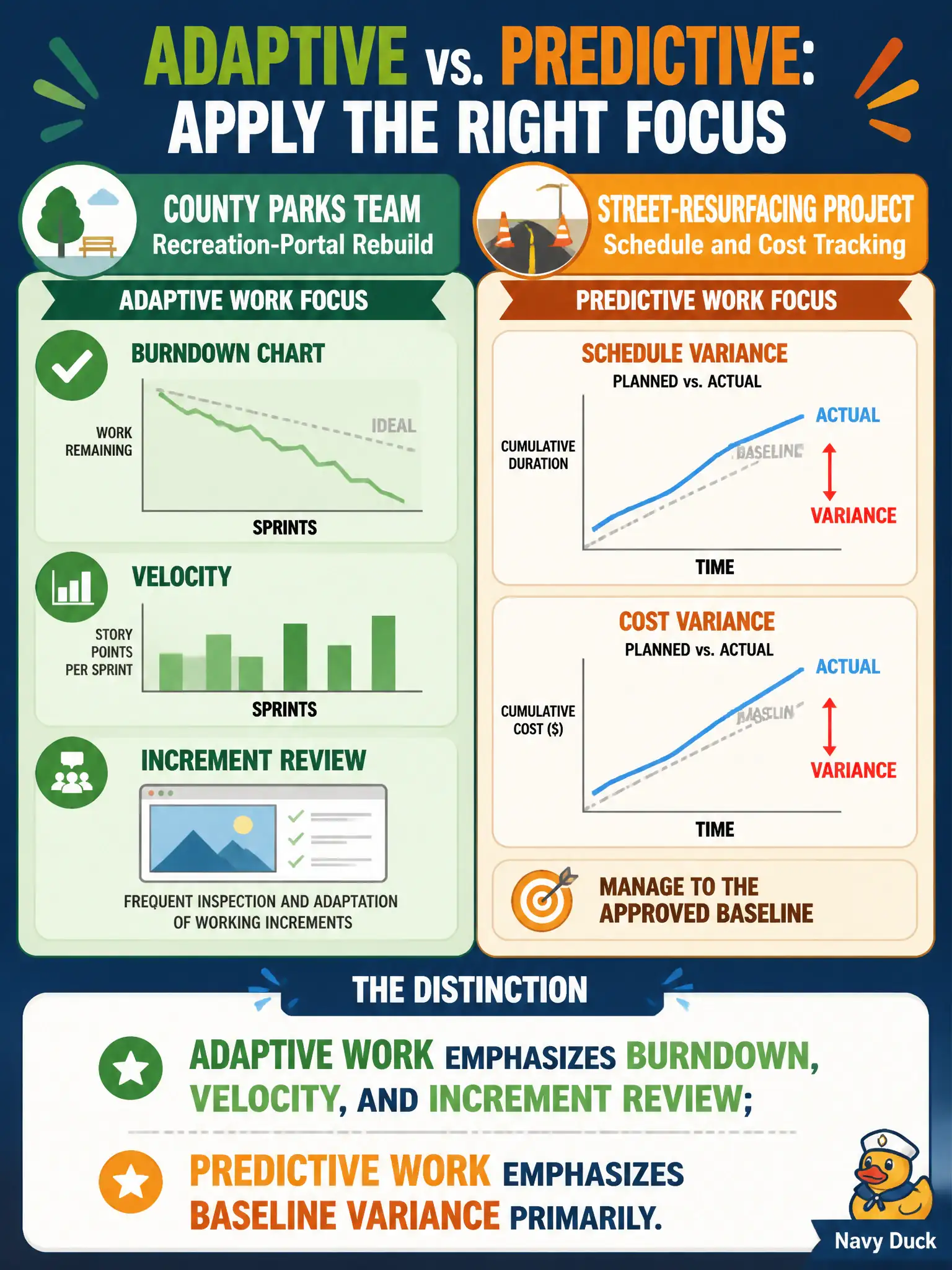
A county parks team tracks a recreation-portal rebuild with burndown charts, velocity, and increment reviews, while a parallel street-resurfacing project tracks schedule and cost variance against a fixed baseline. What distinction should the associate apply?
Select an answer to reveal the explanation.
Short Explanation
Think of adaptive work like checking the scoreboard every quarter of a game, not waiting for the final whistle. Burndown, velocity, and increment reviews give that frequent pulse, while a resurfacing baseline lives on planned-versus-actual variance. Mixing those signals upside down loses the whole point of how each approach learns.
Full Explanation
An associate comparing a county parks recreation-portal rebuild tracked with burndown, velocity, and increment reviews against a parallel street-resurfacing project tracked with schedule and cost variance against a fixed baseline should apply a life-cycle-matched distinction: adaptive work emphasizes burndown, velocity, and increment review, while predictive work emphasizes baseline variance primarily. Matching the tracking method to the approach is CAPM-level practice rather than forcing one primary control onto both civic efforts.
Saying both projects should ignore velocity and use only earned-value variance even on iterative software work fails conceptually because adaptive software commonly uses empirical iteration metrics as primary progress signals. Saying predictive resurfacing should replace baseline variance with story-point burndown as its primary control fails because paving packages are typically governed by predictive baselines, not story-point charts. Saying adaptive tracking means waiting until year-end before any progress signal is reviewed fails because adaptive methods require frequent inspection, not deferred annual-only review.
Exam caveat: Do not treat earned-value variance or burndown as universally primary; select the control family that fits predictive versus adaptive work. Operational check: keep portal progress on burndown/velocity/increment reviews and resurfacing on baseline variance dashboards, and explain the dual system clearly to sponsors who oversee both.