
A municipal recreation department rebuilds online class registration and chooses two-week iterations as its delivery cadence. What does that choice primarily represent?
Select an answer to reveal the explanation.
Short Explanation
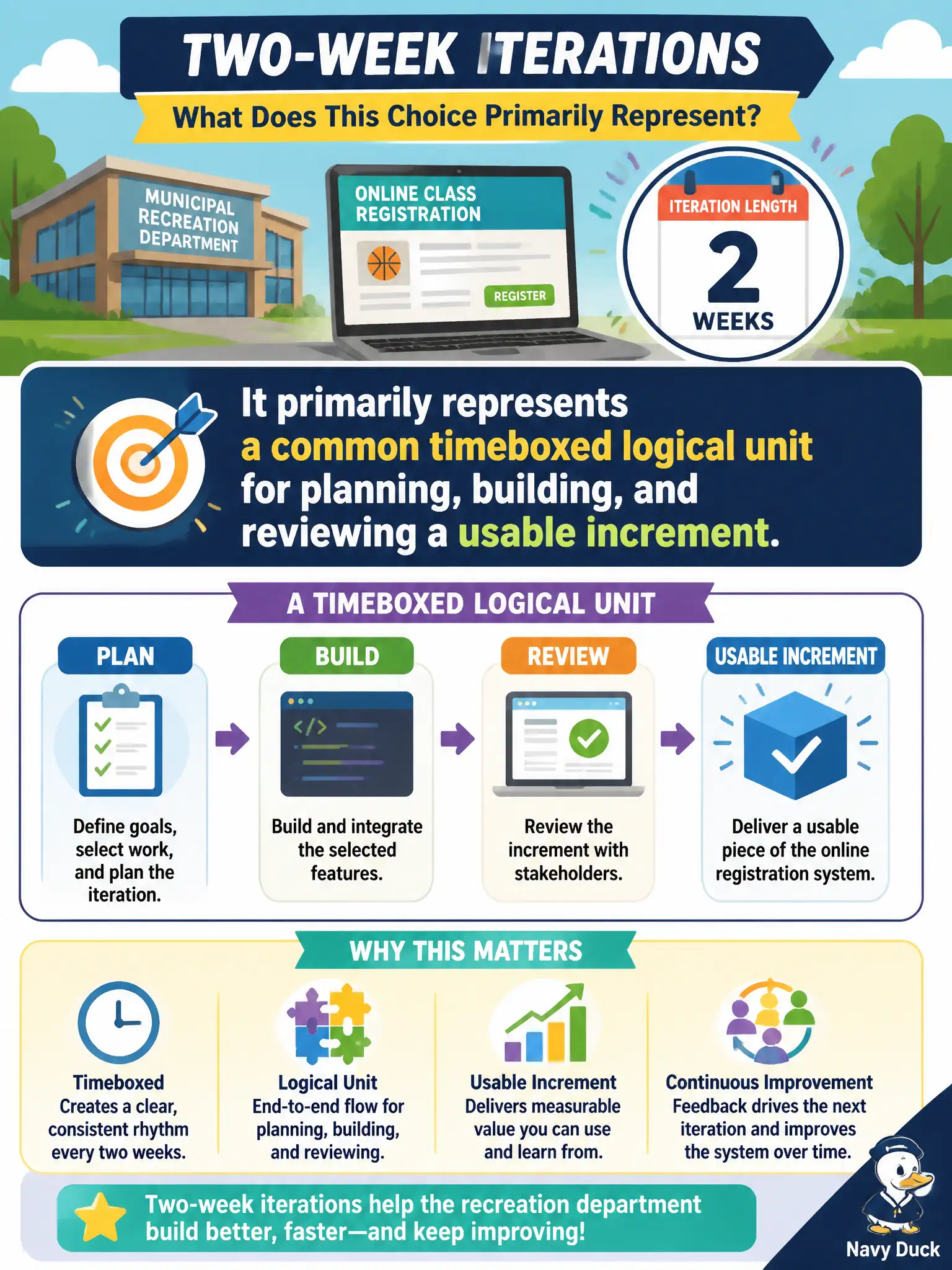
Picture two weeks like a fixed box on the calendar: plan what fits, build it, then show it. That timebox is the logical unit agile teams use so learning arrives on a steady rhythm. It is not a year-long freeze or a Kanban card count.
Full Explanation
Choosing two-week iterations for rebuilding municipal recreation class registration primarily represents a common timeboxed logical unit for planning, building, and reviewing a usable increment. Iterations create a repeating cadence that bounds commitment, enables inspection, and aims at potentially usable product each cycle. That is the core meaning of the delivery cadence choice at CAPM depth.
Treating the choice as a mandatory predictive phase gate that freezes all scope for twelve months fails conceptually because iterations are short adaptive timeboxes, not annual predictive freezes. Treating it as a Kanban WIP limit measured in cards rather than calendar days fails because WIP limits constrain item count in flow systems; iteration length is a timebox, a different logical unit. Treating it as a replacement for the product backlog so stories are never prioritized again fails because the backlog remains the living ordered list; the iteration only bounds what is pursued next.
Exam caveat: Distinguish iteration timeboxes from predictive phase gates and from Kanban WIP limits; they are related adaptive ideas but not interchangeable definitions. Operational check: run the registration rebuild in two-week cycles with planning, a clear goal, review of a usable increment, and backlog reordering afterward.