
A new adaptive team delivering a parks reservation app can browse a citywide library of prior retrospective outcomes and improvement experiments. What kind of asset is that library?
Select an answer to reveal the explanation.
Short Explanation
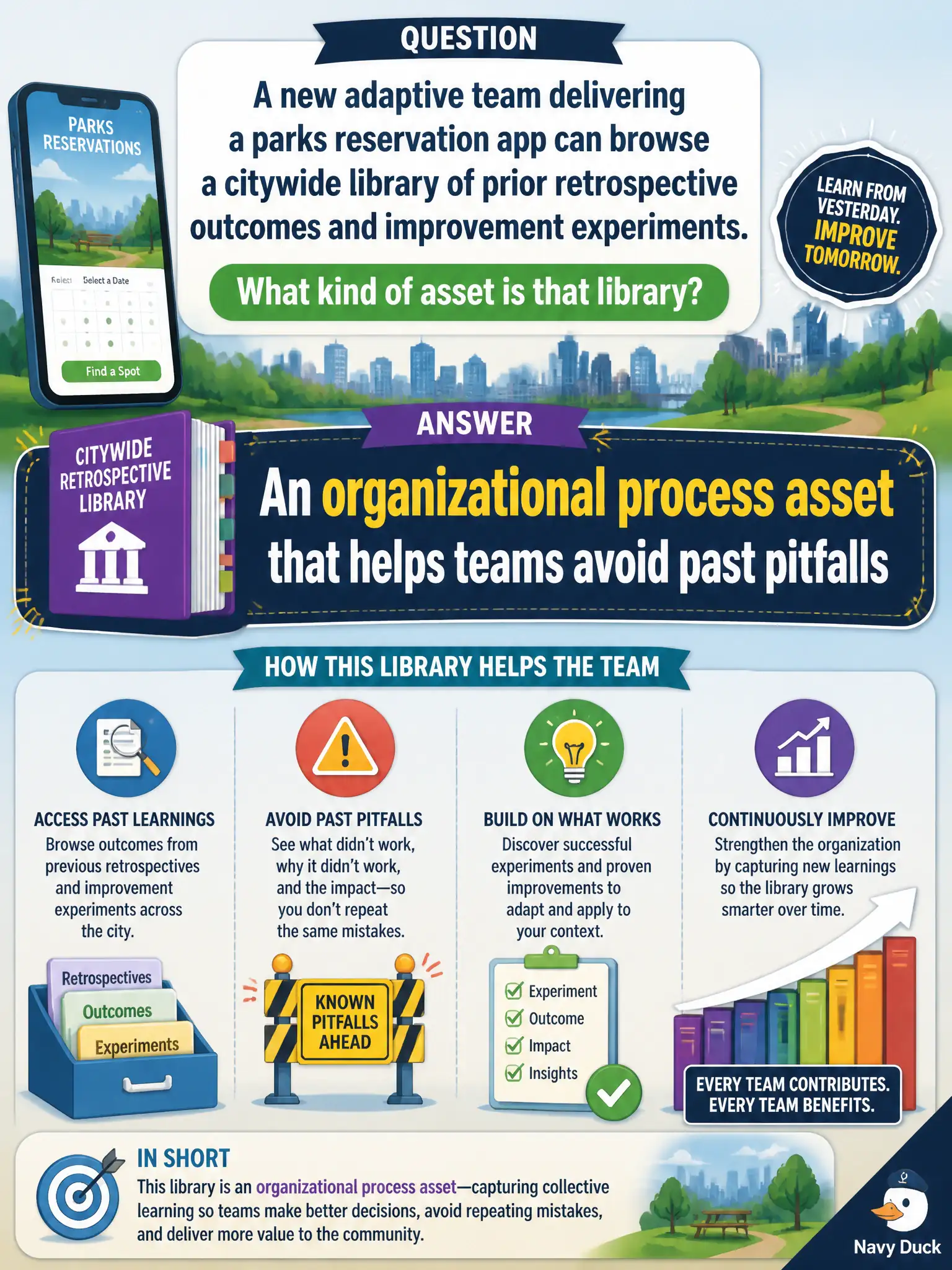
A retrospective library is institutional memory in a binder — an OPA that lets the parks app team skip reinventing last year's mistakes. It does not ban retros, replace the backlog, or act like a bid bond. Lean on it to start smarter.
Full Explanation
A citywide library of prior retrospective outcomes and improvement experiments available to a new adaptive team delivering a parks reservation app is an organizational process asset (OPA). Lessons-learned repositories and retrospective outcome libraries help teams avoid repeating known pitfalls and reuse proven experiments. That asset facilitates adaptive adoption by transferring institutional memory into the new product effort.
Calling the library an enterprise environmental factor that always forbids retrospectives fails conceptually because EEFs constrain or condition work; a lessons library does not ban retros and is classified as an OPA when it is reusable process knowledge. Calling it a procurement bid bond unrelated to team learning fails because bid bonds are commercial instruments, not learning assets. Calling it a schedule baseline that replaces the need for any backlog fails because a lessons library neither baselines schedule nor substitutes for the product backlog.
Exam caveat: Distinguish OPAs that help adaptive teams learn from EEFs and from unrelated procurement or baseline artifacts. Operational check: have the parks app team review the retrospective library during kickoff, select relevant experiments to try, and contribute new outcomes back so the civic OPA stays current.