
A civic digital-twin program includes a fixed sensor-network build and a citizen-facing UI that will learn from monthly public demos. How should the team compare approaches across those workstreams?
Select an answer to reveal the explanation.
Short Explanation
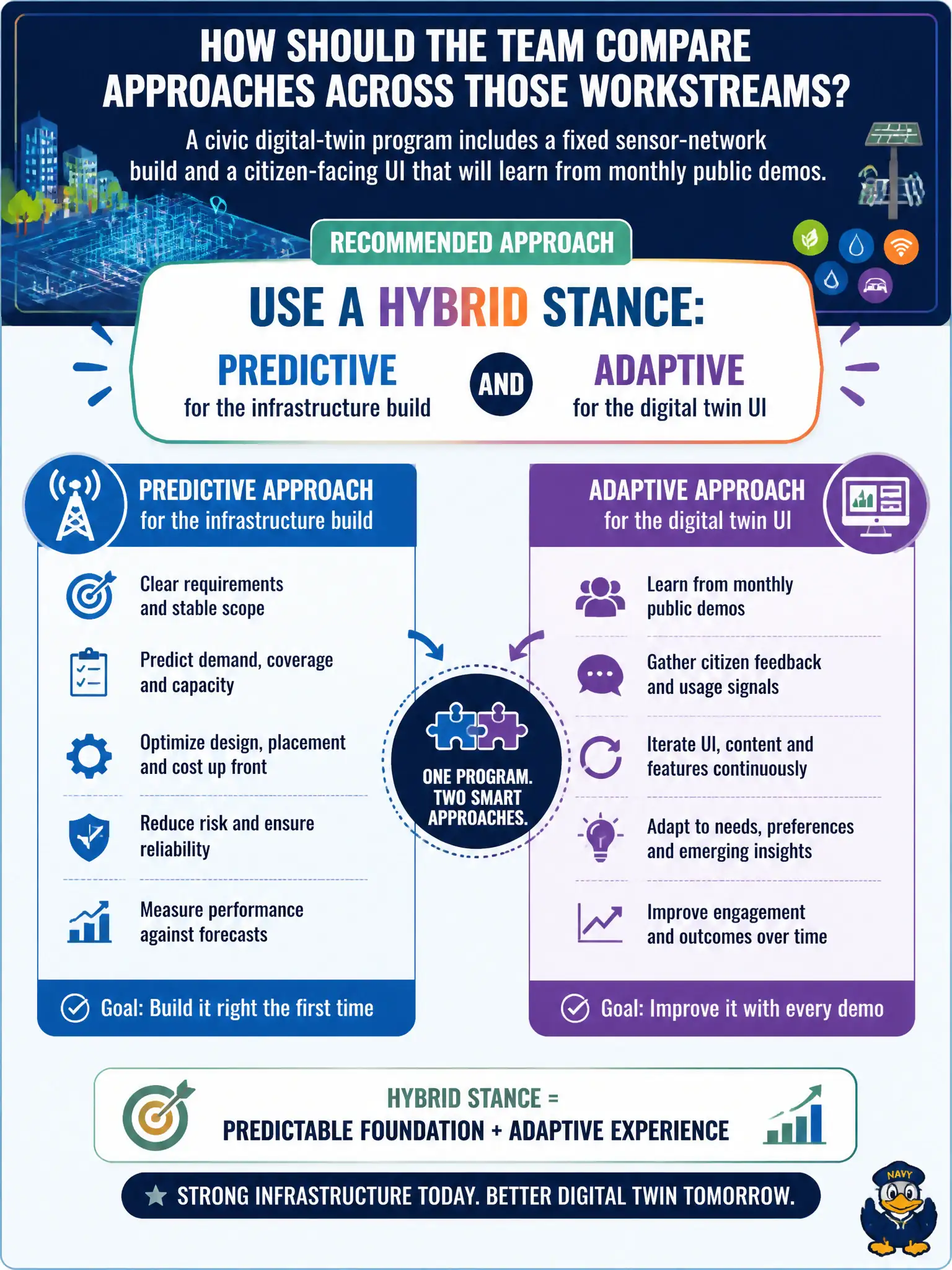
Different lanes can use different driving rules: lay the sensor network like a planned road, and keep tuning the digital twin UI like a product that learns from demos. Hybrid thinking matches the work. One blunt approach for both lanes fights either physics or feedback.
Full Explanation
A civic digital-twin program that includes a fixed sensor-network build and a citizen-facing UI that will learn from monthly public demos is best compared with a hybrid stance: predictive methods for the infrastructure build and adaptive methods for the digital twin UI. Workstream characteristics differ—stable specification-heavy sensors versus high-feedback interface learning—so matching approach to each stream is sound program thinking rather than forcing one life cycle onto both.
Forcing both workstreams into one frozen predictive baseline with no UI learning fails conceptually because it discards valuable demo feedback for the citizen-facing layer. Forcing both into pure adaptive mid-install changes to physical sensors fails because physical sensor installs often lack safe mid-install learning value and need predictive control. Cancelling comparison and picking approaches by coin flip each morning fails because suitability should follow work characteristics, not randomness.
Exam caveat: CAPM hybrid awareness means selecting predictive and adaptive elements by context, not declaring one method mandatory for an entire multi-faceted civic program. Operational check: baseline the sensor network predictively, run the UI through iterative demos and backlog refinement, and keep integration points explicit so hybrid governance remains coherent.