
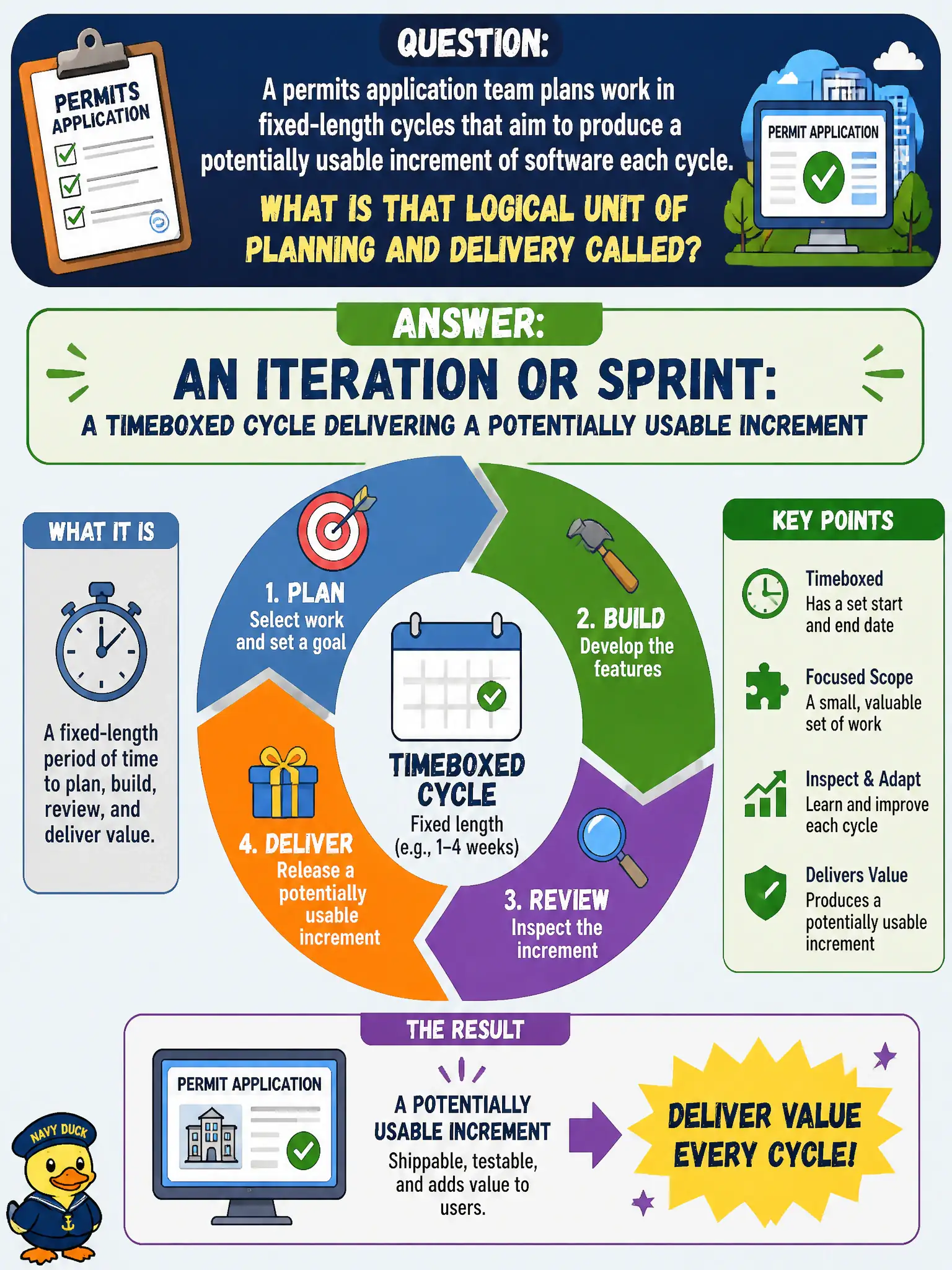
A permits application team plans work in fixed-length cycles that aim to produce a potentially usable increment of software each cycle. What is that logical unit of planning and delivery called?
Select an answer to reveal the explanation.
Short Explanation
An iteration — often called a sprint — is a kitchen timer for delivery: when it rings, you should have something potentially usable for the permits app, not just busywork. Operations shifts and year-long mushy phases are different animals. Timebox plus increment is the idea.
Full Explanation
When a permits application team plans work in fixed-length cycles that aim to produce a potentially usable increment of software each cycle, that logical unit of planning and delivery is an iteration or sprint: a timeboxed cycle for planning, building, and reviewing a potentially usable increment. The timebox structures capacity, goals, and inspection cadence for adaptive civic software delivery rather than unbounded busywork.
A permanent operations shift with no delivery goal fails conceptually because operations work without an increment goal is not the same construct as an iteration aimed at usable product. A multi-year predictive phase gate with no incremental release intent fails because phase gates lock long horizons without the iteration's incremental delivery purpose. A single unstructured year with no timebox and no increment fails because it lacks both the timebox and the potentially usable increment that define the iteration concept.
Exam caveat: CAPM Task-level adaptive vocabulary treats iteration/sprint as the timeboxed delivery unit producing an increment—not as operations, annual phases, or unstructured years. Operational check: set a clear iteration goal for the permits app, define Done for the increment, review the increment at timebox end, and adjust the backlog based on what was learned.