
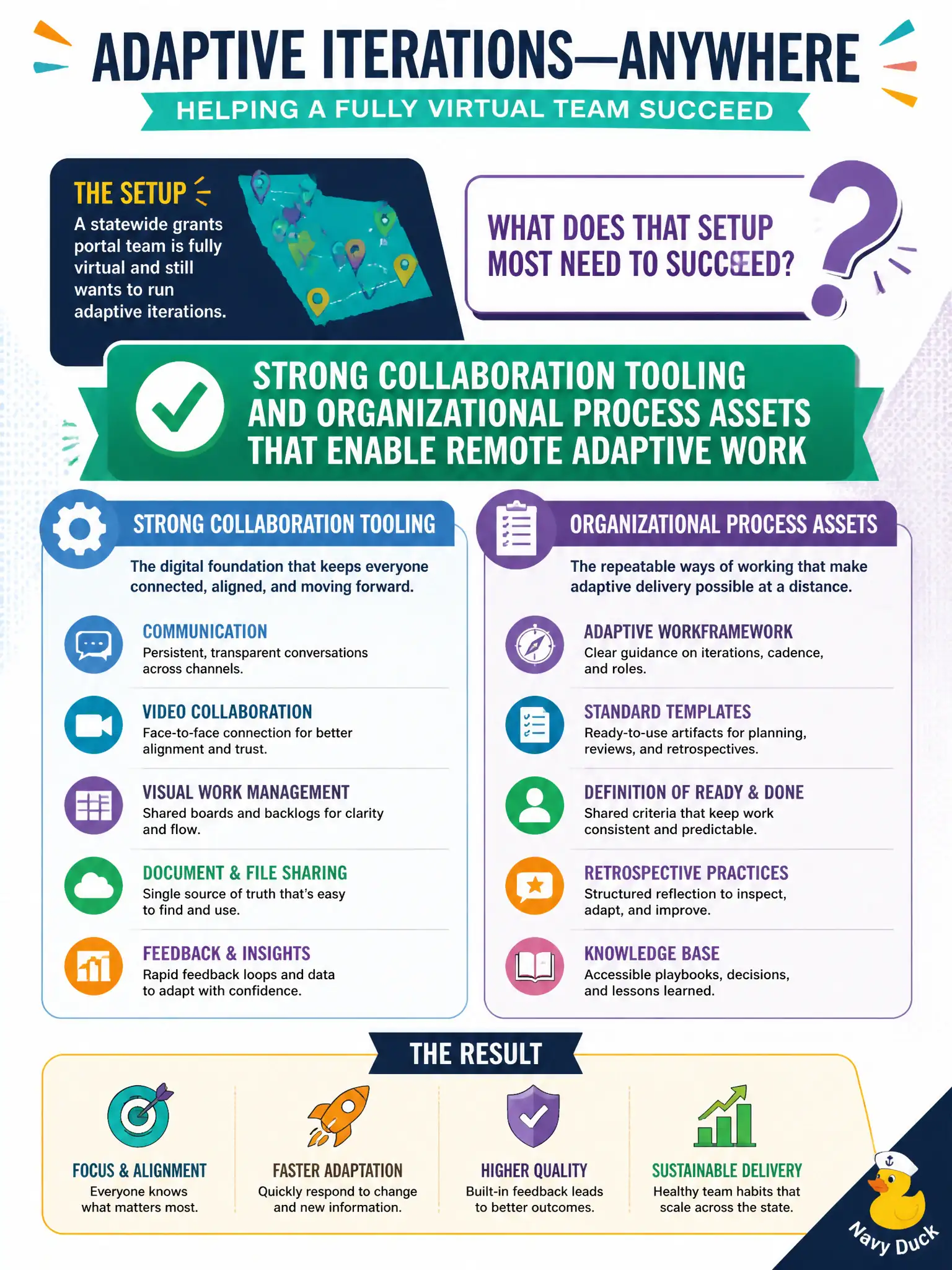
A statewide grants portal team is fully virtual and still wants to run adaptive iterations. What does that setup most need to succeed?
Select an answer to reveal the explanation.
Short Explanation
A virtual adaptive team is like a band rehearsing on video — it works if the mics, shared charts, and playbooks are solid. Tooling and helpful process assets carry the grants portal crew; banning collaboration tools does the opposite. Adaptive still needs goals and done criteria.
Full Explanation
A fully virtual statewide grants portal team that still wants adaptive iterations most needs strong collaboration tooling and organizational process assets that enable remote adaptive work—shared boards, video collaboration, backlog transparency, quality agreements such as a Definition of Done, and playbooks that make ceremonies effective at a distance. Virtual adaptive delivery can succeed when those enablers substitute for physical colocation without abandoning iterative goals.
A rule that bans video calls, boards, and shared backlogs fails conceptually because it removes the very transparency and collaboration channels remote adaptive teams require. A predictive-only concrete pour calendar with no digital collaboration fails by imposing an unsuitable physical-construction control metaphor and omitting adaptive tooling. Removal of all Definition of Done and iteration goals fails because quality agreements and iteration intent remain necessary; virtual status does not justify abandoning them.
Exam caveat: Associates should treat remote adaptive success as an enablement problem (tools and OPAs), not as proof that adaptive methods cannot work virtually. Operational check: for the grants portal, confirm the board, backlog, DoD, and ceremony tooling are live and used every iteration; remove bans on collaboration platforms; and review whether remote impediments are tracked until resolved.