
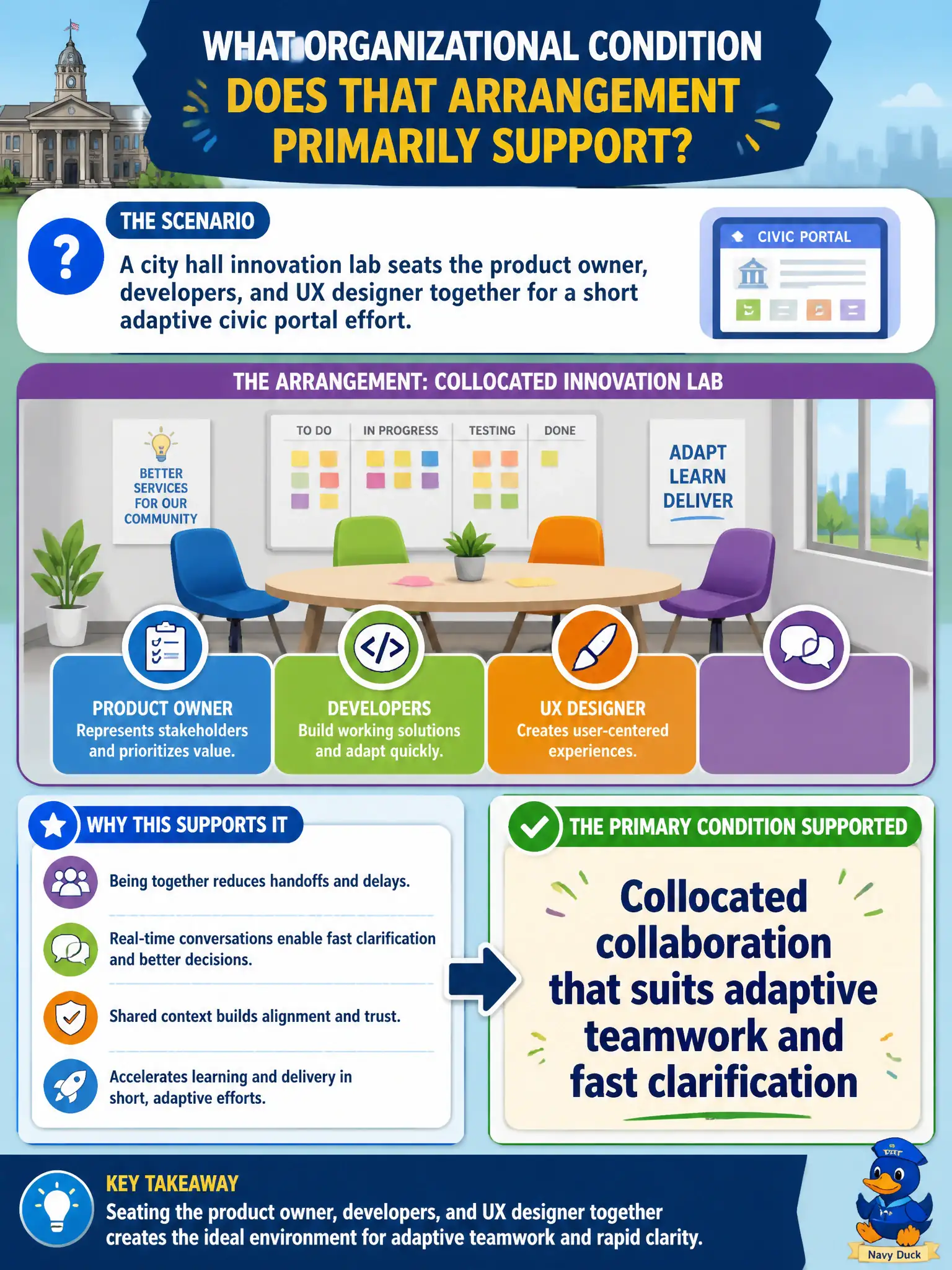
A city hall innovation lab seats the product owner, developers, and UX designer together for a short adaptive civic portal effort. What organizational condition does that arrangement primarily support?
Select an answer to reveal the explanation.
Short Explanation
Putting the portal crew in one lab is like cooking in the same kitchen — questions get answered in minutes, not after a week of memos. That colocation supports adaptive collaboration. Isolating the product owner or relying only on annual paper works against the approach.
Full Explanation
Seating the product owner, developers, and UX designer together in a city hall innovation lab for a short adaptive civic portal effort primarily supports colocated collaboration that suits adaptive teamwork and fast clarification. Colocation shortens feedback loops, enables rapid requirement clarification, and reinforces the face-to-face (or near-face-to-face) collaboration adaptive teams rely on. Organizational setup that enables those loops is a suitability enabler for adaptive civic delivery.
Isolating the product owner from all feedback forever fails conceptually because it destroys the clarification and decision access adaptive teams need. Replacing collaboration with only annual paper memos fails because slow memo cycles undermine inspection-and-adaptation tempo. Claiming the arrangement makes adaptive delivery impossible by design fails because colocation is generally a facilitating condition, not a barrier.
Exam caveat: CAPM suitability topics include organizational conditions such as colocation that enable or hinder adaptive approaches; do not confuse enablers with impediments. Operational check: keep the civic portal squad's colocation (or high-fidelity virtual equivalent) intact for planning, refinement, and review; measure whether clarification time drops compared with memo-only cycles; and protect product-owner access during the lab period.