
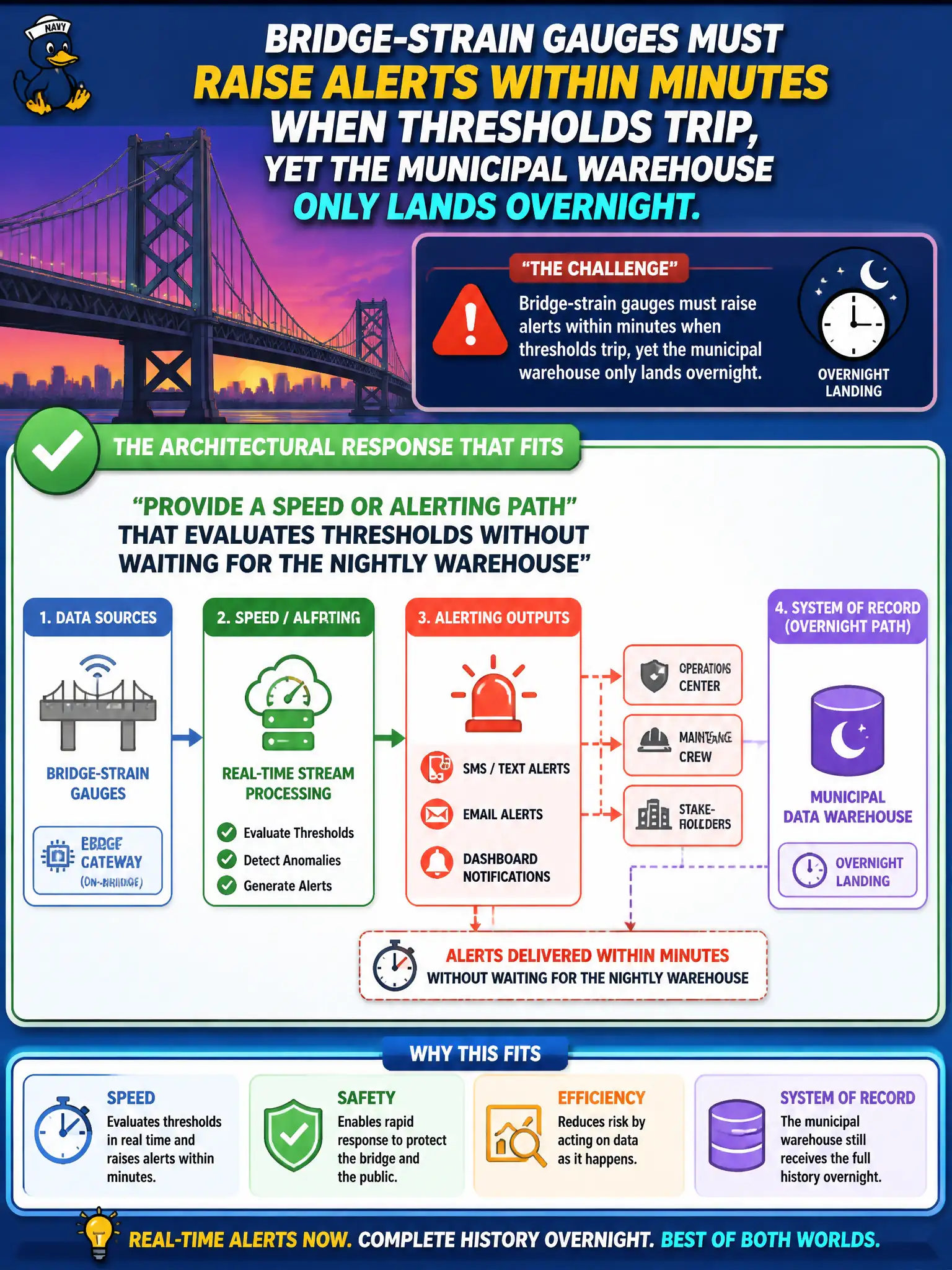
Bridge-strain gauges must raise alerts within minutes when thresholds trip, yet the municipal warehouse only lands overnight. What architectural response fits?
Select an answer to reveal the explanation.
Short Explanation
If the bridge is stressing now, waiting for tonight’s warehouse is too late. Give alerts a fast lane that does not sit behind the nightly truck.
Full Explanation
Bridge-strain gauges that must alert within minutes cannot wait for a municipal warehouse that lands overnight. The architectural response is a speed or alerting path—streaming rules, complex event processing, or near-real-time serving—that evaluates thresholds independently of the nightly warehouse cycle while still allowing warehouse history for later engineering analysis. Public-safety latency and analytical batch cadence must coexist on one civic platform story. Disabling gauges until the warehouse team expands nightly windows abandons safety for batch convenience. Printing strain readings weekly into facilities paper records provides no minute-scale alerting and weak chain of custody for incidents. Requiring every alert to be approved in a monthly architecture board meeting first guarantees the alert arrives after the risk window has passed. Exam caveat: lambda- or kappa-style thinking matters on the exam—batch warehouses do not replace operational alerting paths. Operational check: document dual paths for strain data (fast threshold service plus overnight warehouse load), measure end-to-end alert latency against EOC requirements, and verify that warehouse delay never gates the paging path during a bridge-stress drill.