
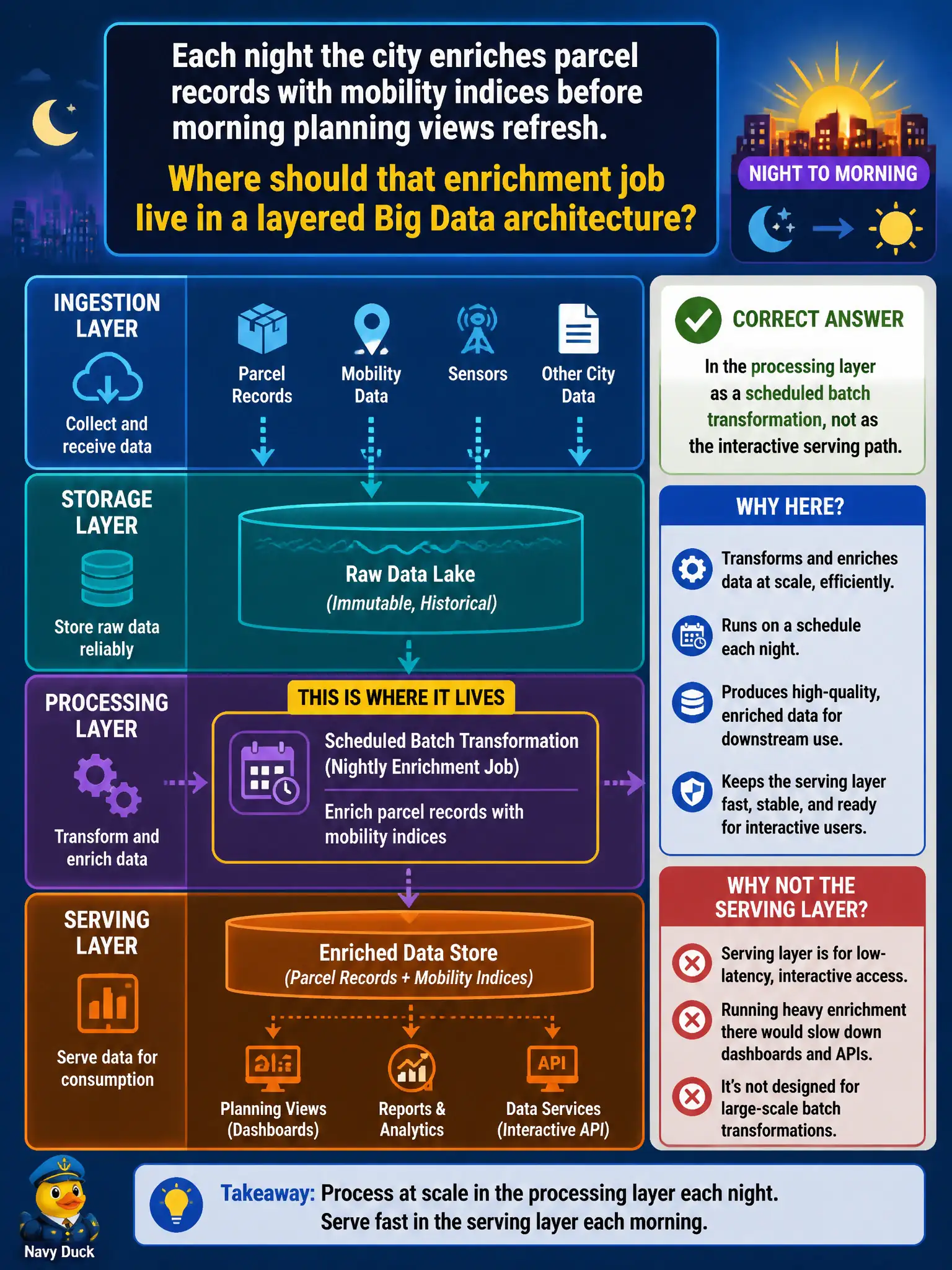
Each night the city enriches parcel records with mobility indices before morning planning views refresh. Where should that enrichment job live in a layered Big Data architecture?
Select an answer to reveal the explanation.
Short Explanation
Nightly parcel enrichment is kitchen prep, not table service. Keep the heavy batch work in processing and let serving just dish up the ready results.
Full Explanation
Nightly enrichment of parcel records with mobility indices is a scheduled batch transformation that belongs in the processing layer of a layered Big Data architecture. Processing prepares analytical products; interactive serving then exposes morning planning views without embedding heavy joins inside UI click paths. Keeping enrichment in processing preserves repeatability, observability, and clean separation from clerk-facing consoles. Running enrichment only inside the dispatcher console’s real-time UI click handlers would stall operations and couple batch logic to interactive latency budgets. Performing it solely on citizens’ phones as client-side spreadsheet formulas cannot produce authoritative citywide planning inputs or auditable lineage. Manual copy-paste into a council agenda Word template is neither scalable nor acceptable as architecture for recurring municipal enrichment. Exam caveat: batch processing is not serving; candidates often misplace enrichment in the UI or assume the lake alone transforms data without a processing stage. Operational check: schedule the parcel–mobility job in the processing orchestration tool, land outputs in curated tables or serving marts before morning refresh, alert on failure before briefings, and keep dispatch UI read-only against enriched products rather than recomputing them per click.