
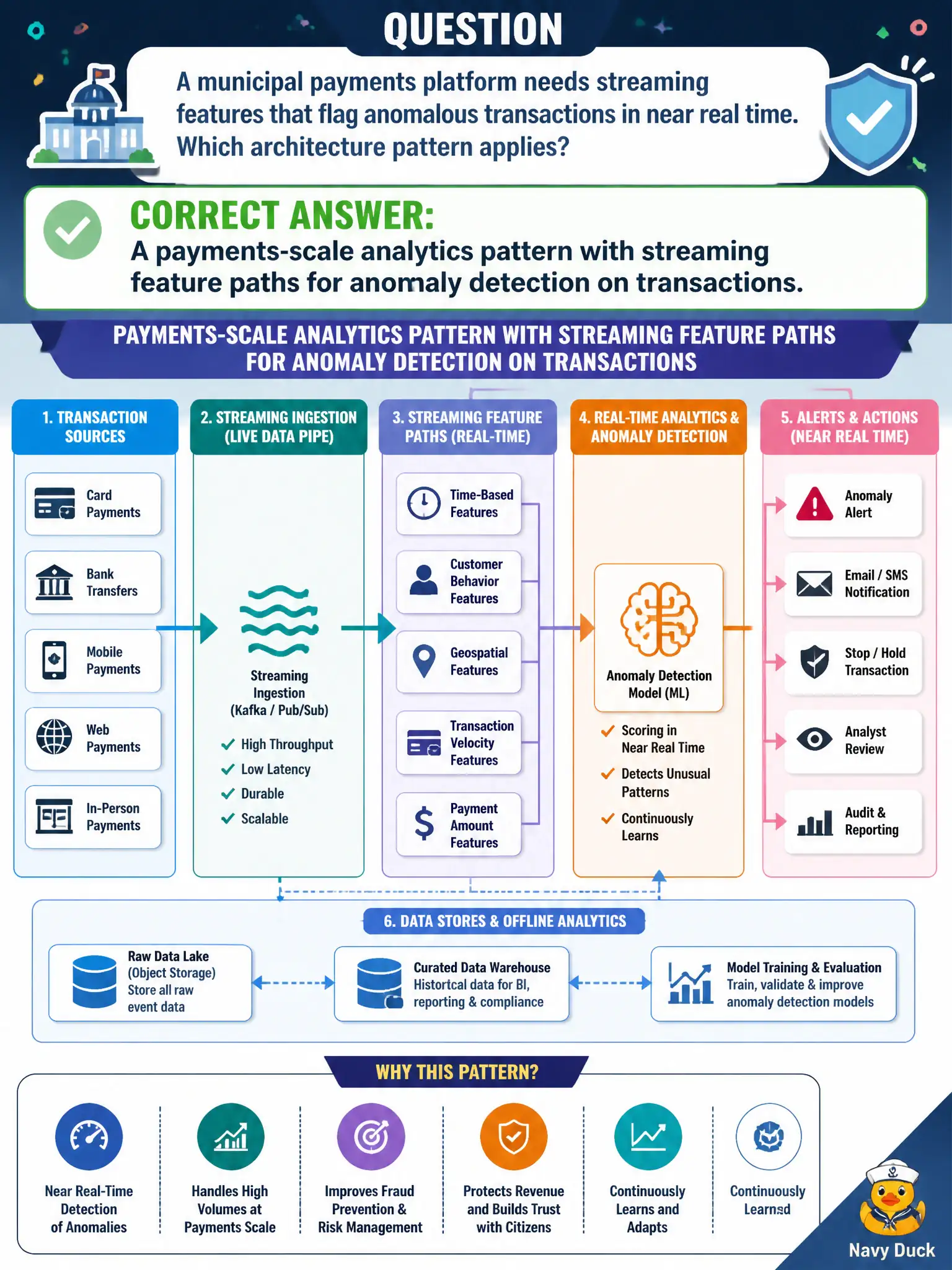
A municipal payments platform needs streaming features that flag anomalous transactions in near real time. Which architecture pattern applies?
Select an answer to reveal the explanation.
Short Explanation
Funny-looking payments need a streaming radar, not next year’s PDF. The pattern is payments-scale analytics with live features watching the transaction flow.
Full Explanation
Payments and fraud-oriented reference architectures combine high-volume transaction ingest with streaming feature computation and alerting. Municipal payment platforms reuse that pattern for anomaly flags without becoming a specialty fraud-vendor exam. Architecture should provision streaming paths beside durable ledgers so civic payment risk is visible in near real time.
A static annual PDF of totals with no streaming features fails by concept: annual PDFs miss near-real-time anomalies. A graph-only résumé matcher with no payment events fails by concept: wrong domain. A media recommender that ranks concert videos instead of payment risk fails by concept: entertainment ranking is not transaction risk.
Exam caveat: Payments-scale analytics with streaming feature paths for anomaly detection—not annual PDFs, résumé graphs, or media recommenders.
Operational check: Stream payment events into feature jobs, alert on anomalies within the agreed latency, keep durable ledgers for audit, and tune false positives with finance owners. Document residual risk for civic operators and revisit after the next production change window. Confirm owners, SLAs, and rollback criteria in the runbook before go-live.