
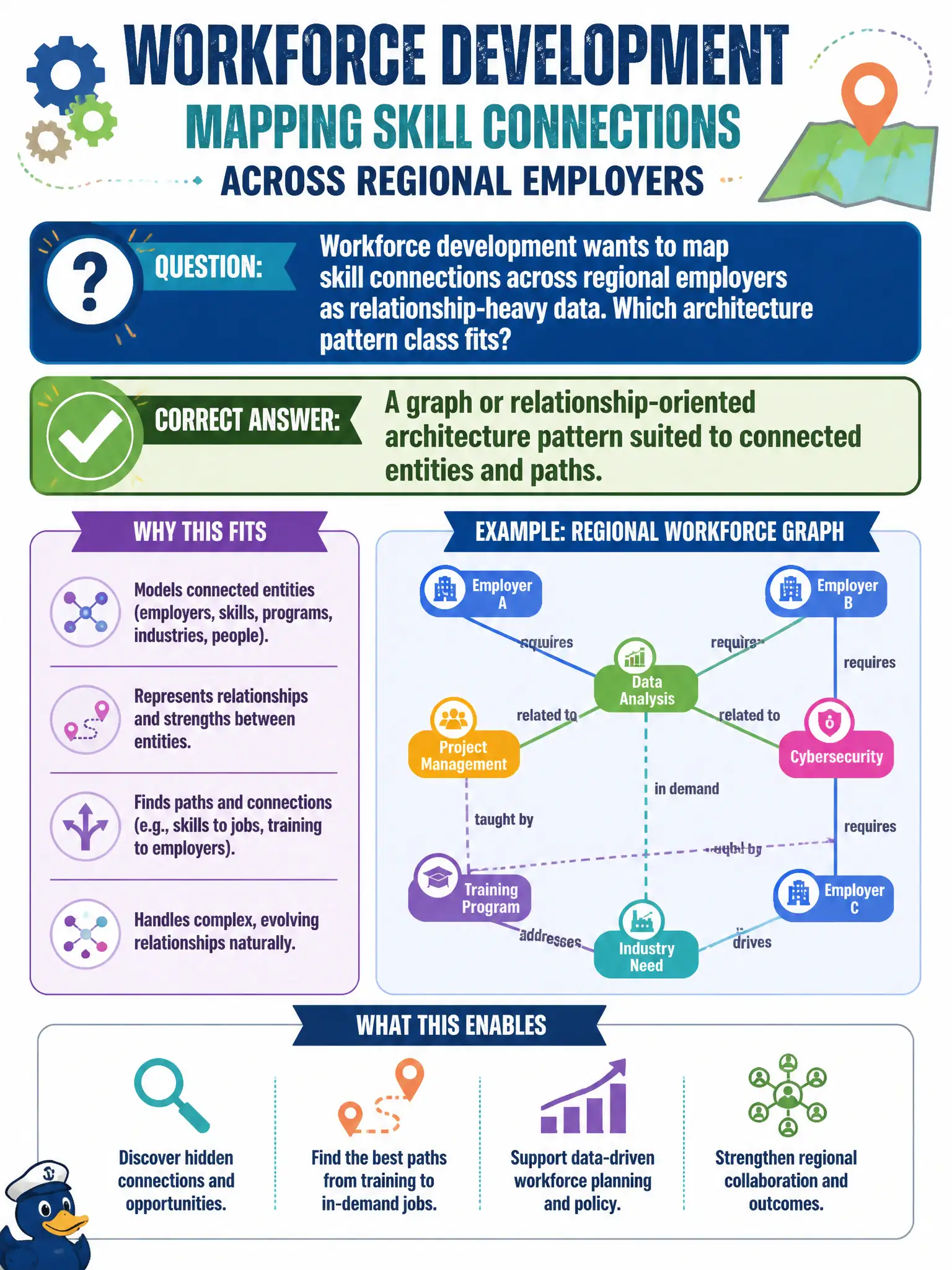
Workforce development wants to map skill connections across regional employers as relationship-heavy data. Which architecture pattern class fits?
Select an answer to reveal the explanation.
Short Explanation
Skills linked to employers is a web of dots and lines, not a thermometer log. Reach for a graph-style pattern when the questions are about connections and paths.
Full Explanation
Social-graph and professional-network reference patterns optimize for entities and relationships rather than flat time series or media blobs. Workforce skill maps across regional employers fit that relationship-heavy class. Choosing graph-aware storage and traversal services aligns architecture with the analytical questions civic workforce programs ask.
A pure sensor weather stack that only stores temperature time series fails by concept: wrong pattern family. A video encode pipeline that only stores council meeting bitrates fails by concept: media pipelines are not skill graphs. A payments anomaly stream that only flags card declines fails by concept: different event analytics class.
Exam caveat: Use graph/relationship-oriented architecture for connected skills and employers—not weather time series, video encode, or payments anomaly patterns.
Operational check: Model employers and skills as nodes/edges, pick a graph or relationship store, and run a path query that answers a workforce program question before expanding the dataset. Document residual risk for civic operators and revisit after the next production change window. Confirm owners, SLAs, and rollback criteria in the runbook before go-live.