
On a hospital interior renovation, a portable diesel air compressor is parked inside a concrete corridor right next to four plumbers threading pipe, forcing workers to shout at arm's length. What is the supervisor's best first health control?
Select an answer to reveal the explanation.
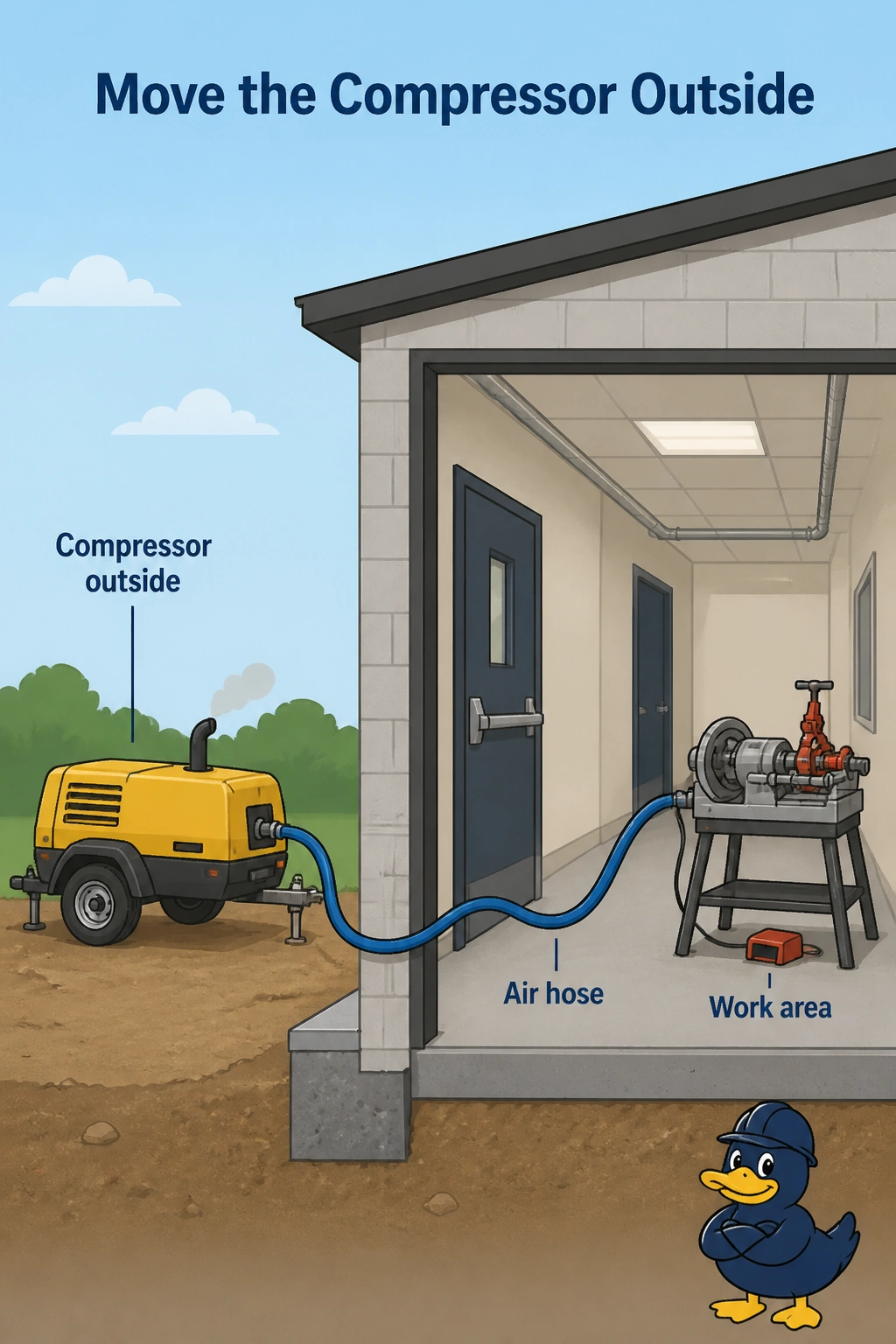
Short Explanation
Putting earplugs on a crew standing beside a roaring diesel engine is like bringing an umbrella indoors instead of fixing the roof leak. The trap is jumping straight to personal protective equipment when you can eliminate the noise at the source by moving the machine outside.
Full Explanation
Under the hierarchy of controls and 29 CFR 1926.52, engineering and source controls come before personal protective equipment, so the supervisor should "Relocate the compressor outside the building and run air hoses into the work area" first. Moving the engine outdoors removes both high noise levels and diesel exhaust from the enclosed corridor. Choosing to "Instruct the plumbers to insert foam earplugs more deeply and continue threading pipe beside the unit" relies on the weakest control tier and leaves the underlying hazard active. Choosing to "Issue high-attenuation earmuffs over the earplugs without moving the compressor from the corridor" still places workers in an unnecessarily loud environment where communication alarms are harder to hear. Choosing to "Schedule the plumbers to take turns working beside the running compressor in two-hour shifts" uses administrative rotation to spread exposure rather than eliminating a readily movable noise source. One caveat is that pneumatic threading tools themselves can still generate hazardous noise, so hearing protection may remain necessary for tool operators. After relocating the unit, check corridor noise levels with a sound meter or confirm workers can converse normally at arm's length.
Prefer to study offline? Printable PDF study book + test engine ($7.50, unofficial). These questions stay free here.