
While moving palletized brick across an uneven commercial site, a telehandler operator raises the loaded forks six feet above the ground to see better while turning onto a sloped ramp. What must the foreman order immediately?
Select an answer to reveal the explanation.
Short Explanation
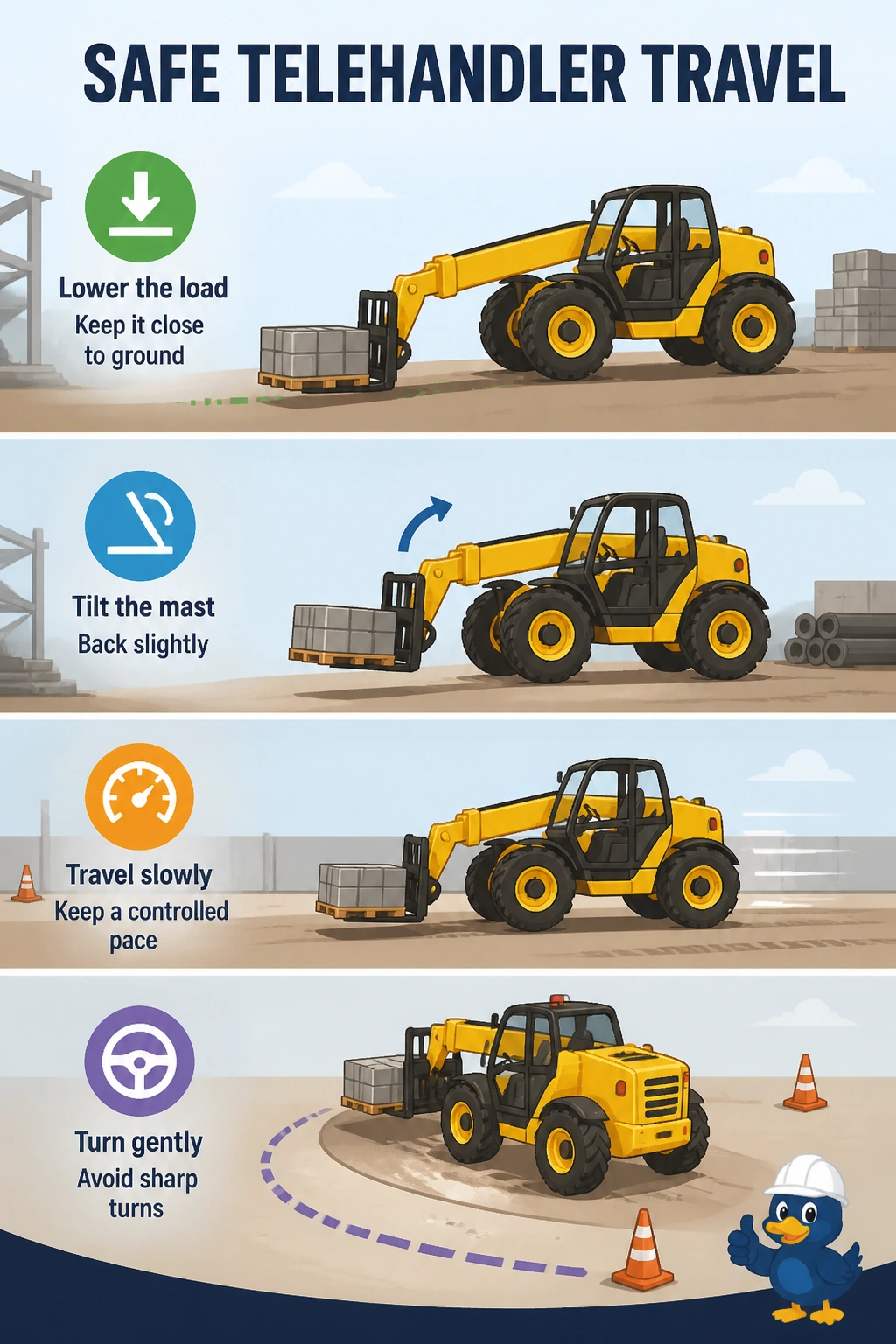
When you turn on a slope with a heavy load, keeping it high is like carrying a bowling ball over your head on an icy driveway. Lower the load quickly to bring the center of gravity down; visibility is not worth risking a tip-over.
Full Explanation
To preserve telehandler stability on uneven ground and slopes, lower the load close to the ground, tilt the mast back slightly, and travel slowly without sharp turns. Keeping the forks low keeps the combined center of gravity inside the stability triangle, tilting back secures the pallet against the backrest, and slow, straight travel helps prevent lateral tip-overs. Keeping the forks elevated at six feet for an unobstructed view raises the center of gravity, making the machine prone to tipping over bumps or during turns; if the load blocks visibility, use a spotter or travel in reverse. Shifting the boom to maximum forward extension while turning uphill moves the load farther from the front fulcrum, sharply reduces capacity, and risks a forward tip rather than counterbalancing the rear axle. Having laborers ride on the rear counterweight frame is prohibited: riders can fall or be crushed, and makeshift ballast violates manufacturer ratings. Exam caveat: consult the specific machine’s load chart because capacity drops sharply as boom angle or extension changes. Practical check: before moving materials, walk the travel path to identify ruts, verify slope limits, and assign a ground spotter whenever the load obstructs forward sightlines.
Prefer to study offline? Printable PDF study book + test engine ($7.50, unofficial). These questions stay free here.