
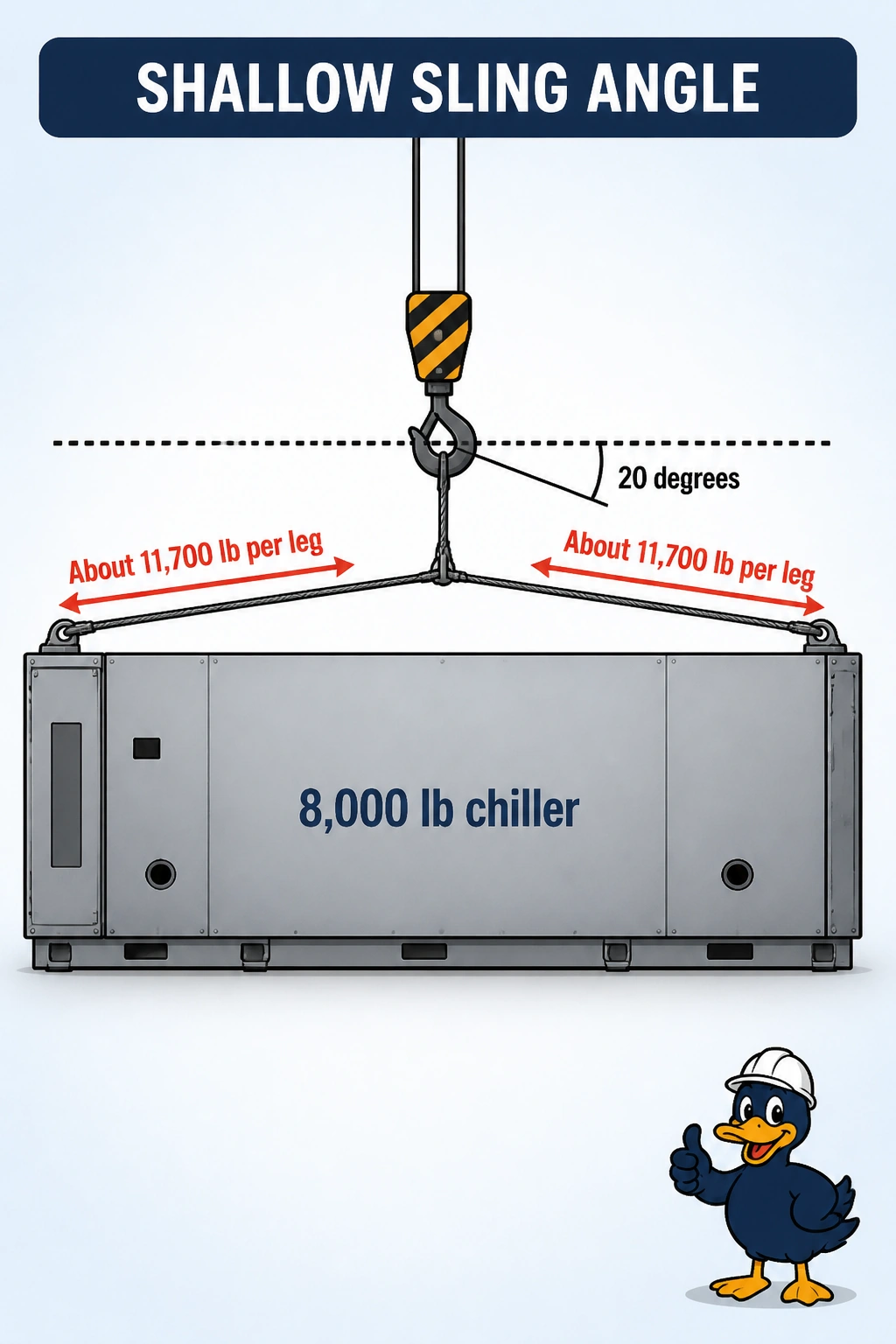
A rigging foreman plans to hoist an 8,000-pound rooftop chiller using a two-leg wire-rope bridle sling, and a rigger suggests shortening the legs to a shallow 20-degree horizontal angle to gain extra hook height. Why must the foreman reject that shallow sling angle?
Select an answer to reveal the explanation.
Short Explanation
Flattening a bridle sling to save a few feet of headroom is like doing a wide-grip pushup—the flatter the angle, the harder each leg has to work. You must reject that setup because shallow sling angles sharply increase tension on each sling leg and risk overload. The trap is dividing the load weight by two without accounting for how horizontal angle multiplies leg force.
Full Explanation
In multi-leg rigging, sling leg tension equals the shared vertical load divided by the sine of the horizontal sling angle, meaning flatter angles below 45 degrees—and especially below 30 degrees—multiply the force on each leg and shackle dramatically. Choosing Shallow sling angles sharply increase tension on each sling leg and risk overload identifies the exact mechanical hazard that can snap a sling or crush a load's lifting points even when the total load weight seems within capacity. Conversely, choosing Shallow sling angles cause the crane's anti-two-block switch to trip during travel confuses sling geometry with boom-tip hoist-limit protection, which prevents the hook block from hitting the boom head. Selecting Shallow sling angles reverse the hoist drum brake and allow free-fall lowering describes an internal crane brake failure unrelated to sling angle. Choosing Shallow sling angles reduce the chiller's gross weight on the crane load chart is physically false because the total suspended weight plus rigging remains unchanged. Rigging practice and ASME B30.9 avoid horizontal sling angles below 30 degrees unless the lift is specifically engineered. 1926.251 does not state that angle. For an operational check, measure the actual sling angle with an inclinometer or geometry check, verify each leg's rated capacity exceeds the calculated angled tension, and use a spreader beam if clearance is tight.
Prefer to study offline? Printable PDF study book + test engine ($7.50, unofficial). These questions stay free here.