
A utility crew is installing sewer pipe inside a 6-foot-deep, 80-foot-long trench that has only one extension ladder placed at the east end. What must the foreman require before workers continue working near the west end?
Select an answer to reveal the explanation.
Short Explanation
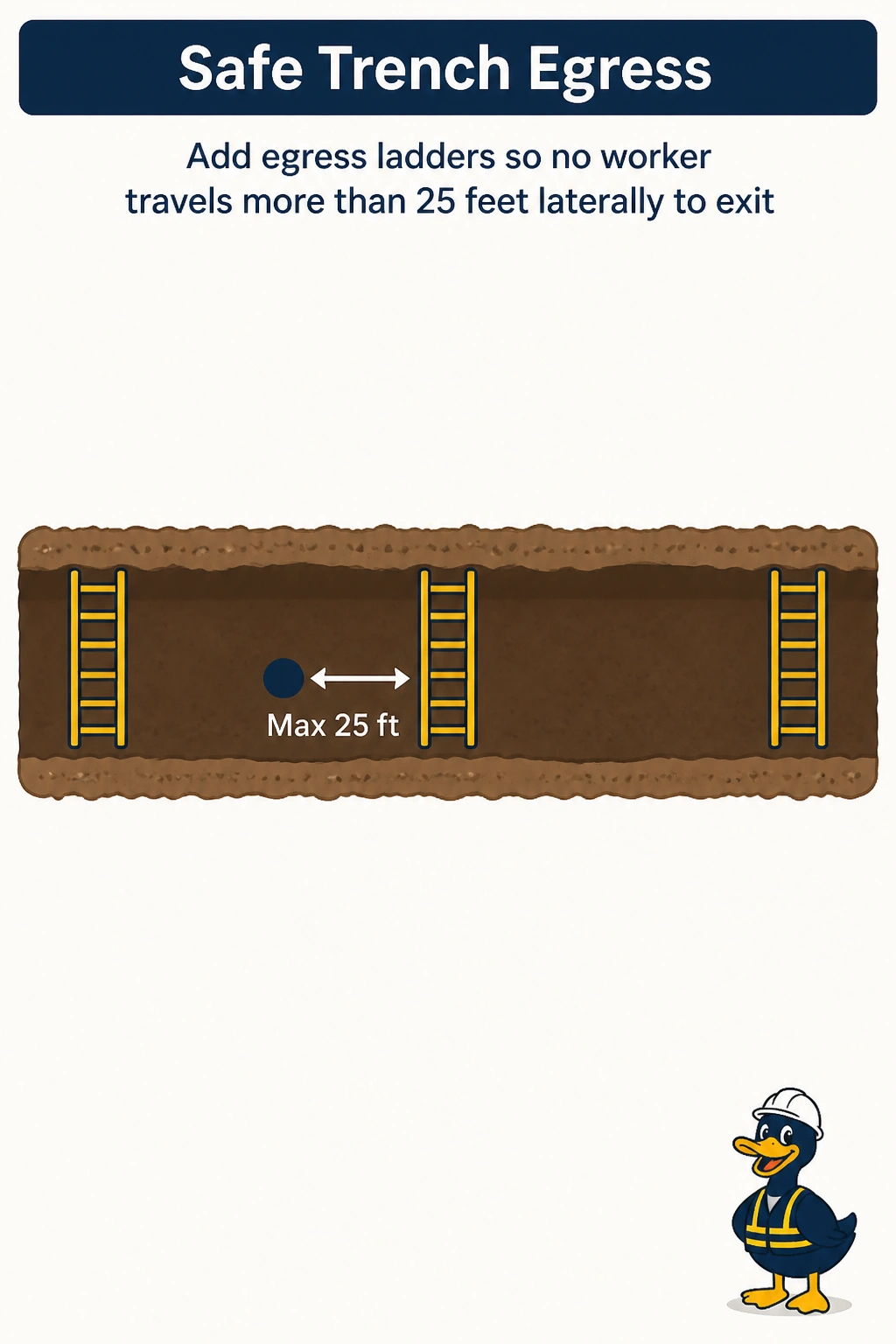
When a trench wall starts to shift or water rushes in, 70 feet of muddy trench bottom feels like a mile. You cannot rely on a single exit at one end; OSHA requires a safe way out within 25 feet of every worker.
Full Explanation
Under OSHA's excavation standard (29 CFR 1926.651), a stairway, ladder, ramp, or other safe means of egress must be located in trench excavations 4 feet or more in depth so employees never travel more than 25 feet laterally, meaning the foreman must "Add egress ladders so no worker travels more than 25 feet laterally to exit". Fast, unobstructed egress is critical because soil failures and utility leaks escalate in seconds. Choosing to "Place a lookout at the top of the east ladder to watch workers at the west end" warns workers of trouble without giving them a nearby route to escape it. Choosing to "Have workers climb out using the trench box cross-braces if an emergency occurs" is unsafe because trench-shield struts are not designed as ladders and increase fall and crush risks. Choosing to "Keep the existing single ladder as long as the trench walls are sloped back" confuses cave-in protection with egress spacing, both of which are independently required. As a caveat, each ladder must also be secured and extend at least 3 feet above the landing or trench edge. As an operational check, pace off the trench length whenever the crew advances pipe and relocate or add ladders before workers move beyond the 25-foot reach.
Prefer to study offline? Printable PDF study book + test engine ($7.50, unofficial). These questions stay free here.